Category Archives: AI

When AI Becomes Too Powerful To Export: Anthropic, Fable 5, Mythos 5, and the moment AI became national security

There are moments in technology when you can almost hear the gears of history clicking into place.

Not loudly. Not with fireworks or a bloke in a shiny suit standing on stage telling us that everything has changed. More often, it happens quietly, in a blog post, a government letter, or a hurried statement published late in the day.

This feels like one of those moments.

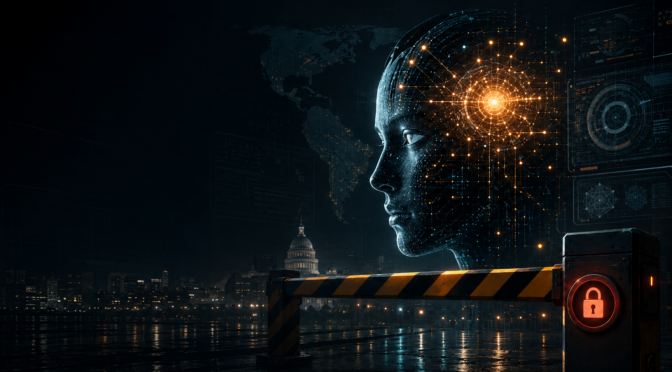
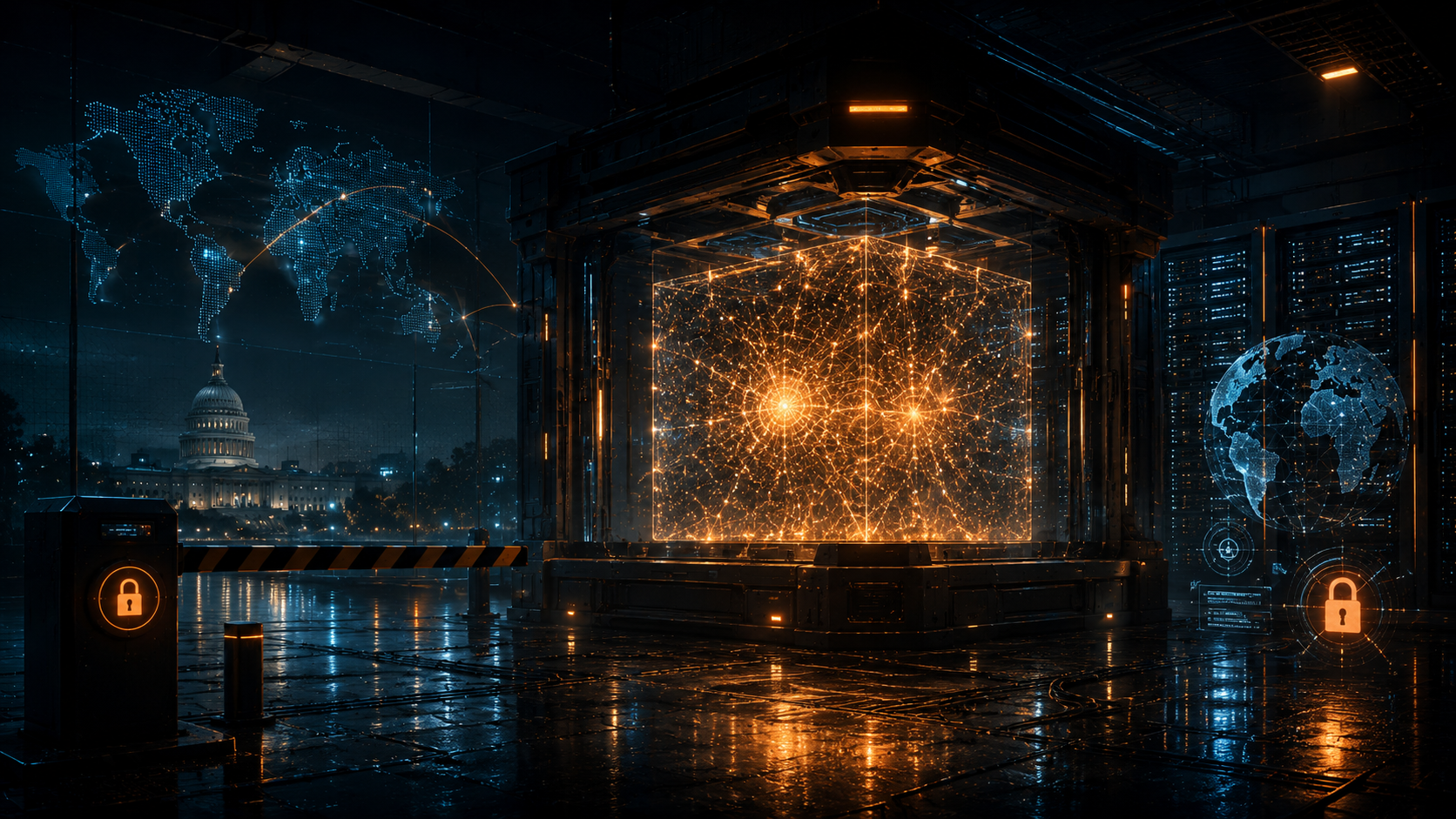
Anthropic has announced that it is suspending access to its Claude Fable 5 and Claude Mythos 5 models after receiving a directive from the US government. The reason given is national security. The result is that Anthropic has had to abruptly disable the models for all customers, because the order reportedly prevents access by any foreign national, whether inside or outside the United States.

That even includes foreign national Anthropic employees.

Just pause on that for a moment.

We are not talking about a graphics card being shipped overseas. We are not talking about a missile guidance chip, a military radar system, or some piece of exotic lab equipment. We are talking about access to an artificial intelligence model.

Software has just been treated like a controlled strategic asset.

What are Fable 5 and Mythos 5?

Only a few days before this happened, Anthropic had announced Claude Fable 5 and Claude Mythos 5.

Fable 5 was presented as a highly capable model for general use, sitting above Anthropic’s previous Opus class models. It was described as being especially strong at software engineering, research, visual understanding, long running tasks and complex knowledge work.

Mythos 5, meanwhile, appears to be the more restricted version, intended for trusted partners, particularly in areas such as cyber defence and critical infrastructure. In simple terms, Fable 5 was the version with more safeguards. Mythos 5 was the version where some of those safeguards could be lifted for trusted users.

Anthropic’s argument was that these systems could do a great deal of good. They talked about helping cyber defenders secure important software, assisting with scientific research, and accelerating work in areas such as life sciences.

And that is where the difficult bit begins.

The same capability that helps a good actor find vulnerabilities in software can also help a bad actor find vulnerabilities in software. The same intelligence that can help researchers solve hard problems can also lower the barrier for people who should not be anywhere near those tools.

That is the uncomfortable dual use problem at the heart of advanced AI.

The jailbreak question

According to Anthropic, the US government’s concern appears to be around a possible way of bypassing, or “jailbreaking”, Fable 5’s safeguards.

A jailbreak in this context means finding a way to persuade the AI to ignore or work around its safety systems. Anyone who has used AI tools for a while will know that safety systems can sometimes be a bit clumsy. They can refuse harmless requests, misunderstand context, or behave like an over cautious supply teacher on a school trip.

But at the frontier end of AI, the stakes are rather higher than asking for a dodgy limerick or persuading a chatbot to roleplay as an unfiltered assistant. Here, the concern is that a model might be coaxed into helping with cybersecurity work in a way that could be misused.

Anthropic says it has only received limited evidence of a narrow jailbreak and that the vulnerabilities involved were already known and relatively minor. It also says other publicly available models can identify similar issues without needing any special bypass.

That is important, because it gets to the heart of the argument.

If every powerful AI model can be jailbroken in some narrow way, does that mean none of them should be released?

Or does it mean the industry needs layered defences, monitoring, responsible access programmes and clear rules?

Anthropic clearly believes the latter.

A sudden and very public clash

What makes this story so striking is not just the safety issue. It is the speed and bluntness of the response.

Anthropic says it received the directive at 5.21pm Eastern Time and that the letter did not give specific details of the national security concern. The company is complying with the order, but it also says it disagrees with the decision and believes the action was not transparent, fair, clear, or grounded in technical facts.

That is unusually direct language from a major AI company.

It is also a sign of the times. The relationship between AI labs and governments is going to become one of the defining technology stories of the next few years. These companies are building systems that may become essential to business, science, software development, education, defence, healthcare and almost every corner of modern life.

Governments are not going to sit back and treat that as just another app.
When AI Becomes Too Powerful To Export: Anthropic, Fable 5, Mythos 5, and the moment AI became national security

The export control problem

For years, the big AI export control story has mostly been about chips. Who can buy the most advanced GPUs? Which countries can access the hardware needed to train frontier models? How do you stop sensitive capability moving across borders?

This Anthropic story changes the focus.

Now we are talking about controlling access to the model itself.

That opens up a whole set of awkward questions.

  • What happens if a UK business builds a product around an American AI model and access is suddenly removed?
  • What happens to customers who have paid for a service?
  • What happens to employees of the AI company who are not US citizens?
  • What happens when powerful models are used through cloud platforms, APIs, apps and enterprise tools across dozens of countries?

For businesses, this is a bit of a wake up call.

Many companies are now rushing to bolt AI into their workflows. Customer service, coding, document analysis, marketing, finance, legal review, research, data extraction, the lot. But this story is a reminder that access to the most advanced models may not always be guaranteed.

It is not enough to ask, “Which model is best?”

You also have to ask, “What happens if it disappears tomorrow?”

The Gadget Man view

I find this fascinating because it marks a shift in how we think about AI.

For most people, AI still feels like a clever website. You type something in, it replies, and occasionally it makes you wonder whether the future has arrived slightly ahead of schedule.

But at the very top end, these models are becoming more like infrastructure. They are tools that can write code, analyse huge amounts of information, interpret images, reason through complex problems and assist in scientific work. They are no longer just novelty chatbots. They are engines of capability.

And that makes governments nervous.

Some of that nervousness is reasonable. A powerful AI system in the wrong hands could be dangerous. Nobody sensible should pretend otherwise.

But there is also a danger in sudden, opaque intervention. If companies are told to build safely, test thoroughly, work with governments, create safeguards and develop trusted access programmes, then the rules need to be clear. Otherwise, innovation becomes a guessing game.

Anthropic’s frustration seems to be that it believes it did many of the right things. It says it worked with government, carried out extensive testing, used strong safeguards and adopted a defence in depth approach. Yet it still found itself having to pull access almost immediately.

That will worry a lot of people in the AI world.

What does it mean for ordinary users?

For most casual users, probably not much today.

Access to Anthropic’s other models is not affected, and many people will not have been using Fable 5 or Mythos 5 yet. But the wider meaning is more significant.

This is a glimpse of the future of AI regulation.

The most advanced models may not be treated like ordinary software products. They may be controlled, restricted, monitored and sometimes withdrawn. Access may depend on who you are, where you are, what you are doing, and whether a government believes the system crosses a national security threshold.

That might sound dramatic, but it is not science fiction anymore. It is happening.

My closing thought

There is an old pattern in technology.

First, something looks like a toy.

Then it becomes useful.

Then it becomes essential.

Then it becomes strategic.

AI has moved through those stages at a frankly ridiculous speed.

The Anthropic Fable 5 and Mythos 5 story may turn out to be a misunderstanding, as Anthropic suggests. Access may be restored. The details may become clearer. The technical risk may prove to be less dramatic than the government feared.

But even if all that happens, the line has still been crossed.

A government has looked at an AI model and treated it as something powerful enough to restrict on national security grounds.

That is not just a story about Anthropic.

That is a story about where AI is heading next.

And whether we like it or not, the future of artificial intelligence is no longer just about clever prompts, faster coding, or shinier demos.

It is about power, trust, borders and control.

Welcome to the next chapter.

 

Half of Workers Fear AI Will Take Their Jobs, and I Can Understand Why

Artificial Intelligence is everywhere at the moment.

It is in our phones, our laptops, our search engines, our photo apps, our cars, our customer service systems and, increasingly, our workplaces. For those of us who love technology, AI is fascinating. I use it, I write about it, I test it, and I can see enormous potential in what it can do.

But there is another side to this story, and it is one we cannot afford to ignore.

A new mass survey by GMB Union has found that almost half of workers are worried AI will take their job. The survey, which questioned 5,294 workers across a range of sectors in May and June 2026, found that 48 per cent are concerned that the introduction of Artificial Intelligence in their workplace could lead to them losing their job.

That is not a small number. That is not a fringe concern. That is nearly one in two workers looking at the rapid rise of AI and wondering whether the machine is coming for them next.

The same survey found that 58 per cent of workers believe AI will take jobs away in their workplace. Almost a third said their employer has already introduced AI, and around a quarter of those said AI is now doing tasks they would usually do themselves.

Perhaps most worrying of all, nearly half said AI is being used to track the activity of them or their colleagues during working time.

AI as a tool, or AI as a workplace watchdog?

That, for me, is where the conversation changes.

There is a world of difference between using AI as a helpful tool and using it as a digital overseer. One can make work easier, safer and more productive. The other risks turning workplaces into something cold, monitored and deeply uncomfortable.

This week, there have also been reports of around 1,000 jobs at Asda’s George brand being affected as the supermarket expands its use of AI and automation. Nestlé is also planning hundreds of job cuts at UK sites, with concerns that many roles could be replaced by AI and robotics.

Robert Battell, a Nestlé worker, is due to speak at GMB’s annual congress in Blackpool about what this means for workers on the ground. His words are stark. He describes the heartbreak of seeing colleagues and friends lose their jobs and be replaced by robots.

And that is the human bit we must not lose sight of.

Behind the buzzwords are real people

Behind every phrase like “efficiency savings”, “automation”, “streamlining” or “digital transformation”, there are real people. People with mortgages, rent, children, caring responsibilities, bills, routines and lives built around the work they do.

I am not anti-AI. Far from it. I think AI could be one of the most important technological developments of our lifetime. Used properly, it can help people work smarter. It can take away dull, repetitive tasks. It can help with accessibility, creativity, admin, logistics, research, design, customer support and countless other areas.

But the key phrase there is “used properly”.

Technology should serve people, not quietly replace them with no safety net.

This is our Industrial Revolution moment

The Industrial Revolution changed the world of work forever. Machines altered entire industries, and society had to adapt. AI feels like another of those moments.

It is not just another piece of software. It is a shift in how work itself is organised, measured and valued.

That means we need a serious conversation about rules, protections and responsibilities.

If AI removes a task, what happens to the person who used to do it? Are they retrained? Redeployed? Supported? Or simply shown the door?

If AI is being used to monitor staff, who decides what is fair? How much tracking is too much? What happens when an algorithm gets it wrong?

And if companies are saving money by replacing people with automation, what responsibility do they have to the communities and workers who helped build those businesses in the first place?

AI is not the enemy

AI is not the enemy. Badly used AI is the problem.

There is a version of the future where AI helps doctors, teachers, engineers, designers, drivers, warehouse staff, office workers and small businesses do more with less stress.

There is another version where it becomes a blunt cost-cutting tool, used to squeeze every last drop of productivity out of people before replacing them altogether.

We still have a choice about which version we build.

The technology is moving quickly. The question now is whether the laws, workplace protections and business ethics can move quickly enough to keep up.

Because if half of workers are already worried AI will take their job, then this is no longer some distant debate about the future.

It is happening now.

AI and the Future of Work: Are We Excited, Terrified, or Just Trying to Keep Up?

There are moments in technology when you can almost hear the gears of history turning.

I remember when having a computer in the office made you “the computer person”. I remember dial-up modems, fax machines, early websites, clunky email systems, and the strange magic of watching a machine do something that previously required a drawer full of paper, a telephone call, and usually someone called Janet who knew where everything was filed.

Artificial intelligence feels like one of those moments, except this time the machine is not just helping us type the letter. It is writing the letter, summarising the meeting, drawing the logo, coding the website, generating the video, and quietly eyeing up half the tasks we thought were safely ours.

AI and the Future of Work: Are We Excited, Terrified, or Just Trying to Keep Up?

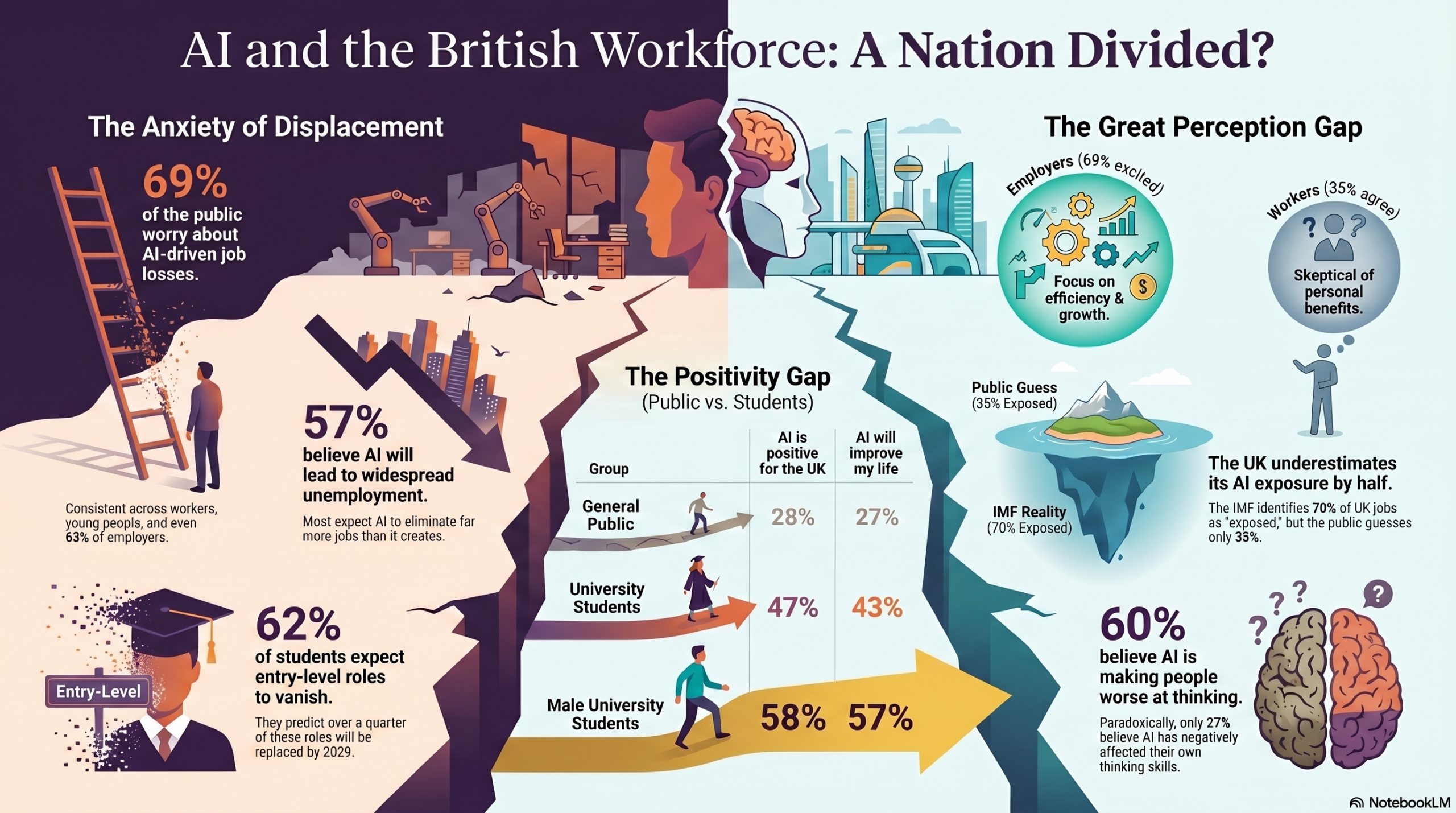
A new report from The Policy Institute at King’s College London, AI and the Future of Work, gives a fascinating snapshot of how the British public, workers, students and employers are feeling about all this.

And the overall picture is not simple optimism. It is more like standing in front of a very clever robot vacuum cleaner that has suddenly learned accountancy.


We are wary, but we know it is coming

One of the most interesting findings is that the public are more negative than positive about AI, yet many people still expect to use it.

Almost half of the public say they would rather avoid AI-based technologies, 41% say they are afraid of AI, and only 24% think AI is positive for humanity. Yet 43% agree they will use AI in the future.

That feels very human to me.

It is the same feeling we had when smartphones began taking over our pockets. We complained about them, worried about them, said they were ruining attention spans, then used them to check the weather, order a takeaway, find a route, take photos of the dog and pay for parking.

AI may be following the same path, only with rather larger consequences.

Parents are looking at this very differently

The part of the report that really lands is the section about parents.

Half of parents with children under 30 say they are worried about how AI will affect their children’s career prospects. Yet only around three in ten parents of 11 to 29-year-olds have actually had a conversation with their child about how AI might affect their future career, and a similar number have encouraged them to learn how to use AI tools.

That gap matters.

Because whether we like AI or not, pretending it is not happening is not a strategy. The best advice we can give young people is probably not “avoid AI”, but “understand it, question it, and learn how to use it better than the next person”.

When I was younger, knowing your way around a computer gave you an edge. Then knowing the web gave you an edge. Then knowing social media, search engines, ecommerce, video, and automation gave you an edge.

Now the edge may come from knowing how to work alongside AI without becoming completely dependent on it.

The fear is not just science fiction

The report also shows that concern about jobs is widespread.

Seven in ten people are worried about the economic impact of job losses caused by AI, and majorities of the general public, young people, university students and workers believe AI will eliminate far more jobs than it creates.

That is not a small worry. That is not people muttering about robots in the pub. That is a mainstream concern.

There is also a particularly sharp anxiety around entry-level roles. The report notes that many people believe AI could eliminate half of all entry-level white-collar jobs within five years.

This is where I think the real danger lies. Not necessarily in AI replacing every professional overnight, but in it quietly removing the first rung of the ladder.

Most of us learned by doing the boring stuff first. We answered support calls, updated spreadsheets, wrote simple copy, fixed small bugs, processed orders, filed things, checked things, tested things, and gradually became useful.

If AI takes away the junior work, where exactly do the next generation learn?

You cannot become experienced without first being inexperienced.

Employers are more optimistic, but even they are worried

Employers are generally more positive about AI than the wider public, but they are not blindly cheerful.

According to the report, 63% of employers are worried about the economic impact of job losses caused by AI, even while many are excited about new jobs opening up.

That is the strange contradiction at the heart of this whole debate.

AI is both an opportunity and a threat. It can help small businesses move faster, reduce admin, improve customer service, generate ideas, speed up research and make previously expensive tasks accessible to people working from a spare room.

But it can also concentrate power.

One of the starkest findings is that 65% of the public think the economic benefits of AI will mainly go to wealthy investors and large companies, while just 7% think the benefits will be shared fairly across society.

That is probably the bit we should be talking about more.

The question is not simply “will AI be clever?” It clearly will be. The question is “who benefits?”

My view from the Gadget Man shed

I use AI. I find it fascinating, useful, occasionally infuriating, sometimes astonishing and often a little unsettling.

It can be like having an enthusiastic assistant who has read everything, forgotten where it read it, and sometimes confidently hands you a screwdriver when you asked for a banana.

But used properly, it is powerful.

For people like me who create websites, write content, tinker with servers, make videos, build odd little systems and generally chase ideas down rabbit holes, AI can be a genuine productivity boost.

It can help you get from “I wonder if this is possible?” to “here is a working prototype” much faster than before.

But I do not think we should confuse productivity with progress.

If AI helps a small business survive, brilliant. If it helps a student learn, excellent. If it helps someone with a disability communicate, create, work or live more independently, fantastic.

If it simply allows large companies to employ fewer people while making a handful of shareholders wealthier, then we have built something clever but not necessarily something good.

The future is not automatic

Technology does not arrive with a moral compass fitted as standard. We decide how it is used.

That means schools, parents, businesses and government all have some catching up to do.

Young people need to understand AI not as magic, but as a tool. Workers need training, not vague reassurance. Employers need to think about responsibility as well as efficiency. And the rest of us need to keep asking awkward questions.

AI is coming into the workplace whether we welcome it with open arms or hide behind the photocopier.

The important thing now is not to panic, but not to sleepwalk either.

We have been here before with big technological shifts, but this one feels faster, wider and stranger.

The machine is no longer just on the desk.

It is in the conversation.


Source: King’s College London, The Policy Institute, “AI and the Future of Work”, May 2026.

I created my own awesome comic strip using ChatGPT

Every now and again, a piece of technology comes along that makes me grin like a child who has just found a secret compartment in a toy robot. This week, that technology was ChatGPT image generation.

I started with a simple idea: what if The Gadget Man was not just a blog, a podcast, or a bloke surrounded by cables, 3D printers, strange gadgets and half-finished ideas, but an actual comic book hero?

Not a cape-wearing superhero. Not someone bitten by a radioactive soldering iron. Just a gadget-loving chap with a cup of tea, a slightly dangerous number of ideas, and the ability to solve problems with technology, common sense and the occasional dramatic pose.

So I gave ChatGPT a photo of myself and typed the following prompt:

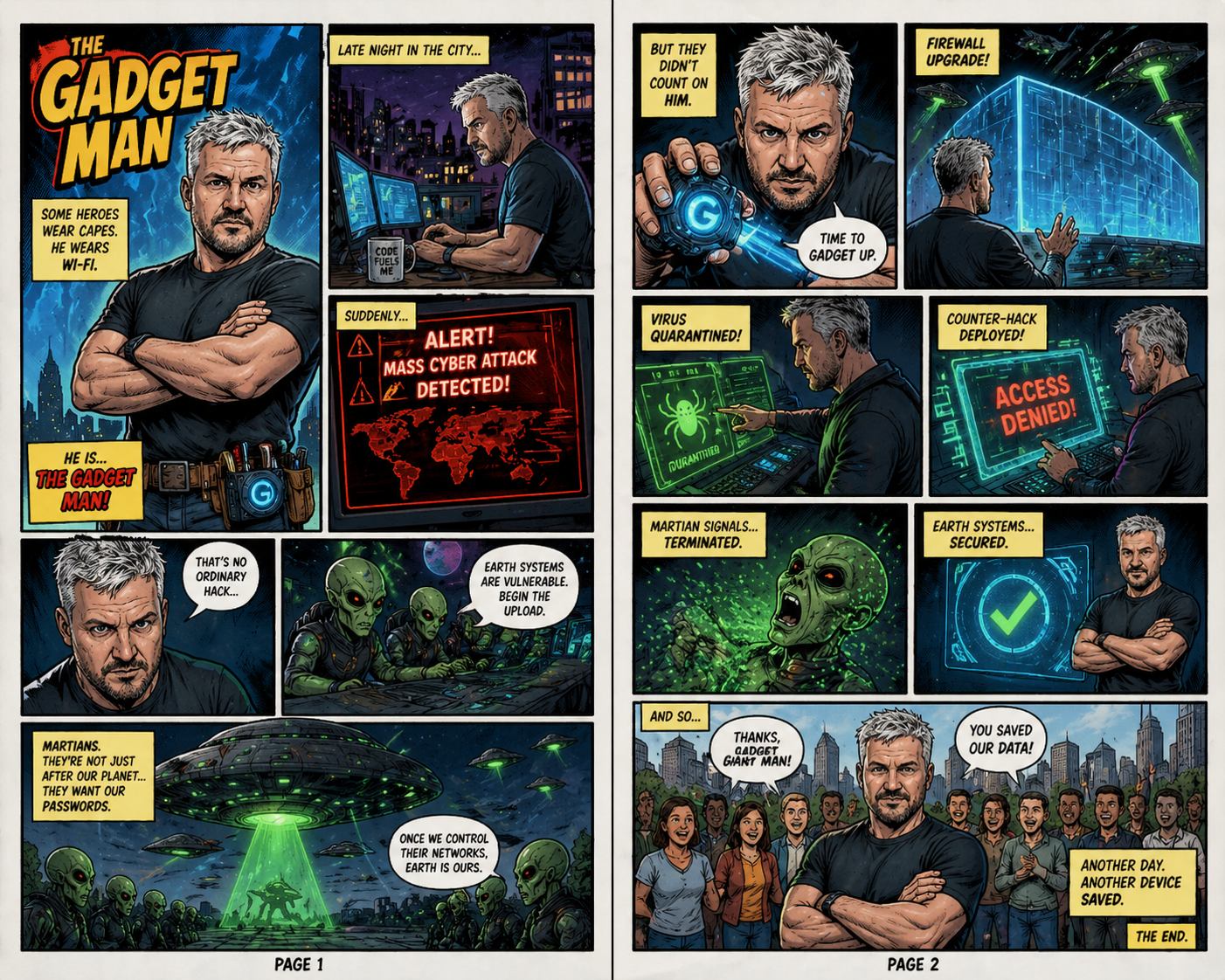
This is The Gadget Man, create a 2 page american style comic strip about him stopping a cyber attack by martians

First Draft of The Gadget Man

And there it was. A full two-page comic book spread featuring The Gadget Man battling Martians who were attempting to take over Earth’s systems. It had panels, speech bubbles, glowing screens, alien spaceships, dramatic lighting, and just the right amount of over-the-top comic book nonsense.

There was one small problem. In the final panel, instead of the crowd saying “Thanks Gadget Man!”, the speech bubble said “Thanks Gadget Giant Man!”

So I simply replied:

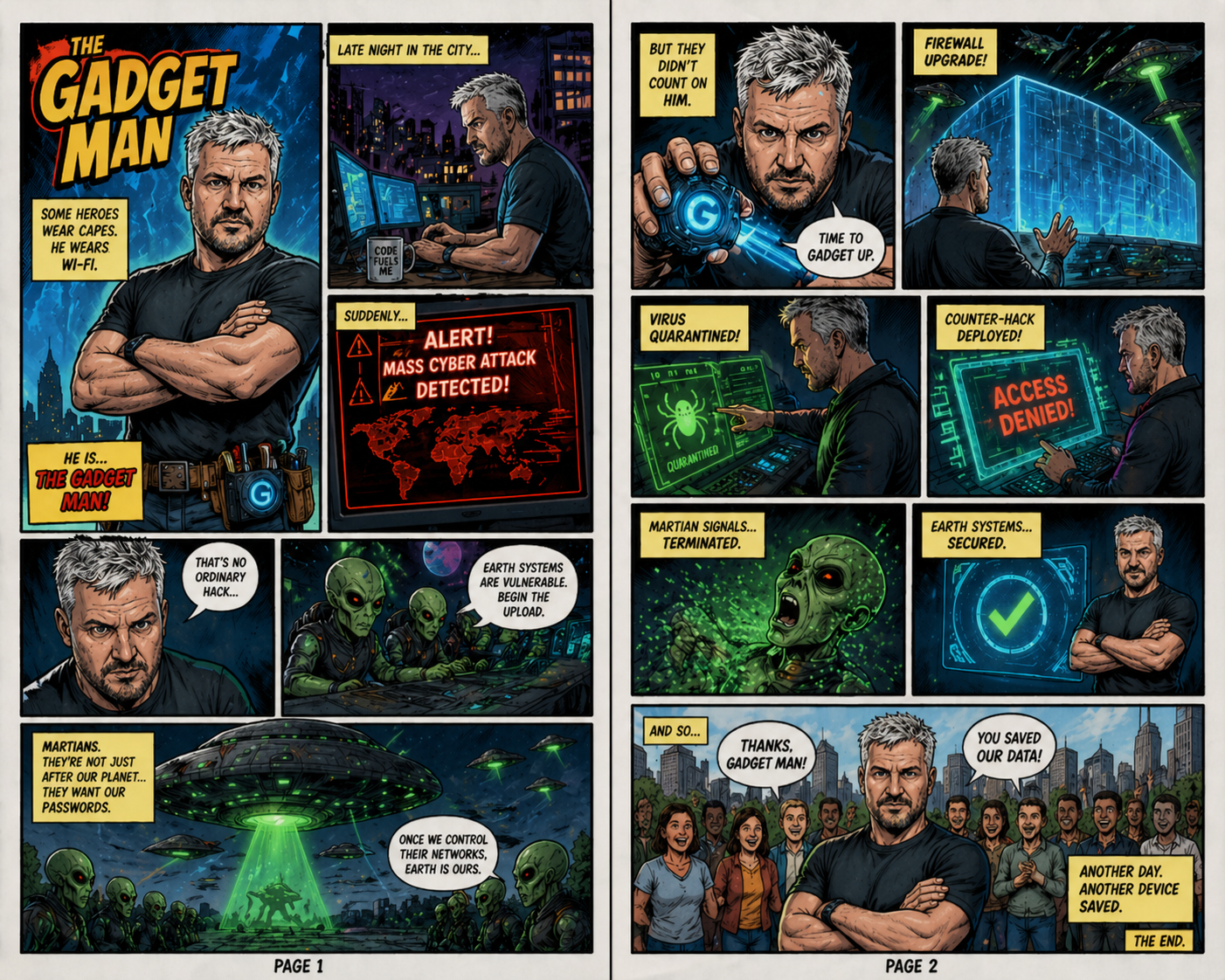
the last panel says THANKS GADGET GIANT MAN!, it should say THANKS GADGET MAN!

And ChatGPT corrected it.

The Gadget Man and The Alien Cyber Attack

That was the moment it really clicked. This was not just asking a computer to make a picture. This was creative direction. I could guide the scene, spot issues, refine the result, and build a series.

The Gadget Man Comic Universe Begins

Once the first comic was created, I did what any sensible adult would do. I immediately made several more.

The next prompt was:

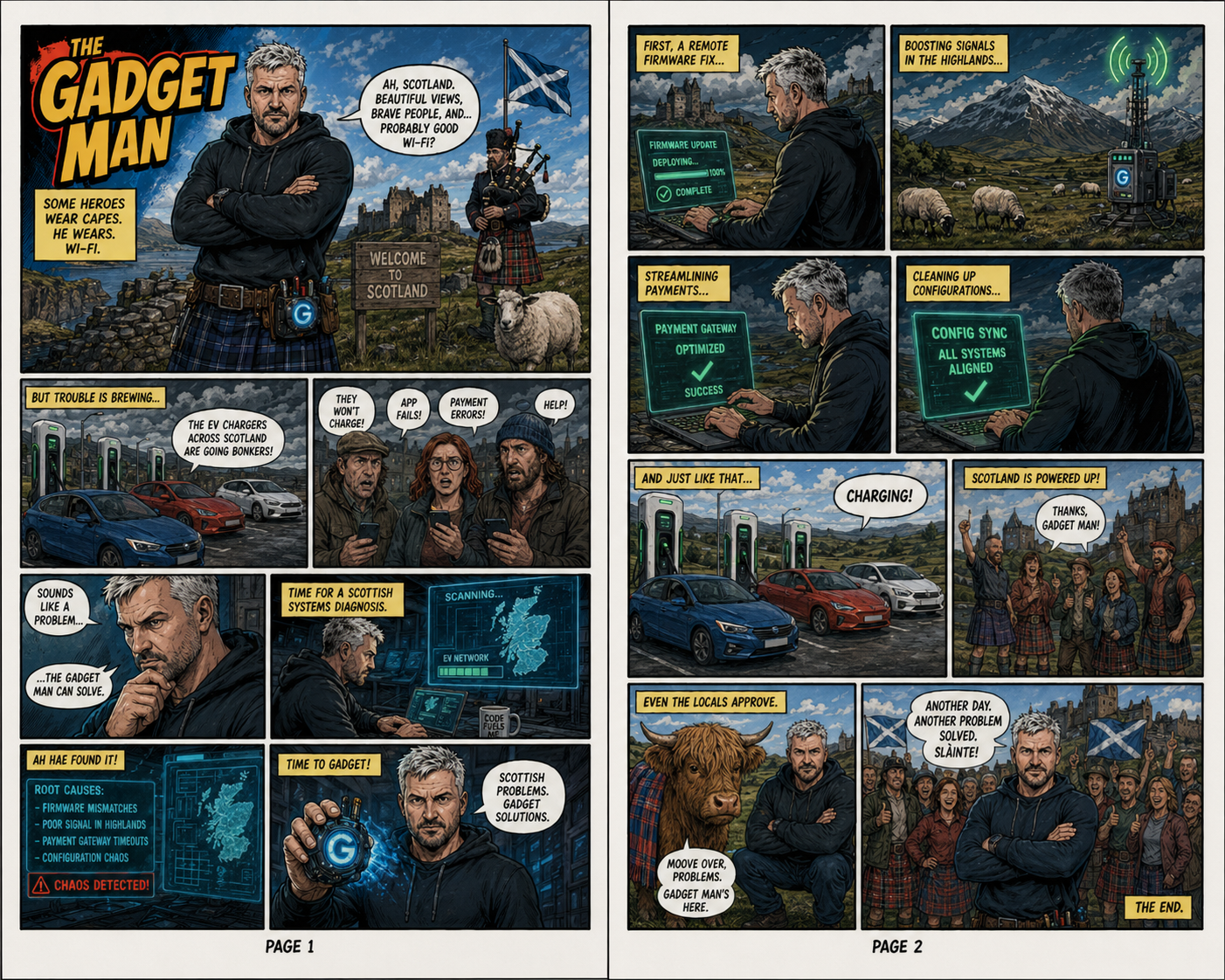
Excellent, create another comic about Gadget Man visiting Scotland and saving them from EV Charger problems

The Gadget Man and the Mystery of the Scottish EV Chargers

This produced a wonderfully ridiculous adventure in which The Gadget Man travels north of the border to rescue Scotland from faulty EV chargers, broken apps, signal problems and confused motorists. There were Highland cows, charging stations, Scottish scenery, and, naturally, the sort of technological tinkering that saves the day.

Then came one of my favourites:

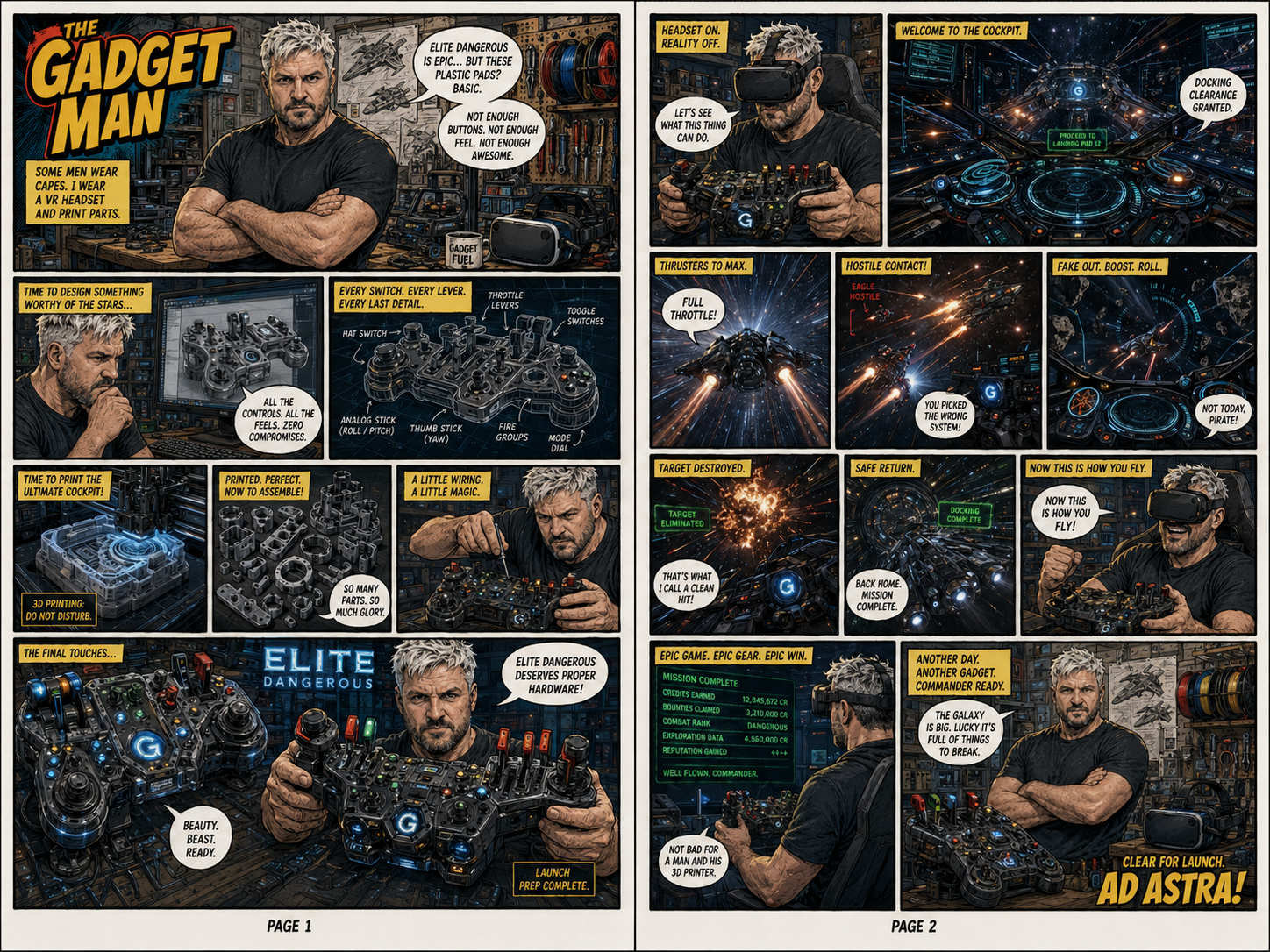
Create another comic featuring Gadget Man 3d Printing an elaborate controller for use with his VR headset to play Elite Dangerous

The Gadget Man and the 3d Printed Elite Dangerous Controller

This one was pure Gadget Man territory. 3D printing, VR, Elite Dangerous, switches, buttons, joysticks, wiring, and a controller that looked as though it had been designed by someone who had spent far too long thinking, “You know what this game needs? More buttons.”

After that, Vanessa joined the adventure.

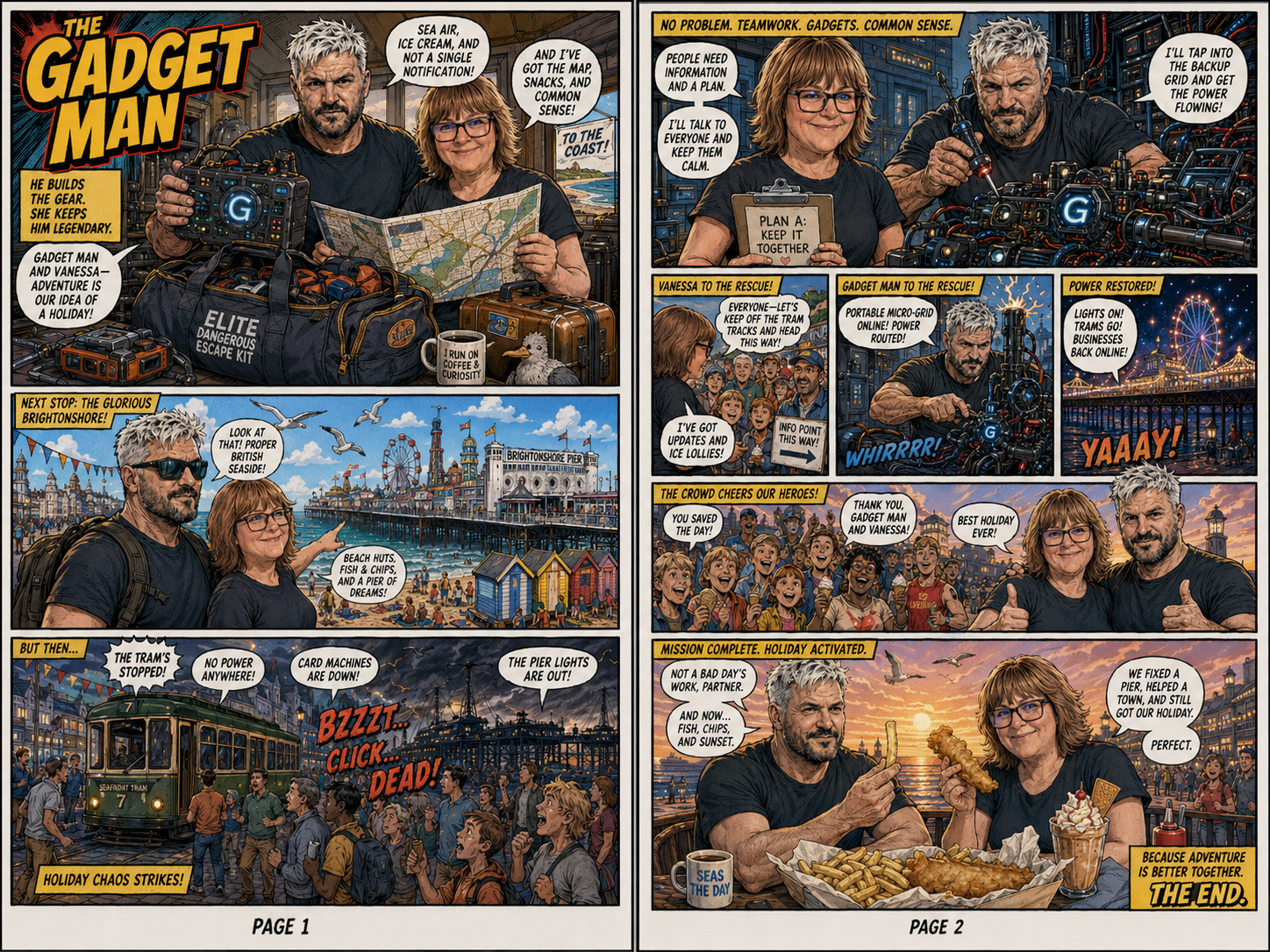
Create another comic featuring Gadget Man and his sidekick wife Vanessa. Their adventure is finally getting away for a break at the coast

Gadget Man and Vanessa go to the Coast

The result was a seaside adventure featuring Gadget Man and Vanessa finally escaping for a well-earned break, only to find that even a trip to the coast can turn into a heroic mission when technology, transport and holiday chaos collide.

Of course, Vanessa deserved a break from all this madness, so I followed up with:

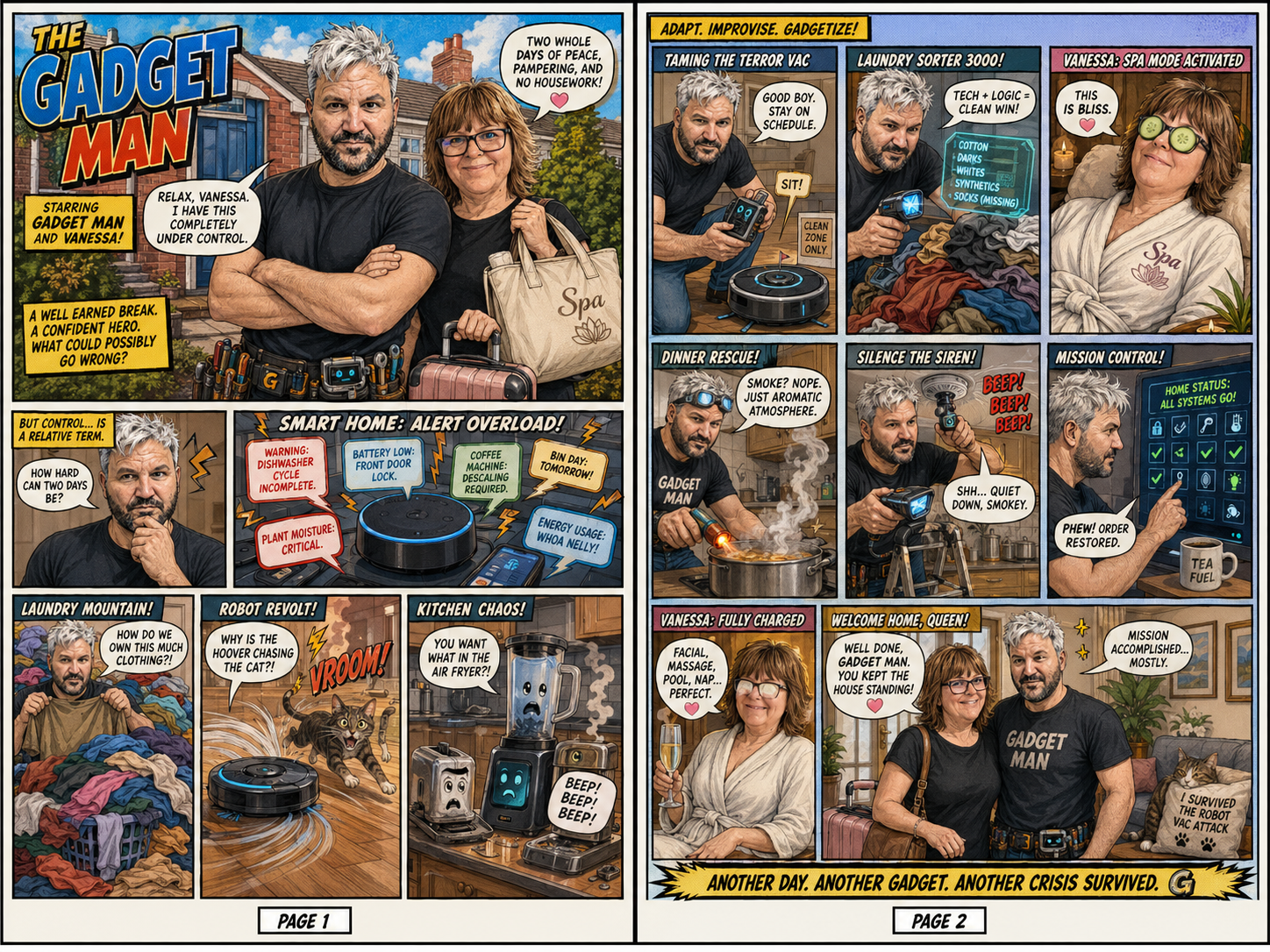
Create another comic featuring Gadget Man looking after the house whilst Vanessa spends two well deserved days at a Spa Retreat

The Gadget Man: Vanessa goes to the Spa

This produced a domestic disaster story full of smart home alerts, robot vacuums, laundry mountains, kitchen chaos and Gadget Man attempting to maintain order while Vanessa relaxed in peace. In other words, science fiction with a suspicious amount of truth in it.

Finally, I went bigger. Much bigger.

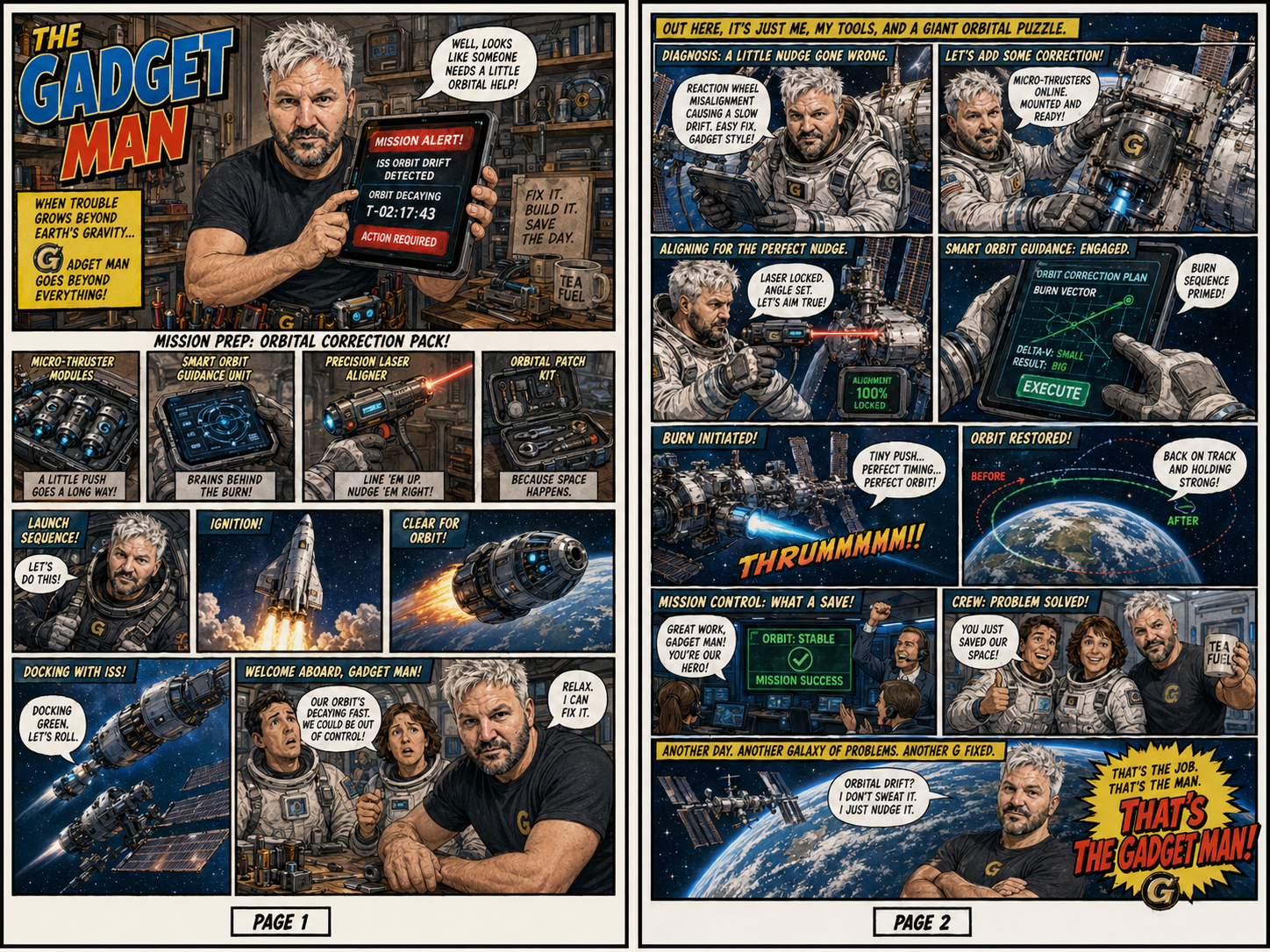
create another comic book featuring Gadget Man. This time he goes to the ISS to correct it’s orbit

The Gadget Man Saves the ISS

Yes, The Gadget Man went to space. The International Space Station had an orbital problem, and naturally the only person qualified to give it “a little nudge” was a man with a tool belt, a mug of tea, and an alarming level of confidence.

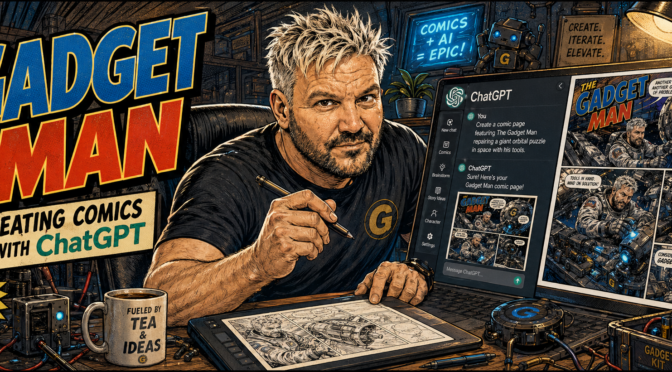
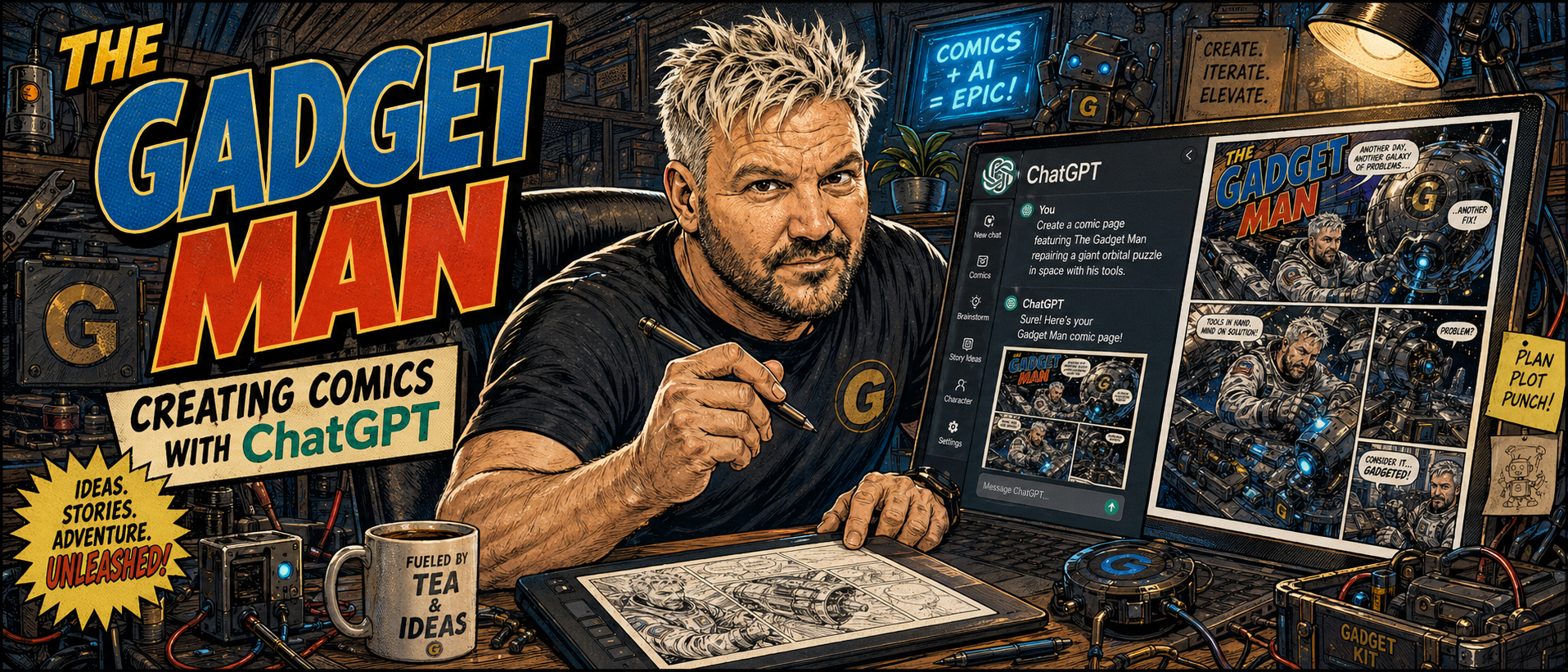
To finish the project, I also created a header image for this very article:

create a header image in the same style showing The Gadget Man creating the comic using ChatGPT

I created my own awesome comic strip using ChatGPT

That image showed The Gadget Man at his desk, creating comics using ChatGPT, surrounded by gadgets, screens, sketches, tools and the usual creative chaos. It perfectly captured what this whole experiment was about.

Why This Is Possible Now

What makes this so interesting is not simply that ChatGPT can generate an image. Image generators have existed for a while. The difference now is the conversational workflow.

OpenAI describes ChatGPT Images as a tool that can create new images and edit existing ones directly inside ChatGPT. You can ask for an image in plain English, refine it, adjust the composition, and explore new visual directions without needing to start from scratch each time. OpenAI also notes that recent image generation models are designed to follow prompts more accurately, render text more effectively, and use chat context, including uploaded images, as visual inspiration

That last point is important. I was not typing a technical command into a complicated art package. I was having a conversation. I could say “make this a two-page American-style comic strip”, then “change that wording”, then “now do one in Scotland”, then “now add Vanessa”, and ChatGPT understood the creative thread.

It feels less like using software and more like working with an incredibly fast illustrator, layout artist, letterer and visual brainstorming partner, all rolled into one.

The Magic Is in the Iteration

The real power here is not the first image. It is the second, third, fourth and fifth version.

Traditional creative work often involves a long gap between idea and result. You sketch, brief, wait, revise, wait again, make changes, and eventually arrive at something close to what you imagined.

With ChatGPT, the loop is much shorter. You can create a concept, respond to it, correct it, extend it, and build a whole fictional world in minutes. OpenAI’s own guidance highlights this ability to generate and refine images using clear prompts, request variations, adjust composition or size, and produce polished visuals quickly.

For someone like me, with a head full of odd ideas, half-remembered pop culture references, gadgets, stories, jokes, and technical rabbit holes, this is incredibly powerful.

I do not need to stop at “Wouldn’t it be funny if…”

I can actually see it.

What This Means for Artists

Now, this is where things become more complicated.

As exciting as all this is, it also raises serious questions for artists, illustrators, designers and the wider creative industry.

On one hand, tools like ChatGPT could be hugely empowering. They allow people who cannot draw to visualise ideas. They help writers create concept art. They help small businesses produce mock-ups, campaign ideas, storyboards, social media graphics and playful content that might previously have been out of reach.

For independent creators, this could be a revolution. A blogger can create a comic strip. A podcaster can build a visual world. A small business can prototype adverts. A game designer can test character ideas. A 3D printing enthusiast can imagine packaging, instructions, posters, comics and product artwork without needing a full design department.

But there is another side.

Professional artists have every right to be concerned. If companies decide to replace commissioned artwork with AI-generated images purely to save money, that has consequences. If the visual language of artists is absorbed, imitated and mass-produced without care, credit or fair compensation, that is not something we should casually ignore.

There is also the question of value. Art is not just the finished image. It is experience, taste, judgement, intention and human interpretation. A good artist does not simply “make a picture”. They solve visual problems. They understand emotion, framing, symbolism, storytelling and audience. AI can generate astonishing things, but it does not live a life. It does not have childhood memories, favourite comics, personal grief, humour, nostalgia or the strange little sparks that make human creativity so fascinating.

A Tool, Not a Replacement for Imagination

The way I see it, ChatGPT does not remove the need for creativity. It shifts where the creativity happens.

The prompt matters. The idea matters. The direction matters. The ability to look at an image and say “that is nearly right, but the final speech bubble is wrong” matters.

In my Gadget Man comic experiment, ChatGPT created the images, but the idea came from a very human place: my own interests, my humour, my love of gadgets, my fondness for comic book drama, my 3D printing obsession, my VR tinkering, my family life, and my lifelong habit of turning ordinary things into stories.

That is where I think these tools are at their best. Not replacing imagination, but amplifying it.

The Future of Comic Creation?

Will AI-generated comics replace traditional comics? I hope not.

Will they change how people make comics? Almost certainly.

We may see writers using AI to storyboard ideas before handing them to professional artists. We may see artists using AI for rough concepts, layouts, backgrounds or experimentation. We may see hobbyists creating personal comics for fun, families, blogs and social media. We may also see new kinds of hybrid workflows where human creators and AI tools sit side by side.

There will be arguments, and there should be. Creative industries need rules, ethics, transparency and respect for human artists.

But there is also something genuinely wonderful about being able to type a sentence and watch a ridiculous idea become visible.

Final Thoughts

What started as a quick experiment became a whole mini comic universe.

The Gadget Man fought Martians, fixed Scotland’s EV chargers, 3D printed a controller for Elite Dangerous, went on holiday with Vanessa, survived domestic chaos during a spa weekend, corrected the orbit of the ISS, and then sat down to create the comics using ChatGPT.

That is absurd.

It is also brilliant.

For me, this is exactly what technology should do. It should unlock ideas. It should make us laugh. It should help us create things that would otherwise remain trapped in our heads.

And if it occasionally turns “Gadget Man” into “Gadget Giant Man”, well, that is all part of the adventure.

Another day. Another gadget. Another comic created.

Gadget Man Signing Off

Anthropic’s Project Glasswing Could Change Cybersecurity Forever

There are moments in tech when you read an announcement and immediately realise that something important has shifted.

That was very much my reaction when I came across Project Glasswing, a newly announced initiative from Anthropic that is aimed squarely at one of the biggest looming problems in modern computing: what happens when AI becomes exceptionally good at finding software vulnerabilities. Source

According to Anthropic, Project Glasswing brings together a heavyweight list of partners including Amazon Web Services, Apple, Broadcom, Cisco, CrowdStrike, Google, JPMorganChase, the Linux Foundation, Microsoft, NVIDIA and Palo Alto Networks, all with the goal of securing critical software for what Anthropic calls the AI era. It is also extending access to more than 40 additional organisations that build or maintain important software infrastructure. Source

Now, that alone would be interesting enough, but the real headline here is the model sitting behind it all.

Anthropic says its unreleased model, Claude Mythos Preview, has already demonstrated the ability to find and exploit software vulnerabilities at a level beyond all but the most skilled human experts. That is a huge claim, and if it holds up in practice, it means we may have crossed into a very different phase of cybersecurity. Source

In plain English, this is not just about a chatbot helping someone write a bit of code more quickly. This is about AI being able to inspect complex software, spot weaknesses that humans and automated tools have missed for years, and in some cases work out how those weaknesses could be exploited. Anthropic says the model has already found thousands of high-severity vulnerabilities, including flaws affecting major operating systems and web browsers. Source

Some of the examples are rather startling. Anthropic says Mythos Preview uncovered a 27-year-old vulnerability in OpenBSD, a 16-year-old flaw in FFmpeg, and even chained together several Linux kernel vulnerabilities in a way that could escalate ordinary user access into full control of a machine. The company says those issues have now been responsibly disclosed and patched. Source

That, to me, is the bit that really lands.

Because for years we have tended to think of cybersecurity in terms of patching known issues, following best practice, keeping software up to date and hoping the really serious flaws are found by the good people before the bad people. But if AI systems are now reaching the point where they can autonomously discover dangerous bugs in code that has survived decades of scrutiny, then the pace of both defence and attack could increase dramatically. Source

Anthropic is clearly trying to frame Glasswing as a defensive first move. The company says it is committing up to $100 million in usage credits for Mythos Preview and $4 million in direct donations to open-source security organisations. The idea seems to be to put these capabilities into the hands of defenders, infrastructure operators and maintainers before similar systems become more widely available. Source

And that is probably the most sensible angle here.

Because whether we like it or not, the genie is not going back in the bottle. If one frontier AI lab can build a model that is frighteningly good at vulnerability discovery, others will too. Eventually, those capabilities will spread further. The question is not really whether AI will reshape cybersecurity. It is whether defenders can get enough of a head start to stop things getting seriously messy. That is an inference from Anthropic’s announcement and the examples it gives, rather than a direct claim from the company, but it feels like the unavoidable conclusion. Source

For those of us who run websites, servers, ecommerce platforms, mail systems or anything else connected to the wider internet, this should be a bit of a wake-up call. The old approach of leaving systems half-maintained, delaying updates, or assuming that obscure software will somehow stay below the radar looks even more risky in a world where AI can inspect code at speed and scale.

Project Glasswing may turn out to be remembered as one of those early milestone moments, the point where the cybersecurity industry publicly acknowledged that AI is no longer just a helpful assistant for defenders. It is becoming a serious force multiplier, and one that could work for either side.

That makes this announcement both exciting and slightly chilling.

And, in true Gadget Man fashion, it is exactly the kind of development that reminds us technology is never just about shiny new tools. It is also about consequences, responsibility and how quickly the world has to adapt when the rules suddenly change.

Source

Anthropic, Project Glasswing: Securing critical software for the AI era

From Pixels to Platinum: When AI Designed My New Hairstyle

From Pixels to Platinum: When AI Designed My New Hairstyle

There’s something oddly thrilling about letting technology take creative control. I’ve spent years testing gadgets, reviewing innovations, and exploring the limits of artificial intelligence — but this time, I let the tech get a little more personal.

A few weeks ago, I asked Midjourney — my go-to AI image generator — a simple question:
“What would The Gadget Man look like with a fresh new hairstyle?”

The result was, quite frankly, impressive. The AI produced a series of strikingly realistic portraits featuring a textured, platinum-blonde cut that looked part cyberpunk, part 21st-century rockstar. I loved it. The catch? It wasn’t real… yet.

The AI Concept

Armed with a few reference prompts and an experimental mindset, I spent an evening fine-tuning the digital version of myself. Midjourney, in its infinite wisdom, decided that bleached hair and choppy texture were the future of The Gadget Man brand.

At first, it was just a bit of fun. But the more I looked at the AI render, the more I realised — this was something I could actually pull off. So, I decided to make it happen.

Turning AI Into Reality

I booked an appointment with my stylist and brought along the AI images on my phone — full 360-degree green-screen shots of the “digital me.” It’s not every day you walk into a salon and say, “I’d like this look, please — it was designed by artificial intelligence.”

To their credit, they didn’t flinch. Instead, we broke it down into human-achievable steps:

  • The Cut: Short, faded sides with plenty of texture on top.
  • The Style: Tousled and natural, with enough lift to keep things casual.
  • The Colour: A cool, silver-white platinum tone — bold but clean.

The Result

Wait and see!!!

AI as a Creative Partner

This little experiment isn’t just about hair — it’s about what happens when AI moves from the screen into the real world. Whether it’s designing products, testing ideas, or in this case, reinventing a hairstyle, AI has become a kind of creative partner.

From Pixels to Platinum: When AI Designed My New Hairstyle


From Pixels to Platinum: When AI Designed My New Hairstyle

Coming soon: a behind-the-scenes video of the full transformation — from my original hairstyle to the final platinum reveal. Keep an eye on The Gadget Man socials for the big unveil.

#TheGadgetMan #AIstyle #MidjourneyToReality #TechMeetsHuman #FromPixelsToPlatinum

How I Wrote an Retro 80s-Inspired Adventure Game About The KLF

If you grew up in the 1980s, you’ll remember that unmistakable feeling of loading a game on your ZX Spectrum, Commodore 64, or BBC Micro. The hypnotic screech of the cassette loading, the colour bars flickering on screen, and that eternal moment of suspense — would it load this time, or had the tape stretched just enough to doom you to a R Tape Loading Error?

Loading the KLF Adventure

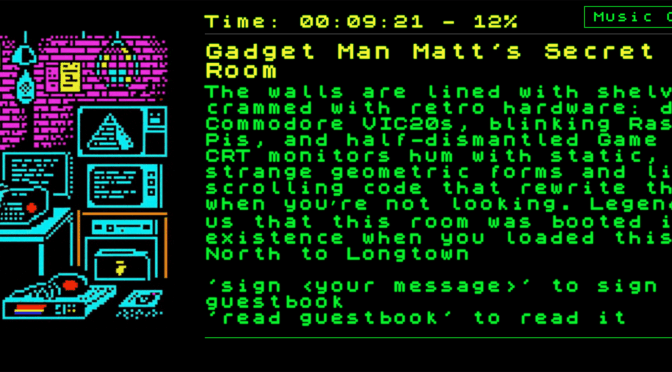
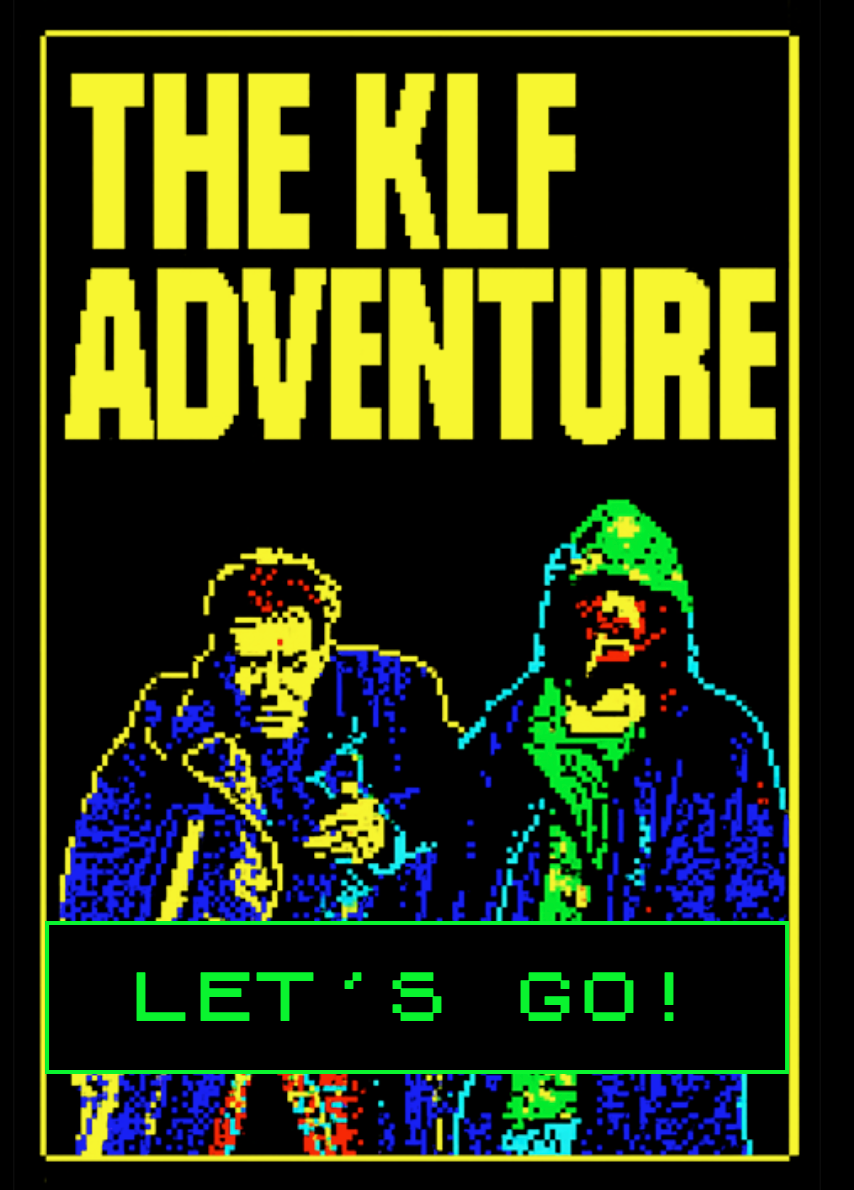
Fast forward to the 2020s and, somewhere between my love of retro computing, The KLF’s music, and an itch to make something creative, I decided: I’m going to write a text adventure game. Not just any text adventure, but one dripping with late-night 80s energy, pop culture references, and a healthy dose of KLF mythology.

The KLF Adventure Begins

It started innocently enough — I wanted to relive the magic of the Scott Adams-style adventures I played as a kid. Those games weren’t about graphics; they were about imagination. Every location, every object, every strange instruction was something you had to picture in your head. And if you were a bit obsessive (guilty), you’d spend hours mapping every room on graph paper.

Finding the Right Ingredients

The KLF have always been masters of mystery — their story threads through pop hits, art projects, strange performances, and burning a million pounds on a remote Scottish island. That mix of chaos, humour, and myth-making was perfect for a game world.

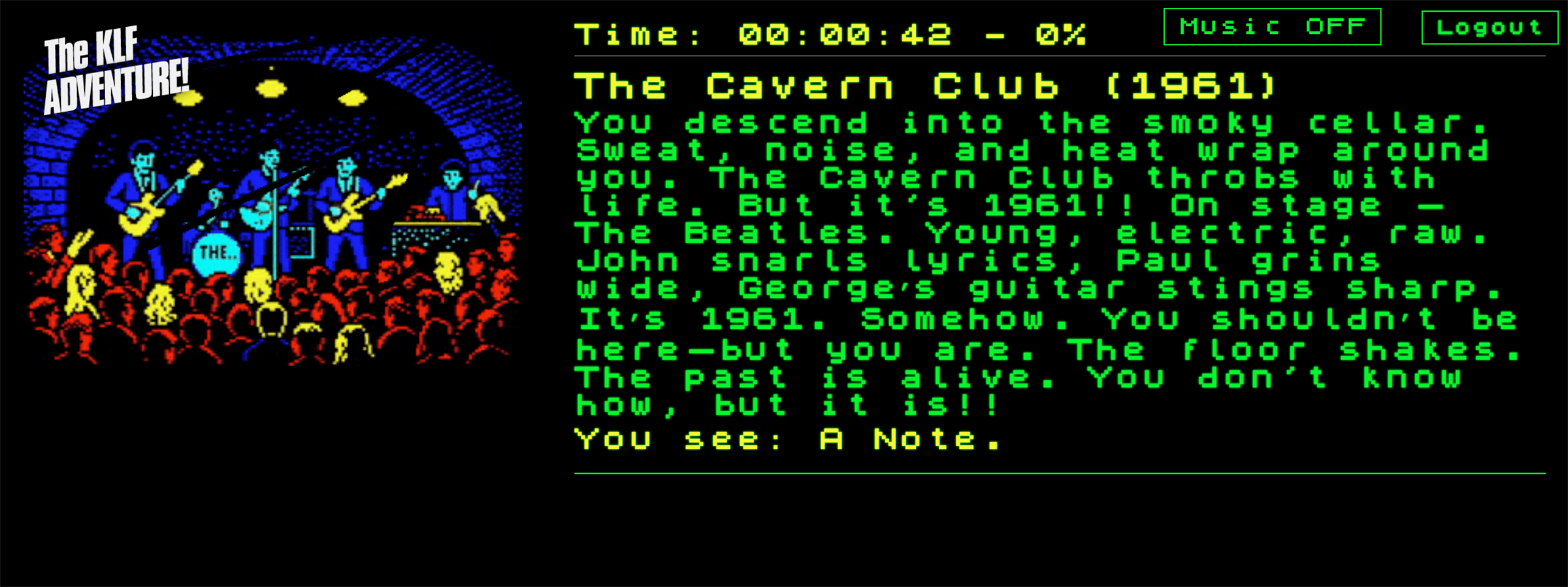
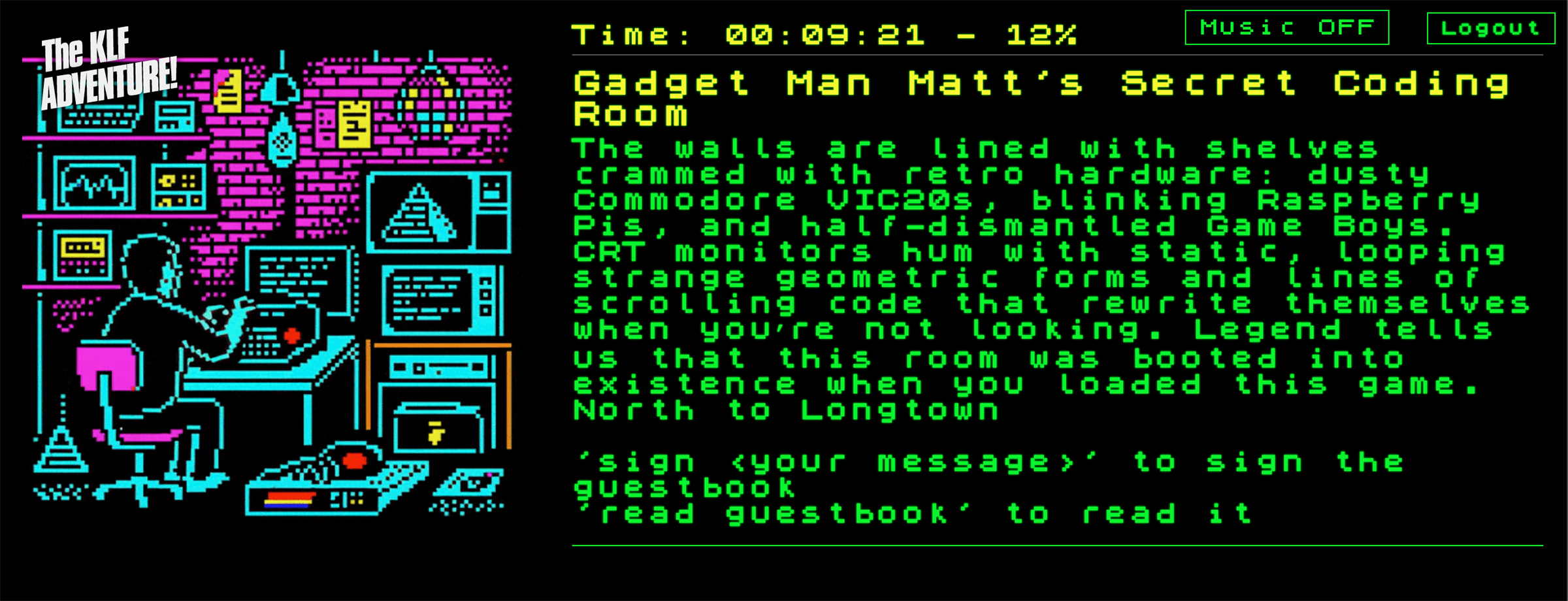
I started building a map: fictional places merged with real ones from KLF history. Bold Street in Liverpool. The Cavern Club in the 1960s. A boathouse with a roaring fire. And, naturally, Trancentral — the spiritual HQ of The KLF. I even included surreal locations like the “Little Fluffy Cloud Factory” and “Maze of Caves” for that dreamlike adventure feel.

Travel Back in Time to The Cavern Club in 1961

The NPCs? Oh, they had to be special. Sigmund Freud gives cryptic instructions. Ivan Pavlov demands you “Lie Down” before telling you to “Keep Calm”. Even Denzil the Baker makes an appearance, along with other nods that KLF fans will appreciate.

Building It Like It’s 1984 — With a 2025 Twist

I didn’t just want to write about the 80s — I wanted it to feel like the 80s. So I coded the game in a modern environment but kept the old-school constraints: short descriptions, tight vocabulary, and a parser that understands commands like GO NORTH, GET TICKET, or SAY CHILLOUT.

Don't get stuck in the record industry execs meeting!!!
Don’t get stuck in the record industry execs meeting!!!

But here’s the twist — I didn’t do it alone. My coding partners were Gemini CLI and OpenAI Codex, coding with me directly in my command line. The imagery was created using ChatGPT, with animations by Midjourney. The music came courtesy of Suno, while the sound effects were crafted by ElevenLabs. Together, these AI tools became my team of coders, designers, composers, and consultants, enabling me to bring this game to life in a way that would have been impossible on my own.

And because I couldn’t resist going full retro, I’ve also been experimenting with encoding the game into audio so it can be loaded into a ZX Spectrum emulator straight from a physical cassette tape. Because why not?

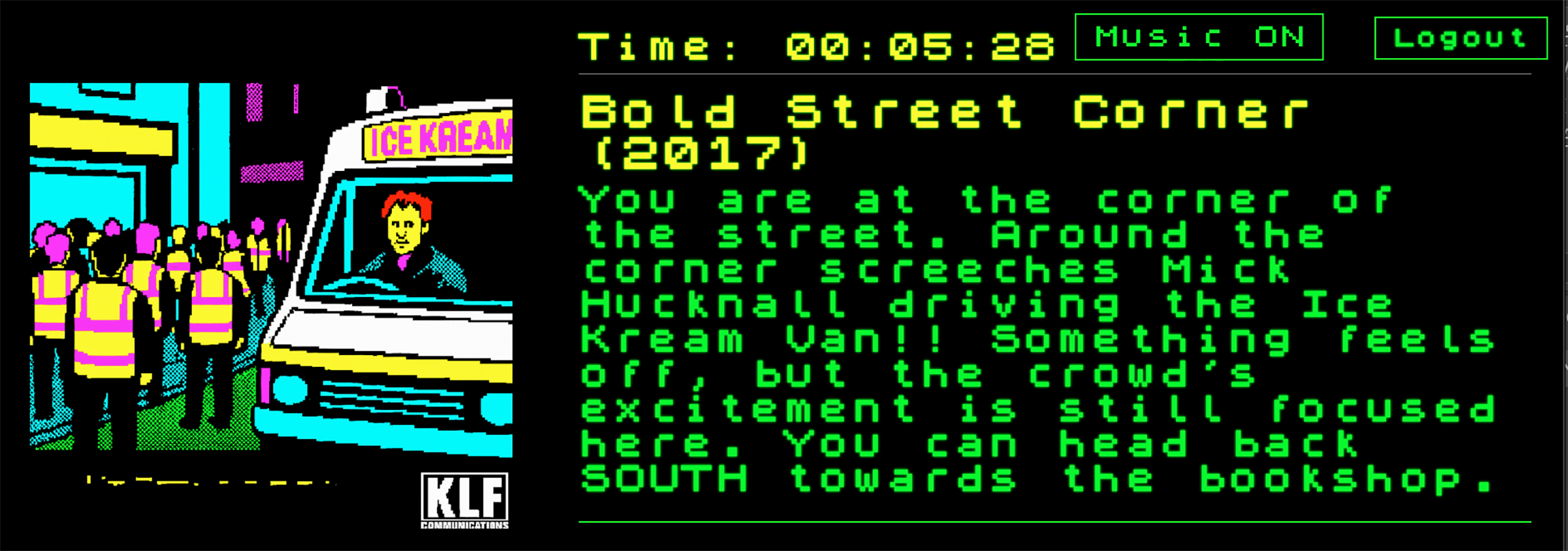
Timeslips abound in Bold Street with alternate timelines showing Mick Hucknall driving the Ice Kream Van!

The Result

What emerged is The KLF Adventure — part game, part interactive art piece, and part love letter to the days when imagination did the heavy lifting. It’s an 80s-inspired world you can explore, puzzle over, and get gloriously lost in. It rewards curiosity, nods knowingly to KLF lore, and might just make you say “What Time Is Love?” at least once.

For me, this wasn’t just a coding project. It was a way of reconnecting with that kid who sat cross-legged in front of a rubber-keyed Spectrum, waiting for the next adventure to begin. Only now, I’m the one writing the adventure — with a 21st-century team of AIs by my side.

You can even find me in the game... But where?
You can even find me in the game… But where?

If you fancy diving in, the game is live at klfgame.co.uk. Just remember: keep your wits about you, don’t trust every whisper, and above all… CHILLOUT. Twice.

How I Created and Published Gizmos and Gadgets in Cockney in Less Than 24 Hours

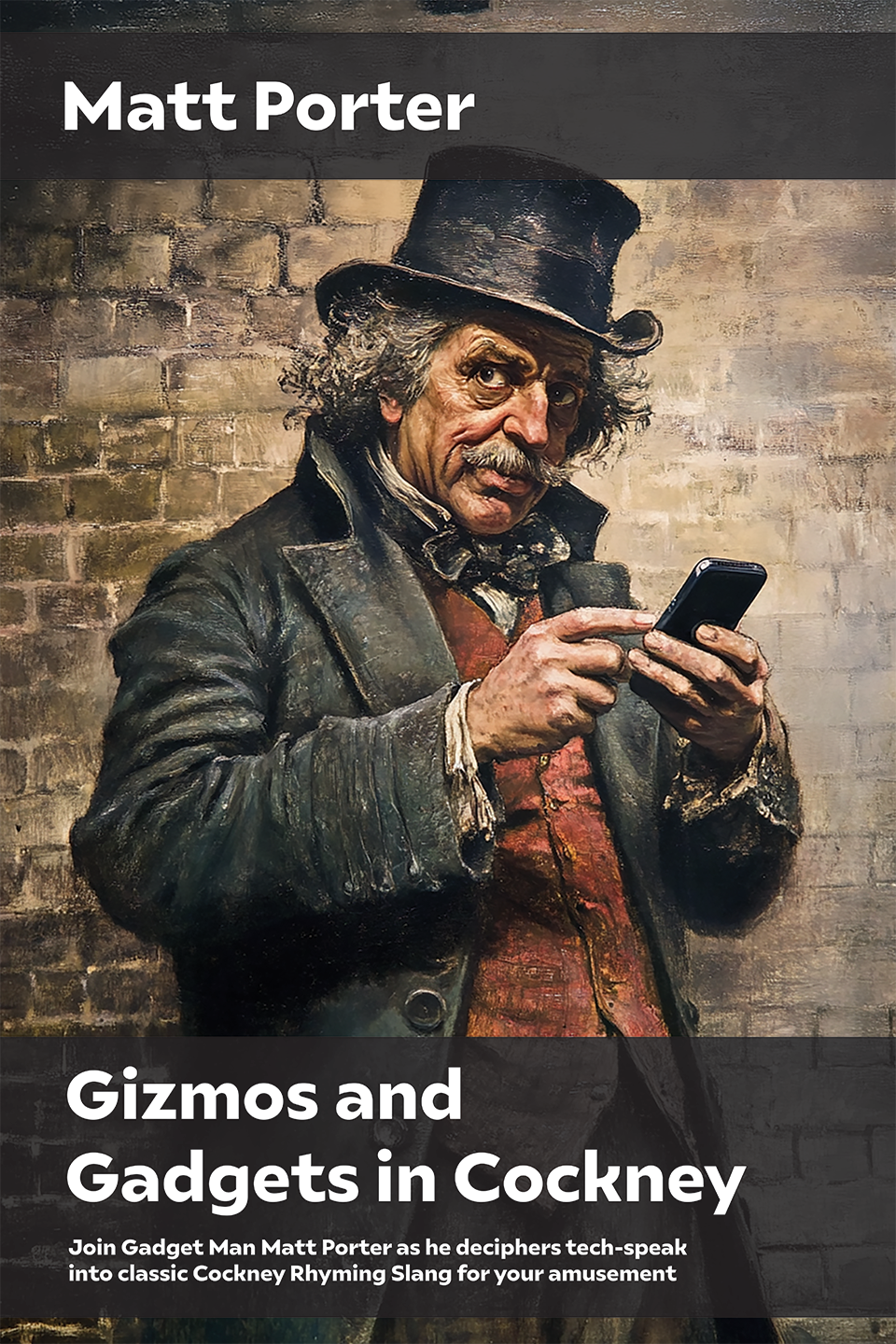
Sometimes, you have an idea so out there, you just have to run with it. That’s exactly what happened with my latest experiment—writing, editing, and publishing a book in under 24 hours. Yes, you read that right: Gizmos and Gadgets in Cockney by Matt Porter went from a concept swirling in my head to a fully published book faster than you can say “Bob’s your uncle.” Now, before you start expecting War and Peace or something that’ll win a Pulitzer, let me set the record straight: this book is meant to be a laugh. So, get that tongue planted firmly in your cheek and read on!


A Silly Idea Turned Into Reality

I’ve always loved Cockney rhyming slang. There’s something so playful and creative about it, and being a tech nerd, I thought, “Why not merge the two?” With that spark of inspiration and a challenge I set for myself, the idea was born: a humorous book that reimagines the world of tech with Cockney flair. Gizmos and Gadgets in Cockney would be a light, fun read for anyone who’s ever wondered what you’d call a smartphone (a “dog”) or a smart speaker (a “chirper”) in the East End’s colourful lingo.

But then I upped the stakes: I decided to see if I could write, edit, and publish the whole thing in less than 24 hours. Why? Because life’s too short not to try ridiculous things.

How I Created and Published Gizmos and Gadgets in Cockney in Less Than 24 Hours
You can buy and read Gizmos and Gadgets in Cockney right now and very soon in physical paperback at https://amzn.to/40QzUnI

Don’t Expect High Art—This Is Pure, Unfiltered Fun

Let’s be clear: you’re not about to read a literary masterpiece. This isn’t War and Peace or The Great Gatsby. It’s more like a mate telling you stories down the pub, but instead of talking about football, I’m rambling about gadgets and tech in Cockney slang. This book was written fast, with lots of tea, laughter, and a “who-cares-if-it’s-not-perfect” attitude. If you’re looking for a deep exploration of tech or a polished manual, you might be barking up the wrong tree.

But if you’re after a book that doesn’t take itself seriously, one that pokes fun at tech jargon while teaching you some cheeky Cockney phrases, this might be your cup of rosie-lee.

The Writing Process: Fuelled by Tea and Banter

Once the idea hit me, I got to work with one goal: get it done before the clock ran out. I wrote chapter after chapter, each filled with witty slang, light-hearted anecdotes, and ridiculous comparisons between tech gadgets and everyday London life. Need to know why Wi-Fi is like a “Skyhook” or why a computer’s operating system is the “Guv’nor”? I’ve got you covered.

To keep it fun and breezy, I didn’t worry too much about polishing every sentence. It was all about the charm, the humour, and the Cockney twist. The result? A book that feels like a good ol’ natter with a mate—unpolished, maybe a bit rough around the edges, but full of character.

Editing and Formatting: It’s Good Enough

I gave the manuscript a quick once-over (yes, quick), fixing the obvious typos and ensuring the Cockney slang made sense. But did I spend hours agonising over sentence structure or tweaking every paragraph? Absolutely not. This was about speed and spirit, not perfection. Think of it like street food: messy, but oh-so-satisfying.

I also threw in a handy Cockney slang glossary at the end, so you can brush up on your rhyming slang while giggling at the tech comparisons.

The Cover: Simple, Bold, and Straight to the Point

When you’ve only got 24 hours, you don’t spend ages designing a cover that rivals The Da Vinci Code. I kept it simple and bold, with the title front and centre: Gizmos and Gadgets in Cockney by Matt Porter. The cover hints at the humour inside without giving too much away—exactly how I like it.

Publishing: The Final Countdown

With just minutes to spare, I uploaded the book to the publishing platform, hit “Publish,” and breathed a sigh of relief. I did it! A fully published book in less than a day.

Why I Did It

Let’s face it, we all overthink things sometimes. This project was a reminder to embrace spontaneity, take risks, and have fun with creativity. You don’t always need months of preparation or endless rewrites to make something worth sharing. Sometimes, done is better than perfect.

Gizmos and Gadgets in Cockney isn’t meant to change your life, but it just might make you chuckle, and that’s good enough for me.

What to Expect When You Read It

  • Lots of laughs: If you’ve ever struggled to explain tech to your nan or been baffled by a new gadget, you’ll feel right at home.
  • Cockney charm: From “whirligigs” to “dog and bones,” the slang is in full force.
  • Zero seriousness: This book is pure entertainment, so don’t come looking for an academic breakdown of microchips.

Final Thoughts: Take It with a Pinch of Salt (and a cup of ‘rosie’)

If you’re the kind of reader who enjoys a bit of banter, a bit of tech, and a whole lot of Cockney rhyming slang, this book is for you. But remember: it’s all in good fun. Don’t take it too seriously—just sit back, grab a cuppa, and enjoy the ride.

So, there you have it. My little 24-hour experiment, wrapped up and ready for you to enjoy. Gizmos and Gadgets in Cockney is out now on Kindle and will be available very soon in paperback (As soon as I have approved the… Proof), and I hope it brings you as many laughs reading it as I had writing it.

Cheers,
Matt Porter
February 2025


📚 Want a bit of tech banter with a Cockney twist? Grab your copy of Gizmos and Gadgets in Cockney on Kindle now, and don’t forget to keep that tongue firmly in cheek.


Acer Predator Helios Neo AI Gaming Laptops: Elevating Gaming to the Next Level

Acer is pushing the boundaries of gaming laptops with the launch of its Predator Helios Neo 16 AI and Predator Helios Neo 18 AI models, delivering cutting-edge AI-enhanced gaming and creative experiences. These machines combine the latest Intel Core Ultra 200HX Series processors with NVIDIA GeForce RTX 50 Series Laptop GPUs, making them ideal for gamers, creators, and AI enthusiasts alike.

Acer Predator Helios Neo AI Gaming Laptops: Elevating Gaming to the Next Level

Unleashing the Power of Next-Gen Hardware

At the heart of the Helios Neo AI models lies a combination of powerful processors and GPUs. The laptops are equipped with up to an Intel® Core™ Ultra 9 275HX processor and up to an NVIDIA® GeForce RTX™ 5070 Ti Laptop GPU. This hardware combination ensures smooth gameplay, ultra-fast rendering, and AI-powered enhancements across gaming, content creation, and development tasks.

NVIDIA Blackwell Architecture with DLSS 4

The NVIDIA GeForce RTX 50 Series graphics cards, powered by the NVIDIA Blackwell architecture, offer new levels of AI performance. Gamers can take advantage of NVIDIA DLSS 4, a suite of neural rendering technologies designed to boost frame rates, improve image quality, and reduce latency. Additionally, NVIDIA Studio enables creators to explore new dimensions in design, animation, and video editing with optimized performance.

The inclusion of NVIDIA NIM microservices allows developers to build AI applications, virtual assistants, and automation workflows efficiently, making the laptops suitable for both gaming and AI-related projects.

Stunning Displays for Immersive Visuals

The Predator Helios Neo models offer premium display options tailored to gamers and creative professionals. The 16-inch version features an OLED panel option with WQXGA resolution (2560 x 1600) and a 240 Hz refresh rate. The 18-inch model includes a Mini LED display with a 250 Hz refresh rate for smooth visuals and precise color representation.

Both displays support NVIDIA G-SYNC and NVIDIA Advanced Optimus to eliminate screen tearing and optimize power efficiency. The MUX switch allows users to bypass integrated graphics for direct GPU performance, ideal for high-demand gaming sessions.

Cooling and Efficiency: 5th Gen AeroBlade Fans

Acer’s innovative cooling system features 5th Gen AeroBlade™ 3D fans, liquid metal thermal grease, and vector heat pipes to keep the laptops running cool under heavy loads. The thermal design ensures consistent performance during intense gaming or resource-heavy tasks.

AI-Enhanced Performance and Features

The Predator Helios Neo AI laptops offer a range of AI-enhanced features:

  • Intel Application Optimization: Reduces latency and improves performance for popular games.
  • Acer PurifiedVoice™ 2.0: AI noise reduction ensures clear communication during multiplayer sessions.
  • Acer PurifiedView™ 2.0: AI-powered webcam optimization for video calls and content creation.
  • PredatorSense 5.0 Utility App: AI-driven optimization for performance, cooling, and power management.

Multi-Tasking with 64 GB of RAM and 2 TB Storage

Both the 16-inch and 18-inch models support up to 64 GB of DDR5 memory running at 6400 MHz and up to 2 TB of PCIe Gen 4 SSD storage. This configuration ensures seamless multitasking, fast load times, and ample storage for large game libraries, creative projects, or AI workflows.

Connectivity and Gaming Precision

The laptops come equipped with Wi-Fi 6E, Intel Killer Ethernet E3100G, and Thunderbolt 4 for high-speed internet and data transfer. A combination of USB-C and USB-A ports, HDMI 2.1, and a microSD card reader provide versatile connectivity for peripherals and external displays.

Audio and Immersion

Acer enhances immersion with DTS® X:Ultra audio, delivering clear and rich sound for gaming and media consumption. The laptops also feature a full HD IR camera for Windows Hello support and video conferencing.

Pricing and Availability

The Predator Helios Neo 16 AI (PHN16-73) and Helios Neo 18 AI (PHN18-72) will be available as follows:

  • Predator Helios Neo 16 AI (PHN16-73)
    • North America: April 2025, starting at USD 1,899.99
    • EMEA: May 2025, starting at EUR 1,699
  • Predator Helios Neo 18 AI (PHN18-72)
    • North America: May 2025, starting at USD 2,199.99
    • EMEA: June 2025, starting at EUR 1,799

Specifications at a Glance

Predator Helios Neo 16 AI

  • Display: 16-inch OLED WQXGA (2560 x 1600) 240 Hz or Mini LED options
  • Processor: Intel Core Ultra 9 275HX or Ultra 7 255HX
  • Graphics: NVIDIA GeForce RTX 5070 Ti or 5070 Laptop GPU
  • Memory: Up to 64 GB DDR5
  • Storage: Up to 2 TB PCIe Gen 4 SSD
  • Cooling: 5th Gen AeroBlade fans, liquid metal thermal grease
  • Connectivity: Wi-Fi 6E, Killer Ethernet, Thunderbolt 4, USB-C, HDMI 2.1
  • Battery: 90 Whr

Predator Helios Neo 18 AI

  • Display: 18-inch Mini LED WQXGA (2560 x 1600) 250 Hz or LED options
  • Processor: Intel Core Ultra 9 275HX or Ultra 7 255HX
  • Graphics: NVIDIA GeForce RTX 5070 Ti or 5070 Laptop GPU
  • Memory: Up to 64 GB DDR5
  • Storage: Up to 2 TB PCIe Gen 4 SSD
  • Cooling: 5th Gen AeroBlade fans, liquid metal thermal grease
  • Connectivity: Wi-Fi 6E, Killer Ethernet, Thunderbolt 4, USB-C, HDMI 2.1
  • Battery: 90 Whr

Conclusion: Game On with AI-Powered Performance

The Predator Helios Neo AI laptops blend cutting-edge AI technologies with next-gen hardware, making them the ideal choice for gamers, content creators, and developers looking for top-tier performance and versatility. With powerful GPUs, AI-powered enhancements, and exceptional display options, these laptops offer a glimpse into the future of gaming and creativity.

The UK’s AI Opportunities Action Plan: A Bold Vision for the Future

Artificial Intelligence is not just the technology of the future—it’s the force shaping our present. Recognising this, the UK government has unveiled the AI Opportunities Action Plan, an ambitious roadmap designed to cement Britain’s position as a global AI superpower.

Prime Minister Keir Starmer, in his foreword to the plan, described AI as “the defining opportunity of our generation”, highlighting its transformative potential across public services, healthcare, education, and beyond. The plan outlines 50 recommendations aimed at harnessing AI’s potential to drive innovation, improve lives, and ensure Britain leads in this fiercely competitive sector.


A Vision Rooted in Innovation and Leadership

The Action Plan reflects the UK’s rich history of innovation—from Turing to Lovelace—and leverages the country’s strengths in world-class universities, pioneering tech companies, and a commitment to ethical AI. The government’s mission is clear: be a creator, not just a consumer, of AI breakthroughs.

Key priorities include:

  • Building cutting-edge AI infrastructure.
  • Creating AI Growth Zones to attract investment and foster innovation.
  • Supporting AI adoption in public and private sectors.
  • Addressing the growing demand for AI skills and talent.
  • Strengthening regulations to build trust and promote innovation.
The UK's AI Opportunities Action Plan: A Bold Vision for the Future
The UK’s AI Opportunities Action Plan: A Bold Vision for the Future

Key Highlights from the AI Opportunities Action Plan

  1. Supercomputing for AI:
    The UK will expand its sovereign compute capacity by 20x by 2030, starting with the creation of a state-of-the-art supercomputing facility. AI researchers and SMEs will benefit from powerful resources like Isambard AI in Bristol and Dawn in Cambridge, helping drive economic growth through innovation.
  2. AI Growth Zones (AIGZs):
    The government will pilot AI Growth Zones at sites like Culham, home to the UK Atomic Energy Authority, which will feature one of the UK’s largest AI data centres. These zones aim to accelerate AI infrastructure development while creating jobs and boosting local economies.
  3. Energy for AI:
    With AI’s energy demands growing, the government will establish an AI Energy Council to explore clean, renewable energy solutions, including the use of Small Modular Reactors (SMRs), ensuring sustainable growth in the sector.
  4. The National Data Library:
    Public sector data will be unlocked securely and ethically to drive AI research. The National Data Library will give researchers access to high-value datasets, ensuring that AI advancements directly benefit society.
  5. AI Skills Pipeline:
    To address the skills gap, the government will launch initiatives like an AI scholarship programme and expand pathways into AI education and careers, ensuring diversity in the talent pool.
  6. Safe and Trusted AI:
    By strengthening institutions like the AI Safety Institute, the UK will ensure that advanced AI models are safe, reliable, and aligned with societal goals.
  7. Public Sector Transformation:
    AI pilots, like the Caddy project, will revolutionise public services by automating tasks, improving efficiency, and giving staff more time for meaningful face-to-face interactions.

Why This Matters

AI has the potential to transform every aspect of our society, from reducing NHS waiting lists to revolutionising education and speeding up planning applications. The UK government’s proactive stance reflects the importance of staying ahead in the global AI race.

“Some countries will make AI breakthroughs and export them to the world. Others will be left to import them. This plan ensures Britain is the former,” said the Prime Minister.


Next Steps

The government is already taking action to implement the recommendations. From scaling up compute resources to introducing sector-specific AI champions, the Action Plan is geared to deliver tangible results. By Spring 2025, further details will emerge, including a Compute Strategy, additional AI Growth Zones, and updates on AI regulation.


A Bold Plan for a Transformative Future

The AI Opportunities Action Plan is more than a vision—it’s a blueprint for securing the UK’s place as a global leader in AI innovation. Whether it’s creating jobs, improving public services, or fostering groundbreaking discoveries, the plan is set to shape a future where AI works for everyone.

What do you think of the UK’s bold AI ambitions? Will this plan keep Britain at the forefront of global innovation? Share your thoughts in the comments below!

Artificial Intelligence, Technology, News and Gadget Reviews on air, online, in print and in person