
Tag Archives: generative AI

When “AI Slop” Becomes the Argument: Are We Losing the Ability to Criticise Technology Properly?

There is a phrase being thrown around with increasing enthusiasm whenever artificial intelligence is involved in the production of something creative: AI slop.

Sometimes it is entirely deserved. There is unquestionably an enormous amount of low-effort, mass-produced material being pumped onto the internet using generative AI. Endless fake photographs, meaningless motivational posts, automatically generated articles, bizarre videos, cloned voices and thousands of images created apparently for no greater reason than the fact that somebody could create them. Calling some of that “slop” seems perfectly reasonable.

But something else is starting to happen. “AI slop” is gradually becoming less of a criticism of the work and more of a label applied to the tool used to make it. Those are very different things.

The criticism is becoming the conclusion

I have noticed this increasingly when discussing creative projects involving generative AI. The criticism often begins and ends with “It was made with AI”, “It looks like AI”, or simply “Slop”.

There is no discussion about composition, storytelling, typography, pacing, characterisation, continuity, editing, design, or whether the finished thing actually succeeds at what it is trying to do. The presence of AI becomes the entire review.

It is a rather strange way of judging creative work. Imagine reviewing a photograph by saying “Photoshop”, or reviewing an album with “Synthesiser”, or dismissing a film because it uses “Computer graphics”. Those things may be relevant to how something was produced, but they do not tell you whether the finished work is any good. And yet with AI, increasingly, the production method appears to have become the criticism itself.

We have been here before

Whenever a significant new technology appears, there tends to be a period where society struggles to separate reasonable concerns from fear of the technology itself. The Luddites are probably the most famous example.

Today the word “Luddite” is generally used to describe somebody who simply dislikes technology. The actual Luddites were considerably more interesting than that. They were skilled textile workers in early nineteenth-century England who attacked certain machinery being introduced into their industry, but their dispute was not simply “machines bad”.

They were concerned about what those machines were being used to do. Mechanisation could allow employers to replace skilled workers with cheaper labour, reduce wages, weaken working conditions and dismantle established trades. Their objection was therefore partly technological, but also economic and social.

That distinction matters, because ironically the historical Luddites often had a far more sophisticated criticism of technological change than the caricature of them that survives today. They were asking who benefits, who loses, what happens to skilled labour, what happens to quality and what happens to wages.

Those are sensible questions. We should be asking exactly the same sort of questions about artificial intelligence.

There are plenty of things about AI worth criticising

The frustrating thing about the current “AI slop” debate is that there are genuinely important issues surrounding generative AI, and they deserve far more attention than a dismissive label.

We should be discussing copyright and how training data is obtained. We should be discussing the rights of artists, writers, musicians and photographers. We should be discussing consent when voices or likenesses are reproduced, hallucinations and misinformation, bias, what automation means for employment, and the environmental and computational cost of enormous models.

We should absolutely be discussing quality too. Perhaps most importantly, we should be discussing where human creativity sits when machines can increasingly participate in the creative process.

Those are interesting questions.

“Slop” is not a particularly interesting answer.

Tools have never guaranteed talent

Technology has always made creative production easier. Desktop publishing meant you no longer needed a typesetter and printing department to produce something resembling a magazine. Digital photography removed the cost of film. Photoshop allowed people to perform manipulations that once required an extremely skilled darkroom technician.

Digital audio workstations allowed musicians to record entire albums in bedrooms. WordPress allowed practically anybody to become a publisher. YouTube allowed practically anybody to become a broadcaster. Smartphones put a television studio in everybody’s pocket.

Every one of those developments resulted in an explosion of mediocre content. They also resulted in some extraordinary work.

The technology lowered the barrier to entry. It did not eliminate the difference between good and bad work.

AI is doing the same thing, although at a speed and scale we have never seen before. That scale is understandably alarming, but the existence of millions of terrible AI images does not mean every image involving AI is terrible, just as the existence of millions of dreadful photographs does not invalidate photography.

“It looks like AI”

This is another criticism I find interesting. People increasingly claim they can recognise an “AI style”, and sometimes they can.

Certain visual clichés have emerged very quickly. Overly dramatic lighting, perfectly centred subjects, glowing edges, excessively smooth faces, pseudo-cinematic colour grading and hyper-detailed fantasy artwork are all familiar examples. It is the visual equivalent of somebody shouting: LOOK HOW EPIC THIS IS.

Those clichés deserve criticism, but again, we should criticise the cliché rather than merely the technology that produced it.

If every photographer suddenly started using the same Lightroom preset, we would criticise the photographers for producing repetitive work. We would not declare photography itself creatively bankrupt.

The prompt myth

There is also a persistent idea that creating something with generative AI consists entirely of typing a sentence into a box.

Sometimes it does. Someone types “Make me a cool picture of a robot in Tokyo”, thirty seconds later they upload the result, and that probably qualifies as fairly low-effort creative production.

But generative AI can also be incorporated into much larger workflows involving writing, editing, reference material, character design, storyboarding, image generation, compositing, typography, colour correction, layout, iteration and human judgement.

At that point, saying “AI made it” becomes rather meaningless.

Which AI? At what stage? Under whose direction? How many iterations? What was generated? What was manually changed? What decisions were made before and afterwards?

The interesting question is no longer whether AI was involved. The interesting question is how it was used.

The new technological snobbery

There is something slightly uncomfortable developing around this subject. Some people appear to have decided that using AI automatically makes creative work less legitimate.

Not worse. Not less successful. Less legitimate.

That begins to resemble technological snobbery rather than criticism.

Creative history is full of arguments about which tools count. Electronic musicians were accused of not being “real musicians”. Digital photographers were accused of cheating. Sampling was dismissed as stealing rather than music. Computer-generated effects were considered inferior to practical effects. Even photography itself was once regarded by some painters as a mechanical process rather than art.

Eventually we stopped obsessing quite so much about the machinery and started judging what people made with it.

I suspect the same thing will happen with AI.

Good criticism requires more effort

Perhaps this is the real problem. “AI slop” is easy. Proper criticism requires considerably more thought.

If you dislike an AI-generated illustration, tell me why. Is the anatomy wrong? Is the composition derivative? Is the lighting inconsistent? Does the character lack personality? Is the visual style inappropriate? Does the storytelling fail? Does it resemble another artist’s work too closely? Are the design decisions lazy?

Those are useful criticisms. They give the creator something to think about.

Saying “AI slop” does not. It is simply the technological equivalent of saying “I don’t like it”.

That is perfectly valid as an opinion, but not particularly useful as criticism.

Perhaps we need to become better Luddites

There is an irony here. Maybe we should actually learn something from the real Luddites.

Not the cartoon version who supposedly smashed machines because they were frightened of progress, but the real workers who questioned how technology was being introduced and who benefited from it.

Artificial intelligence deserves scrutiny. A great deal of scrutiny. But that scrutiny should be precise.

Ask who owns the technology. Ask where the training material came from. Ask how creators are compensated. Ask whether people are being displaced. Ask whether the output is misleading. Ask whether someone else’s work has simply been imitated. Ask whether the result is any good.

Those questions move the conversation forward.

Automatically attaching the word “slop” to anything touched by generative AI does not.

Because once the label becomes the argument, we are no longer criticising the work. We are simply announcing which side of the technological barricade we happen to be standing on.

And history suggests that technology rarely waits for us to finish arguing about whether it should exist.

When AI Becomes Too Powerful To Export: Anthropic, Fable 5, Mythos 5, and the moment AI became national security

There are moments in technology when you can almost hear the gears of history clicking into place.

Not loudly. Not with fireworks or a bloke in a shiny suit standing on stage telling us that everything has changed. More often, it happens quietly, in a blog post, a government letter, or a hurried statement published late in the day.

This feels like one of those moments.

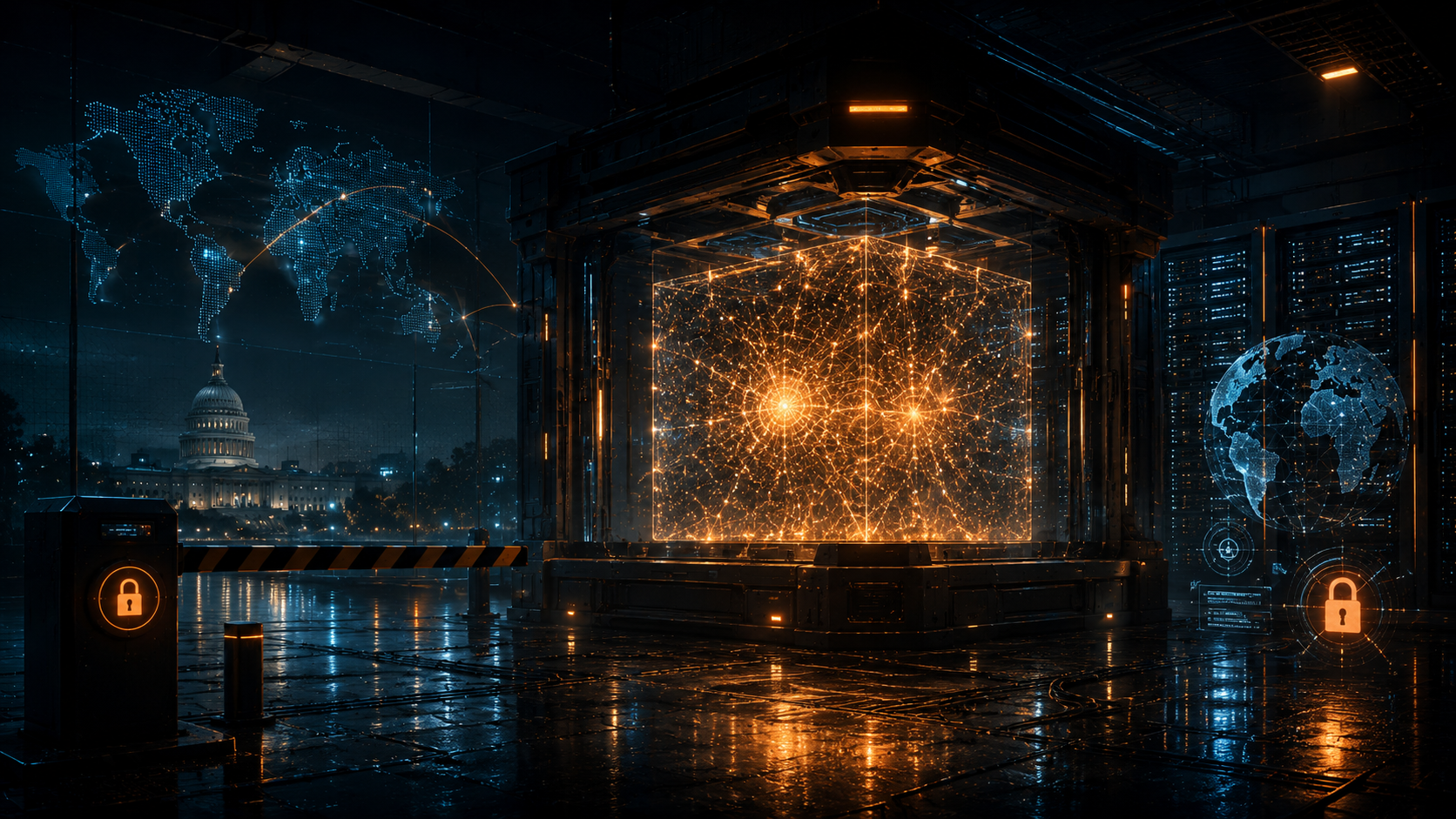
Anthropic has announced that it is suspending access to its Claude Fable 5 and Claude Mythos 5 models after receiving a directive from the US government. The reason given is national security. The result is that Anthropic has had to abruptly disable the models for all customers, because the order reportedly prevents access by any foreign national, whether inside or outside the United States.

That even includes foreign national Anthropic employees.

Just pause on that for a moment.

We are not talking about a graphics card being shipped overseas. We are not talking about a missile guidance chip, a military radar system, or some piece of exotic lab equipment. We are talking about access to an artificial intelligence model.

Software has just been treated like a controlled strategic asset.

What are Fable 5 and Mythos 5?

Only a few days before this happened, Anthropic had announced Claude Fable 5 and Claude Mythos 5.

Fable 5 was presented as a highly capable model for general use, sitting above Anthropic’s previous Opus class models. It was described as being especially strong at software engineering, research, visual understanding, long running tasks and complex knowledge work.

Mythos 5, meanwhile, appears to be the more restricted version, intended for trusted partners, particularly in areas such as cyber defence and critical infrastructure. In simple terms, Fable 5 was the version with more safeguards. Mythos 5 was the version where some of those safeguards could be lifted for trusted users.

Anthropic’s argument was that these systems could do a great deal of good. They talked about helping cyber defenders secure important software, assisting with scientific research, and accelerating work in areas such as life sciences.

And that is where the difficult bit begins.

The same capability that helps a good actor find vulnerabilities in software can also help a bad actor find vulnerabilities in software. The same intelligence that can help researchers solve hard problems can also lower the barrier for people who should not be anywhere near those tools.

That is the uncomfortable dual use problem at the heart of advanced AI.

The jailbreak question

According to Anthropic, the US government’s concern appears to be around a possible way of bypassing, or “jailbreaking”, Fable 5’s safeguards.

A jailbreak in this context means finding a way to persuade the AI to ignore or work around its safety systems. Anyone who has used AI tools for a while will know that safety systems can sometimes be a bit clumsy. They can refuse harmless requests, misunderstand context, or behave like an over cautious supply teacher on a school trip.

But at the frontier end of AI, the stakes are rather higher than asking for a dodgy limerick or persuading a chatbot to roleplay as an unfiltered assistant. Here, the concern is that a model might be coaxed into helping with cybersecurity work in a way that could be misused.

Anthropic says it has only received limited evidence of a narrow jailbreak and that the vulnerabilities involved were already known and relatively minor. It also says other publicly available models can identify similar issues without needing any special bypass.

That is important, because it gets to the heart of the argument.

If every powerful AI model can be jailbroken in some narrow way, does that mean none of them should be released?

Or does it mean the industry needs layered defences, monitoring, responsible access programmes and clear rules?

Anthropic clearly believes the latter.

A sudden and very public clash

What makes this story so striking is not just the safety issue. It is the speed and bluntness of the response.

Anthropic says it received the directive at 5.21pm Eastern Time and that the letter did not give specific details of the national security concern. The company is complying with the order, but it also says it disagrees with the decision and believes the action was not transparent, fair, clear, or grounded in technical facts.

That is unusually direct language from a major AI company.

It is also a sign of the times. The relationship between AI labs and governments is going to become one of the defining technology stories of the next few years. These companies are building systems that may become essential to business, science, software development, education, defence, healthcare and almost every corner of modern life.

Governments are not going to sit back and treat that as just another app.
When AI Becomes Too Powerful To Export: Anthropic, Fable 5, Mythos 5, and the moment AI became national security

The export control problem

For years, the big AI export control story has mostly been about chips. Who can buy the most advanced GPUs? Which countries can access the hardware needed to train frontier models? How do you stop sensitive capability moving across borders?

This Anthropic story changes the focus.

Now we are talking about controlling access to the model itself.

That opens up a whole set of awkward questions.

  • What happens if a UK business builds a product around an American AI model and access is suddenly removed?
  • What happens to customers who have paid for a service?
  • What happens to employees of the AI company who are not US citizens?
  • What happens when powerful models are used through cloud platforms, APIs, apps and enterprise tools across dozens of countries?

For businesses, this is a bit of a wake up call.

Many companies are now rushing to bolt AI into their workflows. Customer service, coding, document analysis, marketing, finance, legal review, research, data extraction, the lot. But this story is a reminder that access to the most advanced models may not always be guaranteed.

It is not enough to ask, “Which model is best?”

You also have to ask, “What happens if it disappears tomorrow?”

The Gadget Man view

I find this fascinating because it marks a shift in how we think about AI.

For most people, AI still feels like a clever website. You type something in, it replies, and occasionally it makes you wonder whether the future has arrived slightly ahead of schedule.

But at the very top end, these models are becoming more like infrastructure. They are tools that can write code, analyse huge amounts of information, interpret images, reason through complex problems and assist in scientific work. They are no longer just novelty chatbots. They are engines of capability.

And that makes governments nervous.

Some of that nervousness is reasonable. A powerful AI system in the wrong hands could be dangerous. Nobody sensible should pretend otherwise.

But there is also a danger in sudden, opaque intervention. If companies are told to build safely, test thoroughly, work with governments, create safeguards and develop trusted access programmes, then the rules need to be clear. Otherwise, innovation becomes a guessing game.

Anthropic’s frustration seems to be that it believes it did many of the right things. It says it worked with government, carried out extensive testing, used strong safeguards and adopted a defence in depth approach. Yet it still found itself having to pull access almost immediately.

That will worry a lot of people in the AI world.

What does it mean for ordinary users?

For most casual users, probably not much today.

Access to Anthropic’s other models is not affected, and many people will not have been using Fable 5 or Mythos 5 yet. But the wider meaning is more significant.

This is a glimpse of the future of AI regulation.

The most advanced models may not be treated like ordinary software products. They may be controlled, restricted, monitored and sometimes withdrawn. Access may depend on who you are, where you are, what you are doing, and whether a government believes the system crosses a national security threshold.

That might sound dramatic, but it is not science fiction anymore. It is happening.

My closing thought

There is an old pattern in technology.

First, something looks like a toy.

Then it becomes useful.

Then it becomes essential.

Then it becomes strategic.

AI has moved through those stages at a frankly ridiculous speed.

The Anthropic Fable 5 and Mythos 5 story may turn out to be a misunderstanding, as Anthropic suggests. Access may be restored. The details may become clearer. The technical risk may prove to be less dramatic than the government feared.

But even if all that happens, the line has still been crossed.

A government has looked at an AI model and treated it as something powerful enough to restrict on national security grounds.

That is not just a story about Anthropic.

That is a story about where AI is heading next.

And whether we like it or not, the future of artificial intelligence is no longer just about clever prompts, faster coding, or shinier demos.

It is about power, trust, borders and control.

Welcome to the next chapter.