Tag Archives: AI tools

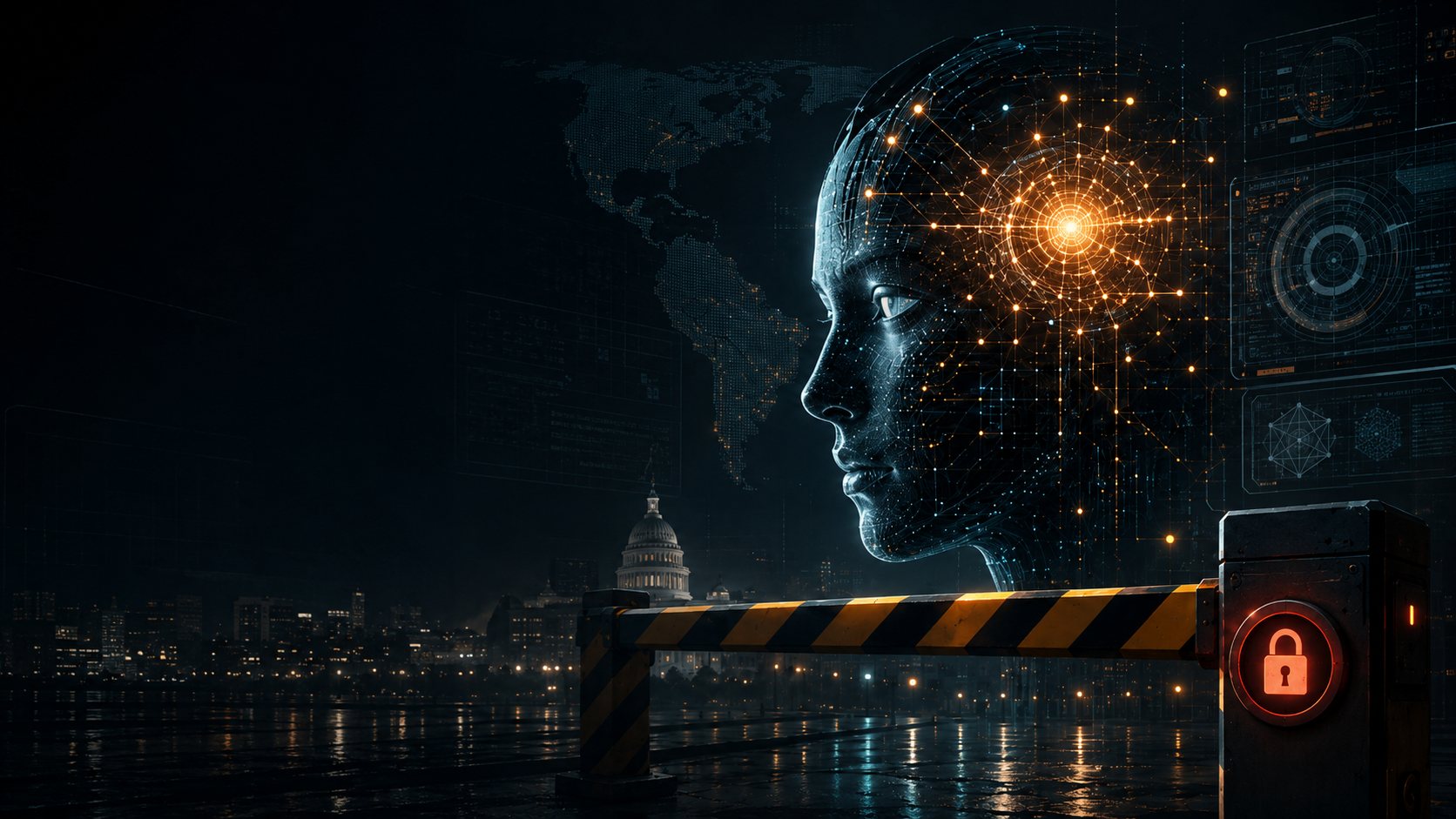
When AI Becomes Too Powerful To Export: Anthropic, Fable 5, Mythos 5, and the moment AI became national security

There are moments in technology when you can almost hear the gears of history clicking into place.

Not loudly. Not with fireworks or a bloke in a shiny suit standing on stage telling us that everything has changed. More often, it happens quietly, in a blog post, a government letter, or a hurried statement published late in the day.

This feels like one of those moments.

Anthropic has announced that it is suspending access to its Claude Fable 5 and Claude Mythos 5 models after receiving a directive from the US government. The reason given is national security. The result is that Anthropic has had to abruptly disable the models for all customers, because the order reportedly prevents access by any foreign national, whether inside or outside the United States.

That even includes foreign national Anthropic employees.

Just pause on that for a moment.

We are not talking about a graphics card being shipped overseas. We are not talking about a missile guidance chip, a military radar system, or some piece of exotic lab equipment. We are talking about access to an artificial intelligence model.

Software has just been treated like a controlled strategic asset.

What are Fable 5 and Mythos 5?

Only a few days before this happened, Anthropic had announced Claude Fable 5 and Claude Mythos 5.

Fable 5 was presented as a highly capable model for general use, sitting above Anthropic’s previous Opus class models. It was described as being especially strong at software engineering, research, visual understanding, long running tasks and complex knowledge work.

Mythos 5, meanwhile, appears to be the more restricted version, intended for trusted partners, particularly in areas such as cyber defence and critical infrastructure. In simple terms, Fable 5 was the version with more safeguards. Mythos 5 was the version where some of those safeguards could be lifted for trusted users.

Anthropic’s argument was that these systems could do a great deal of good. They talked about helping cyber defenders secure important software, assisting with scientific research, and accelerating work in areas such as life sciences.

And that is where the difficult bit begins.

The same capability that helps a good actor find vulnerabilities in software can also help a bad actor find vulnerabilities in software. The same intelligence that can help researchers solve hard problems can also lower the barrier for people who should not be anywhere near those tools.

That is the uncomfortable dual use problem at the heart of advanced AI.

The jailbreak question

According to Anthropic, the US government’s concern appears to be around a possible way of bypassing, or “jailbreaking”, Fable 5’s safeguards.

A jailbreak in this context means finding a way to persuade the AI to ignore or work around its safety systems. Anyone who has used AI tools for a while will know that safety systems can sometimes be a bit clumsy. They can refuse harmless requests, misunderstand context, or behave like an over cautious supply teacher on a school trip.

But at the frontier end of AI, the stakes are rather higher than asking for a dodgy limerick or persuading a chatbot to roleplay as an unfiltered assistant. Here, the concern is that a model might be coaxed into helping with cybersecurity work in a way that could be misused.

Anthropic says it has only received limited evidence of a narrow jailbreak and that the vulnerabilities involved were already known and relatively minor. It also says other publicly available models can identify similar issues without needing any special bypass.

That is important, because it gets to the heart of the argument.

If every powerful AI model can be jailbroken in some narrow way, does that mean none of them should be released?

Or does it mean the industry needs layered defences, monitoring, responsible access programmes and clear rules?

Anthropic clearly believes the latter.

A sudden and very public clash

What makes this story so striking is not just the safety issue. It is the speed and bluntness of the response.

Anthropic says it received the directive at 5.21pm Eastern Time and that the letter did not give specific details of the national security concern. The company is complying with the order, but it also says it disagrees with the decision and believes the action was not transparent, fair, clear, or grounded in technical facts.

That is unusually direct language from a major AI company.

It is also a sign of the times. The relationship between AI labs and governments is going to become one of the defining technology stories of the next few years. These companies are building systems that may become essential to business, science, software development, education, defence, healthcare and almost every corner of modern life.

Governments are not going to sit back and treat that as just another app.

When AI Becomes Too Powerful To Export: Anthropic, Fable 5, Mythos 5, and the moment AI became national security

The export control problem

For years, the big AI export control story has mostly been about chips. Who can buy the most advanced GPUs? Which countries can access the hardware needed to train frontier models? How do you stop sensitive capability moving across borders?

This Anthropic story changes the focus.

Now we are talking about controlling access to the model itself.

That opens up a whole set of awkward questions.

  • What happens if a UK business builds a product around an American AI model and access is suddenly removed?
  • What happens to customers who have paid for a service?
  • What happens to employees of the AI company who are not US citizens?
  • What happens when powerful models are used through cloud platforms, APIs, apps and enterprise tools across dozens of countries?

For businesses, this is a bit of a wake up call.

Many companies are now rushing to bolt AI into their workflows. Customer service, coding, document analysis, marketing, finance, legal review, research, data extraction, the lot. But this story is a reminder that access to the most advanced models may not always be guaranteed.

It is not enough to ask, “Which model is best?”

You also have to ask, “What happens if it disappears tomorrow?”

The Gadget Man view

I find this fascinating because it marks a shift in how we think about AI.

For most people, AI still feels like a clever website. You type something in, it replies, and occasionally it makes you wonder whether the future has arrived slightly ahead of schedule.

But at the very top end, these models are becoming more like infrastructure. They are tools that can write code, analyse huge amounts of information, interpret images, reason through complex problems and assist in scientific work. They are no longer just novelty chatbots. They are engines of capability.

And that makes governments nervous.

Some of that nervousness is reasonable. A powerful AI system in the wrong hands could be dangerous. Nobody sensible should pretend otherwise.

But there is also a danger in sudden, opaque intervention. If companies are told to build safely, test thoroughly, work with governments, create safeguards and develop trusted access programmes, then the rules need to be clear. Otherwise, innovation becomes a guessing game.

Anthropic’s frustration seems to be that it believes it did many of the right things. It says it worked with government, carried out extensive testing, used strong safeguards and adopted a defence in depth approach. Yet it still found itself having to pull access almost immediately.

That will worry a lot of people in the AI world.

What does it mean for ordinary users?

For most casual users, probably not much today.

Access to Anthropic’s other models is not affected, and many people will not have been using Fable 5 or Mythos 5 yet. But the wider meaning is more significant.

This is a glimpse of the future of AI regulation.

The most advanced models may not be treated like ordinary software products. They may be controlled, restricted, monitored and sometimes withdrawn. Access may depend on who you are, where you are, what you are doing, and whether a government believes the system crosses a national security threshold.

That might sound dramatic, but it is not science fiction anymore. It is happening.

My closing thought

There is an old pattern in technology.

First, something looks like a toy.

Then it becomes useful.

Then it becomes essential.

Then it becomes strategic.

AI has moved through those stages at a frankly ridiculous speed.

The Anthropic Fable 5 and Mythos 5 story may turn out to be a misunderstanding, as Anthropic suggests. Access may be restored. The details may become clearer. The technical risk may prove to be less dramatic than the government feared.

But even if all that happens, the line has still been crossed.

A government has looked at an AI model and treated it as something powerful enough to restrict on national security grounds.

That is not just a story about Anthropic.

That is a story about where AI is heading next.

And whether we like it or not, the future of artificial intelligence is no longer just about clever prompts, faster coding, or shinier demos.

It is about power, trust, borders and control.

Welcome to the next chapter.


Half of Workers Fear AI Will Take Their Jobs, and I Can Understand Why

Artificial Intelligence is everywhere at the moment.

It is in our phones, our laptops, our search engines, our photo apps, our cars, our customer service systems and, increasingly, our workplaces. For those of us who love technology, AI is fascinating. I use it, I write about it, I test it, and I can see enormous potential in what it can do.

But there is another side to this story, and it is one we cannot afford to ignore.

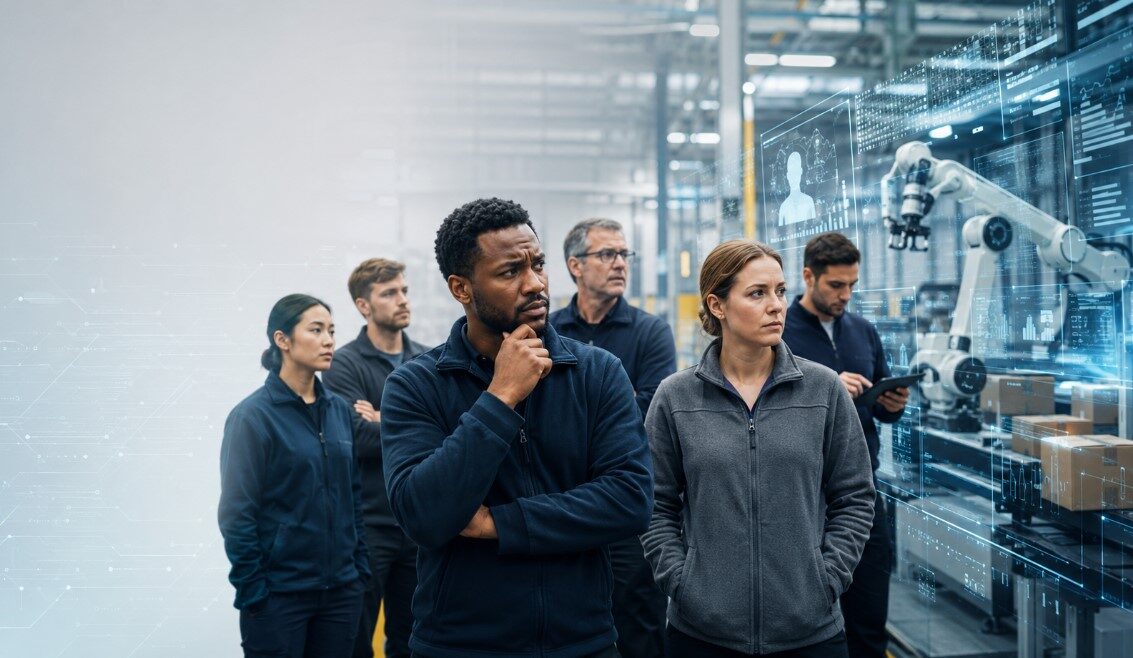
A new mass survey by GMB Union has found that almost half of workers are worried AI will take their job. The survey, which questioned 5,294 workers across a range of sectors in May and June 2026, found that 48 per cent are concerned that the introduction of Artificial Intelligence in their workplace could lead to them losing their job.

That is not a small number. That is not a fringe concern. That is nearly one in two workers looking at the rapid rise of AI and wondering whether the machine is coming for them next.

The same survey found that 58 per cent of workers believe AI will take jobs away in their workplace. Almost a third said their employer has already introduced AI, and around a quarter of those said AI is now doing tasks they would usually do themselves.

Perhaps most worrying of all, nearly half said AI is being used to track the activity of them or their colleagues during working time.

AI as a tool, or AI as a workplace watchdog?

That, for me, is where the conversation changes.

There is a world of difference between using AI as a helpful tool and using it as a digital overseer. One can make work easier, safer and more productive. The other risks turning workplaces into something cold, monitored and deeply uncomfortable.

This week, there have also been reports of around 1,000 jobs at Asda’s George brand being affected as the supermarket expands its use of AI and automation. Nestlé is also planning hundreds of job cuts at UK sites, with concerns that many roles could be replaced by AI and robotics.

Robert Battell, a Nestlé worker, is due to speak at GMB’s annual congress in Blackpool about what this means for workers on the ground. His words are stark. He describes the heartbreak of seeing colleagues and friends lose their jobs and be replaced by robots.

And that is the human bit we must not lose sight of.

Behind the buzzwords are real people

Behind every phrase like “efficiency savings”, “automation”, “streamlining” or “digital transformation”, there are real people. People with mortgages, rent, children, caring responsibilities, bills, routines and lives built around the work they do.

I am not anti-AI. Far from it. I think AI could be one of the most important technological developments of our lifetime. Used properly, it can help people work smarter. It can take away dull, repetitive tasks. It can help with accessibility, creativity, admin, logistics, research, design, customer support and countless other areas.

But the key phrase there is “used properly”.

Technology should serve people, not quietly replace them with no safety net.

This is our Industrial Revolution moment

The Industrial Revolution changed the world of work forever. Machines altered entire industries, and society had to adapt. AI feels like another of those moments.

It is not just another piece of software. It is a shift in how work itself is organised, measured and valued.

That means we need a serious conversation about rules, protections and responsibilities.

If AI removes a task, what happens to the person who used to do it? Are they retrained? Redeployed? Supported? Or simply shown the door?

If AI is being used to monitor staff, who decides what is fair? How much tracking is too much? What happens when an algorithm gets it wrong?

And if companies are saving money by replacing people with automation, what responsibility do they have to the communities and workers who helped build those businesses in the first place?

AI is not the enemy

AI is not the enemy. Badly used AI is the problem.

There is a version of the future where AI helps doctors, teachers, engineers, designers, drivers, warehouse staff, office workers and small businesses do more with less stress.

There is another version where it becomes a blunt cost-cutting tool, used to squeeze every last drop of productivity out of people before replacing them altogether.

We still have a choice about which version we build.

The technology is moving quickly. The question now is whether the laws, workplace protections and business ethics can move quickly enough to keep up.

Because if half of workers are already worried AI will take their job, then this is no longer some distant debate about the future.

It is happening now.

AI and the Future of Work: Are We Excited, Terrified, or Just Trying to Keep Up?

There are moments in technology when you can almost hear the gears of history turning.

I remember when having a computer in the office made you “the computer person”. I remember dial-up modems, fax machines, early websites, clunky email systems, and the strange magic of watching a machine do something that previously required a drawer full of paper, a telephone call, and usually someone called Janet who knew where everything was filed.

Artificial intelligence feels like one of those moments, except this time the machine is not just helping us type the letter. It is writing the letter, summarising the meeting, drawing the logo, coding the website, generating the video, and quietly eyeing up half the tasks we thought were safely ours.

AI and the Future of Work: Are We Excited, Terrified, or Just Trying to Keep Up?

A new report from The Policy Institute at King’s College London, AI and the Future of Work, gives a fascinating snapshot of how the British public, workers, students and employers are feeling about all this.

And the overall picture is not simple optimism. It is more like standing in front of a very clever robot vacuum cleaner that has suddenly learned accountancy.


We are wary, but we know it is coming

One of the most interesting findings is that the public are more negative than positive about AI, yet many people still expect to use it.

Almost half of the public say they would rather avoid AI-based technologies, 41% say they are afraid of AI, and only 24% think AI is positive for humanity. Yet 43% agree they will use AI in the future.

That feels very human to me.

It is the same feeling we had when smartphones began taking over our pockets. We complained about them, worried about them, said they were ruining attention spans, then used them to check the weather, order a takeaway, find a route, take photos of the dog and pay for parking.

AI may be following the same path, only with rather larger consequences.

Parents are looking at this very differently

The part of the report that really lands is the section about parents.

Half of parents with children under 30 say they are worried about how AI will affect their children’s career prospects. Yet only around three in ten parents of 11 to 29-year-olds have actually had a conversation with their child about how AI might affect their future career, and a similar number have encouraged them to learn how to use AI tools.

That gap matters.

Because whether we like AI or not, pretending it is not happening is not a strategy. The best advice we can give young people is probably not “avoid AI”, but “understand it, question it, and learn how to use it better than the next person”.

When I was younger, knowing your way around a computer gave you an edge. Then knowing the web gave you an edge. Then knowing social media, search engines, ecommerce, video, and automation gave you an edge.

Now the edge may come from knowing how to work alongside AI without becoming completely dependent on it.

The fear is not just science fiction

The report also shows that concern about jobs is widespread.

Seven in ten people are worried about the economic impact of job losses caused by AI, and majorities of the general public, young people, university students and workers believe AI will eliminate far more jobs than it creates.

That is not a small worry. That is not people muttering about robots in the pub. That is a mainstream concern.

There is also a particularly sharp anxiety around entry-level roles. The report notes that many people believe AI could eliminate half of all entry-level white-collar jobs within five years.

This is where I think the real danger lies. Not necessarily in AI replacing every professional overnight, but in it quietly removing the first rung of the ladder.

Most of us learned by doing the boring stuff first. We answered support calls, updated spreadsheets, wrote simple copy, fixed small bugs, processed orders, filed things, checked things, tested things, and gradually became useful.

If AI takes away the junior work, where exactly do the next generation learn?

You cannot become experienced without first being inexperienced.

Employers are more optimistic, but even they are worried

Employers are generally more positive about AI than the wider public, but they are not blindly cheerful.

According to the report, 63% of employers are worried about the economic impact of job losses caused by AI, even while many are excited about new jobs opening up.

That is the strange contradiction at the heart of this whole debate.

AI is both an opportunity and a threat. It can help small businesses move faster, reduce admin, improve customer service, generate ideas, speed up research and make previously expensive tasks accessible to people working from a spare room.

But it can also concentrate power.

One of the starkest findings is that 65% of the public think the economic benefits of AI will mainly go to wealthy investors and large companies, while just 7% think the benefits will be shared fairly across society.

That is probably the bit we should be talking about more.

The question is not simply “will AI be clever?” It clearly will be. The question is “who benefits?”

My view from the Gadget Man shed

I use AI. I find it fascinating, useful, occasionally infuriating, sometimes astonishing and often a little unsettling.

It can be like having an enthusiastic assistant who has read everything, forgotten where it read it, and sometimes confidently hands you a screwdriver when you asked for a banana.

But used properly, it is powerful.

For people like me who create websites, write content, tinker with servers, make videos, build odd little systems and generally chase ideas down rabbit holes, AI can be a genuine productivity boost.

It can help you get from “I wonder if this is possible?” to “here is a working prototype” much faster than before.

But I do not think we should confuse productivity with progress.

If AI helps a small business survive, brilliant. If it helps a student learn, excellent. If it helps someone with a disability communicate, create, work or live more independently, fantastic.

If it simply allows large companies to employ fewer people while making a handful of shareholders wealthier, then we have built something clever but not necessarily something good.

The future is not automatic

Technology does not arrive with a moral compass fitted as standard. We decide how it is used.

That means schools, parents, businesses and government all have some catching up to do.

Young people need to understand AI not as magic, but as a tool. Workers need training, not vague reassurance. Employers need to think about responsibility as well as efficiency. And the rest of us need to keep asking awkward questions.

AI is coming into the workplace whether we welcome it with open arms or hide behind the photocopier.

The important thing now is not to panic, but not to sleepwalk either.

We have been here before with big technological shifts, but this one feels faster, wider and stranger.

The machine is no longer just on the desk.

It is in the conversation.


Source: King’s College London, The Policy Institute, “AI and the Future of Work”, May 2026.

How I Wrote an Retro 80s-Inspired Adventure Game About The KLF

If you grew up in the 1980s, you’ll remember that unmistakable feeling of loading a game on your ZX Spectrum, Commodore 64, or BBC Micro. The hypnotic screech of the cassette loading, the colour bars flickering on screen, and that eternal moment of suspense — would it load this time, or had the tape stretched just enough to doom you to a R Tape Loading Error?

Loading the KLF Adventure

Fast forward to the 2020s and, somewhere between my love of retro computing, The KLF’s music, and an itch to make something creative, I decided: I’m going to write a text adventure game. Not just any text adventure, but one dripping with late-night 80s energy, pop culture references, and a healthy dose of KLF mythology.

The KLF Adventure Begins

It started innocently enough — I wanted to relive the magic of the Scott Adams-style adventures I played as a kid. Those games weren’t about graphics; they were about imagination. Every location, every object, every strange instruction was something you had to picture in your head. And if you were a bit obsessive (guilty), you’d spend hours mapping every room on graph paper.

Finding the Right Ingredients

The KLF have always been masters of mystery — their story threads through pop hits, art projects, strange performances, and burning a million pounds on a remote Scottish island. That mix of chaos, humour, and myth-making was perfect for a game world.

I started building a map: fictional places merged with real ones from KLF history. Bold Street in Liverpool. The Cavern Club in the 1960s. A boathouse with a roaring fire. And, naturally, Trancentral — the spiritual HQ of The KLF. I even included surreal locations like the “Little Fluffy Cloud Factory” and “Maze of Caves” for that dreamlike adventure feel.

Travel Back in Time to The Cavern Club in 1961

The NPCs? Oh, they had to be special. Sigmund Freud gives cryptic instructions. Ivan Pavlov demands you “Lie Down” before telling you to “Keep Calm”. Even Denzil the Baker makes an appearance, along with other nods that KLF fans will appreciate.

Building It Like It’s 1984 — With a 2025 Twist

I didn’t just want to write about the 80s — I wanted it to feel like the 80s. So I coded the game in a modern environment but kept the old-school constraints: short descriptions, tight vocabulary, and a parser that understands commands like GO NORTH, GET TICKET, or SAY CHILLOUT.

Don't get stuck in the record industry execs meeting!!!
Don’t get stuck in the record industry execs meeting!!!

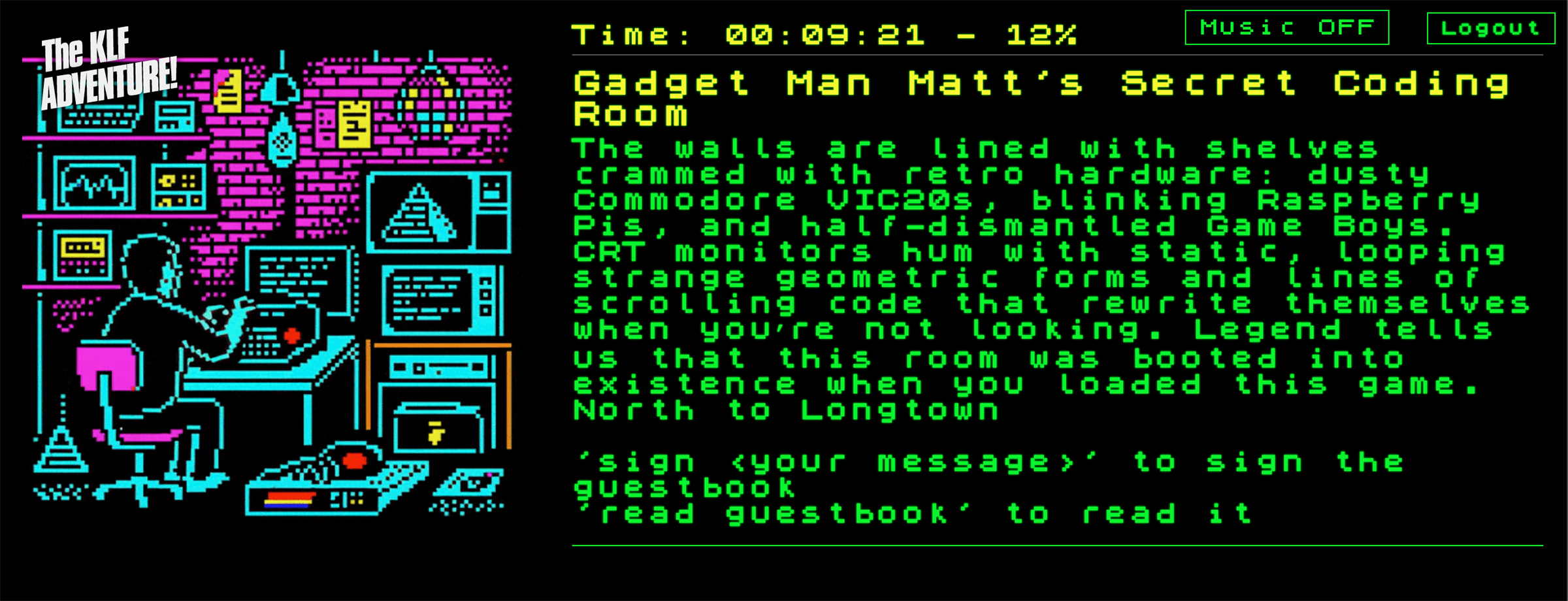
But here’s the twist — I didn’t do it alone. My coding partners were Gemini CLI and OpenAI Codex, coding with me directly in my command line. The imagery was created using ChatGPT, with animations by Midjourney. The music came courtesy of Suno, while the sound effects were crafted by ElevenLabs. Together, these AI tools became my team of coders, designers, composers, and consultants, enabling me to bring this game to life in a way that would have been impossible on my own.

And because I couldn’t resist going full retro, I’ve also been experimenting with encoding the game into audio so it can be loaded into a ZX Spectrum emulator straight from a physical cassette tape. Because why not?

Timeslips abound in Bold Street with alternate timelines showing Mick Hucknall driving the Ice Kream Van!

The Result

What emerged is The KLF Adventure — part game, part interactive art piece, and part love letter to the days when imagination did the heavy lifting. It’s an 80s-inspired world you can explore, puzzle over, and get gloriously lost in. It rewards curiosity, nods knowingly to KLF lore, and might just make you say “What Time Is Love?” at least once.

For me, this wasn’t just a coding project. It was a way of reconnecting with that kid who sat cross-legged in front of a rubber-keyed Spectrum, waiting for the next adventure to begin. Only now, I’m the one writing the adventure — with a 21st-century team of AIs by my side.

You can even find me in the game... But where?
You can even find me in the game… But where?

If you fancy diving in, the game is live at klfgame.co.uk. Just remember: keep your wits about you, don’t trust every whisper, and above all… CHILLOUT. Twice.

AI Transforms Blogging Efficiency (November 2023)

Using AI to Write Blog Posts

In the rapidly evolving digital landscape, artificial intelligence (AI) is no longer just a buzzword but a practical tool revolutionizing various industries, including content creation. Blogging, an integral part of digital marketing and personal expression, is one area where AI’s impact is notably significant. This post delves into how AI is transforming the way we write blog posts, its advantages, potential challenges, and tips for effectively using AI in blogging.

The Emergence of AI in Blogging

AI in blogging isn’t just about automated content generation; it’s about enhancing the writing process. Tools like OpenAI’s GPT-4 offer advanced language models that can draft text, suggest ideas, and even refine content tone. The integration of AI in blogging platforms simplifies tasks such as keyword optimization, grammar checks, and style improvements.

Key Benefits of Using AI for Blogging

  1. Efficiency and Speed: AI can generate drafts quickly, helping bloggers produce content more frequently.
  2. SEO Enhancement: AI tools can optimize content for search engines, improving blog visibility and reach.
  3. Consistency in Quality: AI maintains a consistent quality and tone, crucial for brand messaging.
  4. Idea Generation: It can suggest topics based on trends and user interests, keeping the content relevant and engaging.
  5. Personalization: AI can tailor content to different audience segments, enhancing reader engagement.

Challenges and Considerations

While AI brings numerous benefits, it also poses challenges:

  • Originality: There’s a risk of producing generic content. Balancing AI assistance with personal insight is key.
  • Over-reliance: Sole reliance on AI can diminish a writer’s skill and creativity.
  • Ethical Concerns: Issues like content authenticity and plagiarism need careful consideration.
AI Transforms Blogging Efficiency (November 2023)

Tips for Using AI in Blog Writing

  1. Start with a Clear Goal: Define what you want from the AI tool – be it generating ideas, creating drafts, or editing.
  2. Blend AI with Personal Touch: Use AI for the heavy lifting, but add your insights and experiences to make the content unique.
  3. Regularly Update AI Parameters: Keep the AI tool aligned with your evolving content strategy and audience preferences.
  4. Monitor Performance: Use analytics to understand how AI-generated content performs and refine your approach accordingly.
  5. Stay Informed: Keep up-to-date with AI advancements to leverage new features and capabilities.

Conclusion

AI in blogging is a powerful tool when used wisely. It can enhance the quality and efficiency of content creation while providing valuable insights into audience preferences. However, the heart of a great blog post still lies in the human touch – the experiences, insights, and personal stories that AI cannot replicate. Balancing AI capabilities with human creativity is the key to successful blogging in the AI era.

In embracing AI, bloggers are not replaced but empowered, equipped with tools to create more impactful, relevant, and engaging content. The future of blogging with AI looks promising, offering endless possibilities for content creators worldwide.

This is an update of the original blog post Using AI to Write Blog Posts and using newer versions of ChatGPT (version 4)  and Midjourney (version 5.2)

This post was written by ChatGPT 4 (AI)
Tags produced by a plugin written by ChatGPT4 which utilises the GPT3.5 Turbo API
Images created using Midjourney (AI)
All cut and pasted by Matt Porter The Gadget Man (Human)