Tag Archives: Technology

Robot Beggars, QR Codes and the Strangest Glimpse Yet of the AI Future

There are some news stories that make you stop, read the headline again, and then wonder whether you have accidentally fallen asleep in front of an episode of Black Mirror.

This is one of them.

According to Oddity Central, humanoid robots have reportedly been spotted on the streets of several Chinese cities, apparently begging for money with signs asking passers-by to help pay their electricity bills.

Yes, you read that correctly.

Not a human asking for spare change. Not even one of those slightly unsettling robot dogs trotting around with a camera on its back. A humanoid robot, kneeling or crouching in the street, complete with a QR code for digital donations and messages such as “Please pay my electricity bill”.

It is funny, bleak, clever and faintly horrifying all at the same time.

Humanoid robots have reportedly been spotted begging on Chinese streets. Is it a stunt, social commentary, or a strangely perfect symbol of the AI age?

The future has arrived, and it wants a top up

The reported scenes are almost too perfect as a piece of modern satire. A robot, presumably worth thousands of pounds, sitting on the pavement asking humans to help it recharge.

If Charles Dickens were alive today, he would probably be writing about a small Victorian automaton clutching a tin cup outside a data centre.

The reports suggest that these “robot beggars” have appeared in cities including Beijing, Chengdu and Fuzhou. Some appear to be posed with bowed heads, others with signs, bowls, QR codes and digital payment details.

Of course, the big question is whether this is real begging, performance art, marketing, or simply somebody with a very expensive sense of humour.

My money is on stunt or social commentary.

And in many ways, that makes it even more interesting.

The QR code is the clever bit

The most modern detail in the whole thing is not the robot. It is the QR code.

That tiny square turns the whole scene from a daft novelty into something strangely plausible. A robot begging for power while accepting digital payments feels like a perfect little snapshot of where technology is going.

It is absurd, but only just.

We already live in a world where buskers, cafés, market stalls and even charity collectors use contactless payments. In China, mobile payments are deeply embedded in daily life, so a begging robot with a QR code is not as far fetched as it might first appear.

The technology is not really the shocking part.

The shocking part is how quickly we accept it.

A decade ago, this would have looked like a comedy sketch. Today, people are debating whether the robot is genuine, whether it is an art installation, whether it is a marketing campaign, and whether even begging has now been automated.

That last point is obviously ridiculous.

But also, somehow, not ridiculous enough to dismiss completely.

Are robots really coming for every job?

The lazy version of the AI debate is that robots are coming for factory workers, call centre staff, writers, designers, drivers and anyone who has ever touched a spreadsheet.

But a begging robot flips the whole conversation on its head.

Nobody seriously expected “street beggar” to appear on the great AI replacement list. Yet here we are, staring at photos and videos of humanoid machines apparently asking humans for money.

It is probably not a new economic model. I doubt anyone has run the numbers and decided that placing a Unitree humanoid on a pavement is the fastest route to financial independence.

These machines are still expensive, and they are not exactly discreet. You would need a lot of generous pedestrians to cover the cost of the robot, let alone its maintenance, transport and charging.

But as a symbol, it is brilliant.

It says: if a robot can be made to mimic labour, service, companionship, entertainment and now even desperation, where exactly do we draw the line?

The unsettling human reaction

What fascinates me most is not the robot itself, but how humans react to it.

Do people laugh?

Do they feel sorry for it?

Do they scan the QR code?

Do they take photos and walk away?

We are very good at projecting feelings onto machines. Give a robot a face, a posture and a slightly pathetic sign, and suddenly we start treating it as something more than plastic, metal, servos and software.

This is why robot dogs feel different from wheeled drones. It is why humanoid robots attract so much attention. They borrow just enough from us to make our brains do the rest.

A robot kneeling on a pavement does not need to be sentient to make people uncomfortable. It only needs to look like it is asking.

That is where the story becomes less about robotics and more about us.

Art, marketing or warning?

There is every chance these robot beggars are not what they appear to be. The Oddity Central story itself notes that people online have questioned the authenticity of the trend, with some suggesting that the robots may be art installations designed to make people think about the changing relationship between humans and machines.

If that is the case, then it worked.

A humanoid robot asking for electricity money is a wonderfully simple idea. It compresses dozens of modern anxieties into one image:

AI replacing people.

Machines becoming more lifelike.

Humans becoming more detached.

The gig economy becoming stranger.

Digital payments replacing cash.

Technology needing constant feeding.

And perhaps most importantly, our endless ability to turn almost anything into content.

Because whatever the original intention, the robots have done what all successful modern spectacles do: they went viral.

The Gadget Man view

I do not think this means we are about to see robot beggars on every high street.

At least, not yet.

But I do think it shows how quickly humanoid robots are moving from laboratory curiosities into public imagination. Whether they are used for research, marketing, entertainment, public service or bizarre street theatre, they are becoming more visible.

And visibility matters.

Once people see robots in public spaces, they stop being abstract. They become part of the mental furniture of everyday life. The first time you see one, you take a photo. The tenth time, you step around it on your way to buy a sandwich.

That is how the future usually arrives. Not with one enormous leap, but with a series of odd little moments that make us say, “Well, that’s new.”

A robot begging for electricity money may not be the future of poverty, employment or AI.

But it might be one of the strangest warning signs yet that the AI revolution is not going to stay neatly tucked away inside laptops, smartphones and cloud servers.

Sooner or later, it will be sitting on the pavement, holding up a sign, and asking us to scan a QR code.

And knowing us, somebody probably will

AI and the Future of Work: Are We Excited, Terrified, or Just Trying to Keep Up?

There are moments in technology when you can almost hear the gears of history turning.

I remember when having a computer in the office made you “the computer person”. I remember dial-up modems, fax machines, early websites, clunky email systems, and the strange magic of watching a machine do something that previously required a drawer full of paper, a telephone call, and usually someone called Janet who knew where everything was filed.

Artificial intelligence feels like one of those moments, except this time the machine is not just helping us type the letter. It is writing the letter, summarising the meeting, drawing the logo, coding the website, generating the video, and quietly eyeing up half the tasks we thought were safely ours.

AI and the Future of Work: Are We Excited, Terrified, or Just Trying to Keep Up?

A new report from The Policy Institute at King’s College London, AI and the Future of Work, gives a fascinating snapshot of how the British public, workers, students and employers are feeling about all this.

And the overall picture is not simple optimism. It is more like standing in front of a very clever robot vacuum cleaner that has suddenly learned accountancy.


We are wary, but we know it is coming

One of the most interesting findings is that the public are more negative than positive about AI, yet many people still expect to use it.

Almost half of the public say they would rather avoid AI-based technologies, 41% say they are afraid of AI, and only 24% think AI is positive for humanity. Yet 43% agree they will use AI in the future.

That feels very human to me.

It is the same feeling we had when smartphones began taking over our pockets. We complained about them, worried about them, said they were ruining attention spans, then used them to check the weather, order a takeaway, find a route, take photos of the dog and pay for parking.

AI may be following the same path, only with rather larger consequences.

Parents are looking at this very differently

The part of the report that really lands is the section about parents.

Half of parents with children under 30 say they are worried about how AI will affect their children’s career prospects. Yet only around three in ten parents of 11 to 29-year-olds have actually had a conversation with their child about how AI might affect their future career, and a similar number have encouraged them to learn how to use AI tools.

That gap matters.

Because whether we like AI or not, pretending it is not happening is not a strategy. The best advice we can give young people is probably not “avoid AI”, but “understand it, question it, and learn how to use it better than the next person”.

When I was younger, knowing your way around a computer gave you an edge. Then knowing the web gave you an edge. Then knowing social media, search engines, ecommerce, video, and automation gave you an edge.

Now the edge may come from knowing how to work alongside AI without becoming completely dependent on it.

The fear is not just science fiction

The report also shows that concern about jobs is widespread.

Seven in ten people are worried about the economic impact of job losses caused by AI, and majorities of the general public, young people, university students and workers believe AI will eliminate far more jobs than it creates.

That is not a small worry. That is not people muttering about robots in the pub. That is a mainstream concern.

There is also a particularly sharp anxiety around entry-level roles. The report notes that many people believe AI could eliminate half of all entry-level white-collar jobs within five years.

This is where I think the real danger lies. Not necessarily in AI replacing every professional overnight, but in it quietly removing the first rung of the ladder.

Most of us learned by doing the boring stuff first. We answered support calls, updated spreadsheets, wrote simple copy, fixed small bugs, processed orders, filed things, checked things, tested things, and gradually became useful.

If AI takes away the junior work, where exactly do the next generation learn?

You cannot become experienced without first being inexperienced.

Employers are more optimistic, but even they are worried

Employers are generally more positive about AI than the wider public, but they are not blindly cheerful.

According to the report, 63% of employers are worried about the economic impact of job losses caused by AI, even while many are excited about new jobs opening up.

That is the strange contradiction at the heart of this whole debate.

AI is both an opportunity and a threat. It can help small businesses move faster, reduce admin, improve customer service, generate ideas, speed up research and make previously expensive tasks accessible to people working from a spare room.

But it can also concentrate power.

One of the starkest findings is that 65% of the public think the economic benefits of AI will mainly go to wealthy investors and large companies, while just 7% think the benefits will be shared fairly across society.

That is probably the bit we should be talking about more.

The question is not simply “will AI be clever?” It clearly will be. The question is “who benefits?”

My view from the Gadget Man shed

I use AI. I find it fascinating, useful, occasionally infuriating, sometimes astonishing and often a little unsettling.

It can be like having an enthusiastic assistant who has read everything, forgotten where it read it, and sometimes confidently hands you a screwdriver when you asked for a banana.

But used properly, it is powerful.

For people like me who create websites, write content, tinker with servers, make videos, build odd little systems and generally chase ideas down rabbit holes, AI can be a genuine productivity boost.

It can help you get from “I wonder if this is possible?” to “here is a working prototype” much faster than before.

But I do not think we should confuse productivity with progress.

If AI helps a small business survive, brilliant. If it helps a student learn, excellent. If it helps someone with a disability communicate, create, work or live more independently, fantastic.

If it simply allows large companies to employ fewer people while making a handful of shareholders wealthier, then we have built something clever but not necessarily something good.

The future is not automatic

Technology does not arrive with a moral compass fitted as standard. We decide how it is used.

That means schools, parents, businesses and government all have some catching up to do.

Young people need to understand AI not as magic, but as a tool. Workers need training, not vague reassurance. Employers need to think about responsibility as well as efficiency. And the rest of us need to keep asking awkward questions.

AI is coming into the workplace whether we welcome it with open arms or hide behind the photocopier.

The important thing now is not to panic, but not to sleepwalk either.

We have been here before with big technological shifts, but this one feels faster, wider and stranger.

The machine is no longer just on the desk.

It is in the conversation.


Source: King’s College London, The Policy Institute, “AI and the Future of Work”, May 2026.

I created my own awesome comic strip using ChatGPT

Every now and again, a piece of technology comes along that makes me grin like a child who has just found a secret compartment in a toy robot. This week, that technology was ChatGPT image generation.

I started with a simple idea: what if The Gadget Man was not just a blog, a podcast, or a bloke surrounded by cables, 3D printers, strange gadgets and half-finished ideas, but an actual comic book hero?

Not a cape-wearing superhero. Not someone bitten by a radioactive soldering iron. Just a gadget-loving chap with a cup of tea, a slightly dangerous number of ideas, and the ability to solve problems with technology, common sense and the occasional dramatic pose.

So I gave ChatGPT a photo of myself and typed the following prompt:

This is The Gadget Man, create a 2 page american style comic strip about him stopping a cyber attack by martians

First Draft of The Gadget Man

And there it was. A full two-page comic book spread featuring The Gadget Man battling Martians who were attempting to take over Earth’s systems. It had panels, speech bubbles, glowing screens, alien spaceships, dramatic lighting, and just the right amount of over-the-top comic book nonsense.

There was one small problem. In the final panel, instead of the crowd saying “Thanks Gadget Man!”, the speech bubble said “Thanks Gadget Giant Man!”

So I simply replied:

the last panel says THANKS GADGET GIANT MAN!, it should say THANKS GADGET MAN!

And ChatGPT corrected it.

The Gadget Man and The Alien Cyber Attack

That was the moment it really clicked. This was not just asking a computer to make a picture. This was creative direction. I could guide the scene, spot issues, refine the result, and build a series.

The Gadget Man Comic Universe Begins

Once the first comic was created, I did what any sensible adult would do. I immediately made several more.

The next prompt was:

Excellent, create another comic about Gadget Man visiting Scotland and saving them from EV Charger problems

The Gadget Man and the Mystery of the Scottish EV Chargers

This produced a wonderfully ridiculous adventure in which The Gadget Man travels north of the border to rescue Scotland from faulty EV chargers, broken apps, signal problems and confused motorists. There were Highland cows, charging stations, Scottish scenery, and, naturally, the sort of technological tinkering that saves the day.

Then came one of my favourites:

Create another comic featuring Gadget Man 3d Printing an elaborate controller for use with his VR headset to play Elite Dangerous

The Gadget Man and the 3d Printed Elite Dangerous Controller

This one was pure Gadget Man territory. 3D printing, VR, Elite Dangerous, switches, buttons, joysticks, wiring, and a controller that looked as though it had been designed by someone who had spent far too long thinking, “You know what this game needs? More buttons.”

After that, Vanessa joined the adventure.

Create another comic featuring Gadget Man and his sidekick wife Vanessa. Their adventure is finally getting away for a break at the coast

Gadget Man and Vanessa go to the Coast

The result was a seaside adventure featuring Gadget Man and Vanessa finally escaping for a well-earned break, only to find that even a trip to the coast can turn into a heroic mission when technology, transport and holiday chaos collide.

Of course, Vanessa deserved a break from all this madness, so I followed up with:

Create another comic featuring Gadget Man looking after the house whilst Vanessa spends two well deserved days at a Spa Retreat

The Gadget Man: Vanessa goes to the Spa

This produced a domestic disaster story full of smart home alerts, robot vacuums, laundry mountains, kitchen chaos and Gadget Man attempting to maintain order while Vanessa relaxed in peace. In other words, science fiction with a suspicious amount of truth in it.

Finally, I went bigger. Much bigger.

create another comic book featuring Gadget Man. This time he goes to the ISS to correct it’s orbit

The Gadget Man Saves the ISS

Yes, The Gadget Man went to space. The International Space Station had an orbital problem, and naturally the only person qualified to give it “a little nudge” was a man with a tool belt, a mug of tea, and an alarming level of confidence.

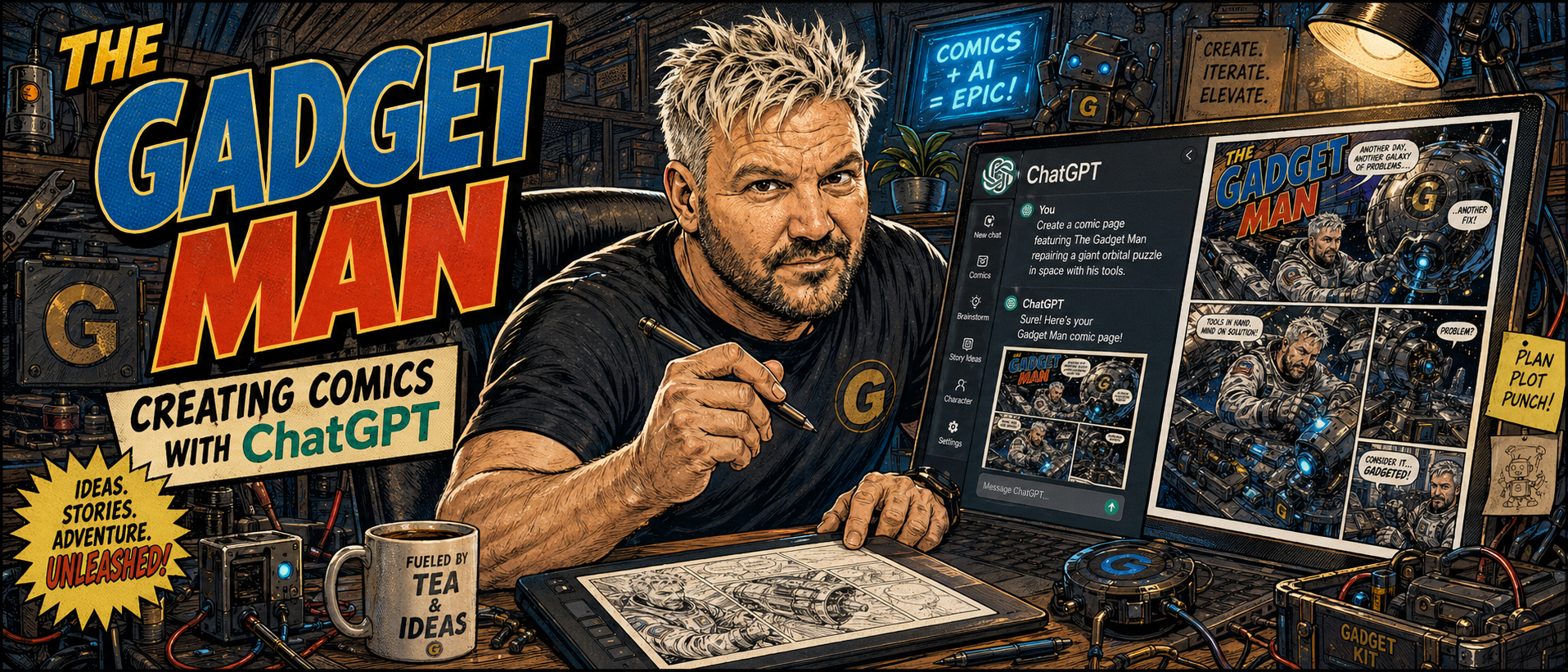
To finish the project, I also created a header image for this very article:

create a header image in the same style showing The Gadget Man creating the comic using ChatGPT

I created my own awesome comic strip using ChatGPT

That image showed The Gadget Man at his desk, creating comics using ChatGPT, surrounded by gadgets, screens, sketches, tools and the usual creative chaos. It perfectly captured what this whole experiment was about.

Why This Is Possible Now

What makes this so interesting is not simply that ChatGPT can generate an image. Image generators have existed for a while. The difference now is the conversational workflow.

OpenAI describes ChatGPT Images as a tool that can create new images and edit existing ones directly inside ChatGPT. You can ask for an image in plain English, refine it, adjust the composition, and explore new visual directions without needing to start from scratch each time. OpenAI also notes that recent image generation models are designed to follow prompts more accurately, render text more effectively, and use chat context, including uploaded images, as visual inspiration

That last point is important. I was not typing a technical command into a complicated art package. I was having a conversation. I could say “make this a two-page American-style comic strip”, then “change that wording”, then “now do one in Scotland”, then “now add Vanessa”, and ChatGPT understood the creative thread.

It feels less like using software and more like working with an incredibly fast illustrator, layout artist, letterer and visual brainstorming partner, all rolled into one.

The Magic Is in the Iteration

The real power here is not the first image. It is the second, third, fourth and fifth version.

Traditional creative work often involves a long gap between idea and result. You sketch, brief, wait, revise, wait again, make changes, and eventually arrive at something close to what you imagined.

With ChatGPT, the loop is much shorter. You can create a concept, respond to it, correct it, extend it, and build a whole fictional world in minutes. OpenAI’s own guidance highlights this ability to generate and refine images using clear prompts, request variations, adjust composition or size, and produce polished visuals quickly.

For someone like me, with a head full of odd ideas, half-remembered pop culture references, gadgets, stories, jokes, and technical rabbit holes, this is incredibly powerful.

I do not need to stop at “Wouldn’t it be funny if…”

I can actually see it.

What This Means for Artists

Now, this is where things become more complicated.

As exciting as all this is, it also raises serious questions for artists, illustrators, designers and the wider creative industry.

On one hand, tools like ChatGPT could be hugely empowering. They allow people who cannot draw to visualise ideas. They help writers create concept art. They help small businesses produce mock-ups, campaign ideas, storyboards, social media graphics and playful content that might previously have been out of reach.

For independent creators, this could be a revolution. A blogger can create a comic strip. A podcaster can build a visual world. A small business can prototype adverts. A game designer can test character ideas. A 3D printing enthusiast can imagine packaging, instructions, posters, comics and product artwork without needing a full design department.

But there is another side.

Professional artists have every right to be concerned. If companies decide to replace commissioned artwork with AI-generated images purely to save money, that has consequences. If the visual language of artists is absorbed, imitated and mass-produced without care, credit or fair compensation, that is not something we should casually ignore.

There is also the question of value. Art is not just the finished image. It is experience, taste, judgement, intention and human interpretation. A good artist does not simply “make a picture”. They solve visual problems. They understand emotion, framing, symbolism, storytelling and audience. AI can generate astonishing things, but it does not live a life. It does not have childhood memories, favourite comics, personal grief, humour, nostalgia or the strange little sparks that make human creativity so fascinating.

A Tool, Not a Replacement for Imagination

The way I see it, ChatGPT does not remove the need for creativity. It shifts where the creativity happens.

The prompt matters. The idea matters. The direction matters. The ability to look at an image and say “that is nearly right, but the final speech bubble is wrong” matters.

In my Gadget Man comic experiment, ChatGPT created the images, but the idea came from a very human place: my own interests, my humour, my love of gadgets, my fondness for comic book drama, my 3D printing obsession, my VR tinkering, my family life, and my lifelong habit of turning ordinary things into stories.

That is where I think these tools are at their best. Not replacing imagination, but amplifying it.

The Future of Comic Creation?

Will AI-generated comics replace traditional comics? I hope not.

Will they change how people make comics? Almost certainly.

We may see writers using AI to storyboard ideas before handing them to professional artists. We may see artists using AI for rough concepts, layouts, backgrounds or experimentation. We may see hobbyists creating personal comics for fun, families, blogs and social media. We may also see new kinds of hybrid workflows where human creators and AI tools sit side by side.

There will be arguments, and there should be. Creative industries need rules, ethics, transparency and respect for human artists.

But there is also something genuinely wonderful about being able to type a sentence and watch a ridiculous idea become visible.

Final Thoughts

What started as a quick experiment became a whole mini comic universe.

The Gadget Man fought Martians, fixed Scotland’s EV chargers, 3D printed a controller for Elite Dangerous, went on holiday with Vanessa, survived domestic chaos during a spa weekend, corrected the orbit of the ISS, and then sat down to create the comics using ChatGPT.

That is absurd.

It is also brilliant.

For me, this is exactly what technology should do. It should unlock ideas. It should make us laugh. It should help us create things that would otherwise remain trapped in our heads.

And if it occasionally turns “Gadget Man” into “Gadget Giant Man”, well, that is all part of the adventure.

Another day. Another gadget. Another comic created.

Gadget Man Signing Off

SAYPH: The Smartphone That Isn’t Trying to Be Everything

There’s a quiet shift happening in the world of tech. For years, smartphones have been on a relentless march toward doing more, showing more, and demanding more of our attention. Now, a UK startup called Sayph is heading in the opposite direction… and it’s rather refreshing.

Sayph has unveiled what it describes as the UK’s first responsible smartphone for children aged 8 to 16. Not a cut-down adult device. Not a standard handset wrapped in layers of parental controls. Instead, this is something altogether different, a phone designed from the ground up with a very specific purpose in mind.

A Middle Ground That Actually Exists

For many parents, the decision is a familiar dilemma. No phone at all, or a fully fledged smartphone with all the baggage that comes with it. Social media, open internet access, endless notifications… it’s a lot.

Sayph positions itself squarely in the middle.

Out of the box, the device focuses on the essentials. Calls, one-to-one messaging, and location tracking. That’s it. No social media apps. No app store. No web browser unless a parent explicitly decides to enable it.

This isn’t about locking things down after the fact. It’s about starting from a place of simplicity and control.

Built Different, Not Bolted On

What makes this interesting is the philosophy behind it. Most devices rely on add-ons and restrictions layered over a standard smartphone experience. Sayph flips that approach completely.

Everything is intentional.

Contacts must be approved. Communication is controlled. And instead of navigating endless menus and toggles, parents use a companion web app designed to give clear oversight without turning into a full-time job.

It’s less about surveillance, more about structure.

Independence Without the Noise

Co-founder Ben Humphrey sums it up neatly, describing the challenge many families face today: giving children independence without exposing them to the pressures of always-on digital life.

Walking to school. Visiting friends. Staying in touch. These are the real-world use cases Sayph is built around.

Not scrolling. Not chasing likes. Not being pulled into the endless gravity of online platforms.

Fellow co-founder Ami Penolver frames it slightly differently, positioning the device as pro-childhood rather than anti-technology. It’s a subtle but important distinction, and one that feels increasingly relevant.

Pricing and Positioning

At £189 for the handset and £5 per month for the parental platform, Sayph is clearly aiming to sit in an accessible space. Not a premium luxury device, but not a disposable gadget either.

It’s a considered purchase. One that reflects a shift in thinking about what a child’s first phone should actually be.

Tech With a Social Angle

There’s also an interesting layer beyond the hardware itself. Sayph has built a social impact model into its rollout.

For every ten devices purchased within a school, one is donated to a pupil premium child. For every hundred devices sold overall, another is provided to a looked-after child.

It’s a small touch, but one that hints at a broader ambition. Not just selling devices, but shaping how children access technology in the first place.

There’s something quite compelling about a product that deliberately does less. In a market obsessed with features, specs and endless capability, Sayph feels like a bit of a reset button.

A phone that knows exactly what it’s for… and more importantly, what it isn’t.

And in today’s world, that might just be its biggest feature.

Available now at Sayph

Anthropic’s Project Glasswing Could Change Cybersecurity Forever

There are moments in tech when you read an announcement and immediately realise that something important has shifted.

That was very much my reaction when I came across Project Glasswing, a newly announced initiative from Anthropic that is aimed squarely at one of the biggest looming problems in modern computing: what happens when AI becomes exceptionally good at finding software vulnerabilities. Source

According to Anthropic, Project Glasswing brings together a heavyweight list of partners including Amazon Web Services, Apple, Broadcom, Cisco, CrowdStrike, Google, JPMorganChase, the Linux Foundation, Microsoft, NVIDIA and Palo Alto Networks, all with the goal of securing critical software for what Anthropic calls the AI era. It is also extending access to more than 40 additional organisations that build or maintain important software infrastructure. Source

Now, that alone would be interesting enough, but the real headline here is the model sitting behind it all.

Anthropic says its unreleased model, Claude Mythos Preview, has already demonstrated the ability to find and exploit software vulnerabilities at a level beyond all but the most skilled human experts. That is a huge claim, and if it holds up in practice, it means we may have crossed into a very different phase of cybersecurity. Source

In plain English, this is not just about a chatbot helping someone write a bit of code more quickly. This is about AI being able to inspect complex software, spot weaknesses that humans and automated tools have missed for years, and in some cases work out how those weaknesses could be exploited. Anthropic says the model has already found thousands of high-severity vulnerabilities, including flaws affecting major operating systems and web browsers. Source

Some of the examples are rather startling. Anthropic says Mythos Preview uncovered a 27-year-old vulnerability in OpenBSD, a 16-year-old flaw in FFmpeg, and even chained together several Linux kernel vulnerabilities in a way that could escalate ordinary user access into full control of a machine. The company says those issues have now been responsibly disclosed and patched. Source

That, to me, is the bit that really lands.

Because for years we have tended to think of cybersecurity in terms of patching known issues, following best practice, keeping software up to date and hoping the really serious flaws are found by the good people before the bad people. But if AI systems are now reaching the point where they can autonomously discover dangerous bugs in code that has survived decades of scrutiny, then the pace of both defence and attack could increase dramatically. Source

Anthropic is clearly trying to frame Glasswing as a defensive first move. The company says it is committing up to $100 million in usage credits for Mythos Preview and $4 million in direct donations to open-source security organisations. The idea seems to be to put these capabilities into the hands of defenders, infrastructure operators and maintainers before similar systems become more widely available. Source

And that is probably the most sensible angle here.

Because whether we like it or not, the genie is not going back in the bottle. If one frontier AI lab can build a model that is frighteningly good at vulnerability discovery, others will too. Eventually, those capabilities will spread further. The question is not really whether AI will reshape cybersecurity. It is whether defenders can get enough of a head start to stop things getting seriously messy. That is an inference from Anthropic’s announcement and the examples it gives, rather than a direct claim from the company, but it feels like the unavoidable conclusion. Source

For those of us who run websites, servers, ecommerce platforms, mail systems or anything else connected to the wider internet, this should be a bit of a wake-up call. The old approach of leaving systems half-maintained, delaying updates, or assuming that obscure software will somehow stay below the radar looks even more risky in a world where AI can inspect code at speed and scale.

Project Glasswing may turn out to be remembered as one of those early milestone moments, the point where the cybersecurity industry publicly acknowledged that AI is no longer just a helpful assistant for defenders. It is becoming a serious force multiplier, and one that could work for either side.

That makes this announcement both exciting and slightly chilling.

And, in true Gadget Man fashion, it is exactly the kind of development that reminds us technology is never just about shiny new tools. It is also about consequences, responsibility and how quickly the world has to adapt when the rules suddenly change.

Source

Anthropic, Project Glasswing: Securing critical software for the AI era

Noble Sceptre Review – Unlocking Proper Bluetooth Without Replacing the Kit You Love

There’s a quiet frustration that many of us never quite articulate.

You buy excellent headphones. You invest in something genuinely special. Then you discover that the weakest link in the entire chain isn’t the drivers, the tuning or the comfort… it’s the Bluetooth chip inside your phone or laptop.

The Noble Sceptre arrives as a rather elegant solution to that problem.

Noble Sceptre Review - Unlocking Proper Bluetooth Without Replacing the Kit You Love
Noble Sceptre Review – Unlocking Proper Bluetooth Without Replacing the Kit You Love

Launching at £64.99, this compact Bluetooth transmitter promises to bypass the limitations of built-in wireless hardware and deliver high-resolution codecs like LDAC and aptX Adaptive to virtually any compatible device .

And in typical Noble fashion, it does so without fuss.


What Exactly Is It?

At first glance, the Sceptre looks like a small, understated USB-C dongle. No flashing lights. No oversized branding. Just a compact metal unit designed to disappear into your setup.

But internally, it’s built around Qualcomm’s QCC5181 chipset with Bluetooth 5.4 support . That’s the important bit.

Rather than relying on whatever Bluetooth radio your phone, tablet or laptop happens to include, Sceptre handles the transmission itself. It becomes the brains of your wireless link.

The result? Access to advanced codecs including:

  • LDAC
  • aptX Adaptive
  • AAC
  • SBC

In practical terms, that means cleaner transmission, better detail retrieval and more consistent audio quality.

Noble Sceptre Review - Unlocking Proper Bluetooth Without Replacing the Kit You Love
Noble Sceptre Review – Unlocking Proper Bluetooth Without Replacing the Kit You Love

Why This Matters

Modern smartphones, particularly some iOS devices, are notoriously restrictive with codec support. Even on Android, implementation can be inconsistent.

Sceptre effectively levels the playing field.

Plug it into a USB-C device and suddenly you’re no longer at the mercy of whatever the manufacturer decided to include. It supports iOS, Android and Windows platforms , and it’s compatible with a wide range of Bluetooth headphones, true wireless buds and even powered speakers.

For anyone running premium wireless IEMs or high-end Bluetooth headphones, that’s a significant upgrade path without replacing your existing gear.

Noble Sceptre Review - Unlocking Proper Bluetooth Without Replacing the Kit You Love
Noble Sceptre Review – Unlocking Proper Bluetooth Without Replacing the Kit You Love

Real-World Use

What impressed me most is how practical it feels.

There’s a charge-through USB-C port, meaning you can power your phone or laptop while using Sceptre . That makes it viable for long commutes, flights or desk use. No battery anxiety.

Bluetooth profiles supported include HFP, A2DP and AVRCP , so calls and media control work as expected. Transmission range is rated at up to 20 metres , which in everyday terms means stable connection across a room, through a couple of interior walls, or around a typical office.

Setup is handled via the Noble app for the initial pairing, after which it behaves like a proper plug-and-play device .


Design and Build

The design language is classic Noble.

Minimal. Purposeful. Compact.

It doesn’t scream “audiophile accessory”. Instead, it feels like a professional tool. Something you carry because you know what it does, not because you want attention.

It’s lightweight enough to live permanently on a laptop. Small enough to disappear into a pocket alongside your phone. And crucially, it doesn’t add clutter.

Noble Sceptre Review - Unlocking Proper Bluetooth Without Replacing the Kit You Love
Noble Sceptre Review – Unlocking Proper Bluetooth Without Replacing the Kit You Love

Who Is It For?

This isn’t aimed at casual listeners.

It’s for:

  • People who own serious wireless headphones
  • Commuters who stream lossless or high-quality audio
  • Gamers who want more consistent wireless performance
  • Anyone frustrated by codec limitations on their device

If you’re perfectly happy with standard SBC streaming, this probably isn’t essential.

But if you’ve invested in quality audio and feel your source is holding you back, Sceptre makes a compelling case.

Noble Sceptre Review - Unlocking Proper Bluetooth Without Replacing the Kit You Love
Noble Sceptre Review – Unlocking Proper Bluetooth Without Replacing the Kit You Love

The Bigger Picture

Noble built its reputation on handcrafted in-ear monitors and distinctive true wireless designs. With Sceptre, they’ve moved upstream into the signal chain itself .

That’s clever.

Rather than asking customers to buy new headphones, they’re enhancing what people already own.

At £64.99 / $69.99 / €69.99 , it’s positioned accessibly for a performance upgrade that could genuinely transform a wireless setup.


Gadget Man Verdict

The Noble Sceptre is one of those devices that solves a problem many people don’t realise they have.

It doesn’t try to be flashy. It doesn’t attempt to reinvent wireless audio. Instead, it quietly improves the weakest link in the chain.

And in audio, the chain matters.

If you’ve invested in quality Bluetooth headphones and want to hear what they’re truly capable of, this small dongle may well be the missing piece.

Compact. Practical. Sensible. And surprisingly impactful.

Exactly the sort of understated gadget I rather enjoy discovering.

Why ‘123456’ Is Still Ruining Business Security

There are some things you expect to see in 2026. AI everywhere. Electric cars quietly taking over. Smart homes that know when you have run out of milk.

What you do not expect is that one of the biggest threats to company security is still someone typing 123456 into a login box.

Yet here we are.

A recent piece of research from NordPass lays it all bare. After analysing huge volumes of passwords exposed in real world data breaches, the conclusion is both fascinating and slightly terrifying. Business passwords are often no better than the ones we were being warned about twenty years ago.

The same bad habits, everywhere

Across sectors like healthcare, manufacturing, tech and finance, the patterns repeat themselves. Simple number sequences dominate. Obvious choices like 123456, 123456789 and password keep cropping up. In some cases people are even using their own email address as the password.

That last one is particularly grim. If your username is already public, you have effectively handed an attacker half the keys to the building.

What struck me most was how universal this problem is. This is not a single careless industry or a few unlucky firms. It is a human behaviour issue. Convenience beats caution every time unless systems are designed to protect us from ourselves.

Why attackers love this

From an attacker’s point of view, weak passwords are a gift. Automated tools can try millions of common combinations in seconds. If employees reuse passwords across systems, one breach can quietly unlock several more doors.

This is often how serious incidents begin. Not with Hollywood style hacking, but with someone guessing a password that should never have existed in the first place.

The uncomfortable truth for businesses

Here is the bit that matters. This is not really a technical problem. The tools to fix it have existed for years.

Strong password policies. Password managers. Multi factor authentication. Alerts for leaked credentials. None of this is exotic or expensive anymore.

What is missing is consistency and enforcement. Many organisations still rely on guidance rather than rules, or assume that staff will naturally do the right thing. History shows they will not, especially when speed and convenience are rewarded.

What actually works

From everything I have seen over the years, both professionally and personally, a few things make the biggest difference.

First, remove the burden from users. A good password manager means nobody has to remember anything clever.

Second, enforce unique passwords everywhere. No exceptions.

Third, enable multi factor authentication wherever possible, especially for email and admin accounts.

Finally, treat leaked passwords as inevitable, not hypothetical. Monitor for them and act quickly.

Still relevant, still risky

It is easy to laugh at 123456. It feels like a joke from the early days of the internet. But when that same password is still opening real company systems today, it stops being funny very quickly.

The NordPass research is a useful reminder that cybersecurity does not always fail at the cutting edge. More often, it fails at the front door.

And the front door is still wide open far too often.