Every now and again, a piece of technology comes along that makes me grin like a child who has just found a secret compartment in a toy robot. This week, that technology was ChatGPT image generation.
I started with a simple idea: what if The Gadget Man was not just a blog, a podcast, or a bloke surrounded by cables, 3D printers, strange gadgets and half-finished ideas, but an actual comic book hero?
Not a cape-wearing superhero. Not someone bitten by a radioactive soldering iron. Just a gadget-loving chap with a cup of tea, a slightly dangerous number of ideas, and the ability to solve problems with technology, common sense and the occasional dramatic pose.
So I gave ChatGPT a photo of myself and typed the following prompt:
This is The Gadget Man, create a 2 page american style comic strip about him stopping a cyber attack by martians
First Draft of The Gadget Man
And there it was. A full two-page comic book spread featuring The Gadget Man battling Martians who were attempting to take over Earth’s systems. It had panels, speech bubbles, glowing screens, alien spaceships, dramatic lighting, and just the right amount of over-the-top comic book nonsense.
There was one small problem. In the final panel, instead of the crowd saying “Thanks Gadget Man!”, the speech bubble said “Thanks Gadget Giant Man!”
So I simply replied:
the last panel says THANKS GADGET GIANT MAN!, it should say THANKS GADGET MAN!
And ChatGPT corrected it.
The Gadget Man and The Alien Cyber Attack
That was the moment it really clicked. This was not just asking a computer to make a picture. This was creative direction. I could guide the scene, spot issues, refine the result, and build a series.
The Gadget Man Comic Universe Begins
Once the first comic was created, I did what any sensible adult would do. I immediately made several more.
The next prompt was:
Excellent, create another comic about Gadget Man visiting Scotland and saving them from EV Charger problems
The Gadget Man and the Mystery of the Scottish EV Chargers
This produced a wonderfully ridiculous adventure in which The Gadget Man travels north of the border to rescue Scotland from faulty EV chargers, broken apps, signal problems and confused motorists. There were Highland cows, charging stations, Scottish scenery, and, naturally, the sort of technological tinkering that saves the day.
Then came one of my favourites:
Create another comic featuring Gadget Man 3d Printing an elaborate controller for use with his VR headset to play Elite Dangerous
The Gadget Man and the 3d Printed Elite Dangerous Controller
This one was pure Gadget Man territory. 3D printing, VR, Elite Dangerous, switches, buttons, joysticks, wiring, and a controller that looked as though it had been designed by someone who had spent far too long thinking, “You know what this game needs? More buttons.”
After that, Vanessa joined the adventure.
Create another comic featuring Gadget Man and his sidekick wife Vanessa. Their adventure is finally getting away for a break at the coast
Gadget Man and Vanessa go to the Coast
The result was a seaside adventure featuring Gadget Man and Vanessa finally escaping for a well-earned break, only to find that even a trip to the coast can turn into a heroic mission when technology, transport and holiday chaos collide.
Of course, Vanessa deserved a break from all this madness, so I followed up with:
Create another comic featuring Gadget Man looking after the house whilst Vanessa spends two well deserved days at a Spa Retreat
The Gadget Man: Vanessa goes to the Spa
This produced a domestic disaster story full of smart home alerts, robot vacuums, laundry mountains, kitchen chaos and Gadget Man attempting to maintain order while Vanessa relaxed in peace. In other words, science fiction with a suspicious amount of truth in it.
Finally, I went bigger. Much bigger.
create another comic book featuring Gadget Man. This time he goes to the ISS to correct it’s orbit
The Gadget Man Saves the ISS
Yes, The Gadget Man went to space. The International Space Station had an orbital problem, and naturally the only person qualified to give it “a little nudge” was a man with a tool belt, a mug of tea, and an alarming level of confidence.
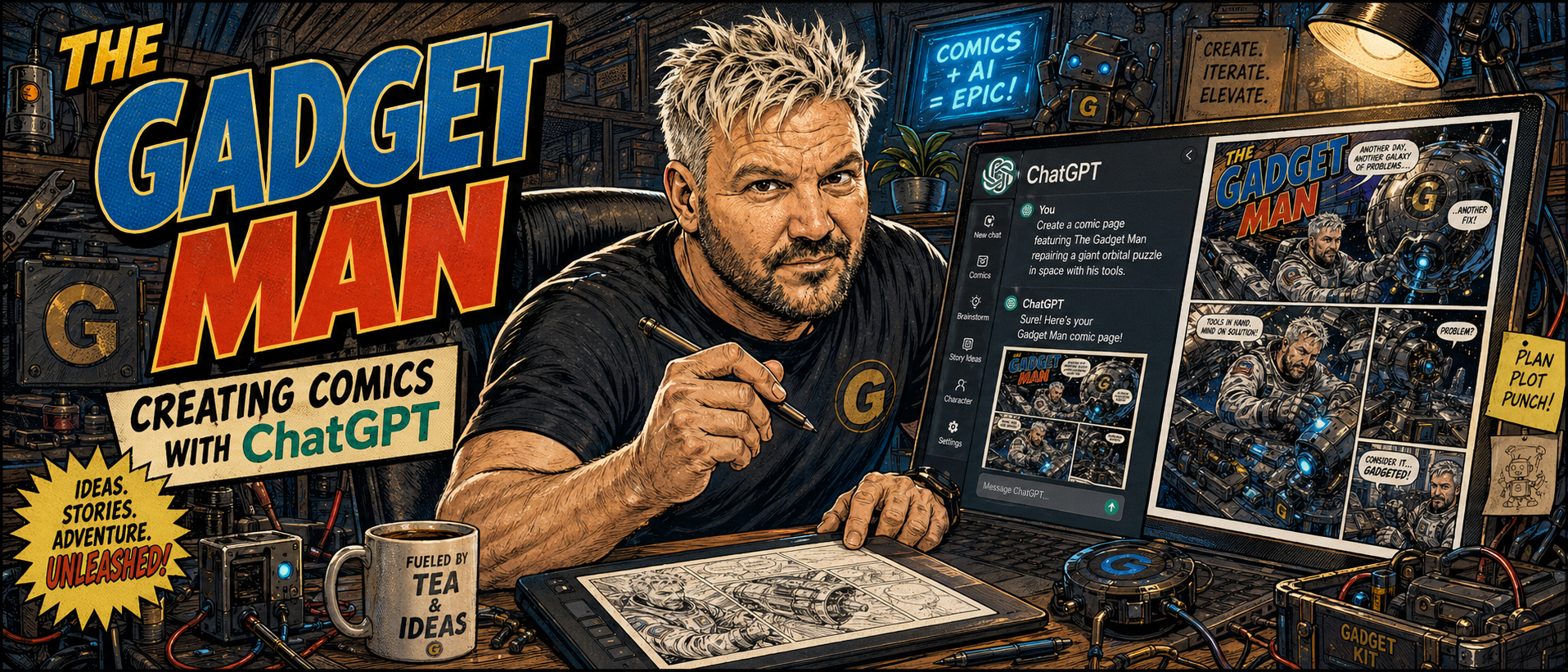
To finish the project, I also created a header image for this very article:
create a header image in the same style showing The Gadget Man creating the comic using ChatGPT
I created my own awesome comic strip using ChatGPT
That image showed The Gadget Man at his desk, creating comics using ChatGPT, surrounded by gadgets, screens, sketches, tools and the usual creative chaos. It perfectly captured what this whole experiment was about.
Why This Is Possible Now
What makes this so interesting is not simply that ChatGPT can generate an image. Image generators have existed for a while. The difference now is the conversational workflow.
OpenAI describes ChatGPT Images as a tool that can create new images and edit existing ones directly inside ChatGPT. You can ask for an image in plain English, refine it, adjust the composition, and explore new visual directions without needing to start from scratch each time. OpenAI also notes that recent image generation models are designed to follow prompts more accurately, render text more effectively, and use chat context, including uploaded images, as visual inspiration
That last point is important. I was not typing a technical command into a complicated art package. I was having a conversation. I could say “make this a two-page American-style comic strip”, then “change that wording”, then “now do one in Scotland”, then “now add Vanessa”, and ChatGPT understood the creative thread.
It feels less like using software and more like working with an incredibly fast illustrator, layout artist, letterer and visual brainstorming partner, all rolled into one.
The Magic Is in the Iteration
The real power here is not the first image. It is the second, third, fourth and fifth version.
Traditional creative work often involves a long gap between idea and result. You sketch, brief, wait, revise, wait again, make changes, and eventually arrive at something close to what you imagined.
With ChatGPT, the loop is much shorter. You can create a concept, respond to it, correct it, extend it, and build a whole fictional world in minutes. OpenAI’s own guidance highlights this ability to generate and refine images using clear prompts, request variations, adjust composition or size, and produce polished visuals quickly.
For someone like me, with a head full of odd ideas, half-remembered pop culture references, gadgets, stories, jokes, and technical rabbit holes, this is incredibly powerful.
I do not need to stop at “Wouldn’t it be funny if…”
I can actually see it.
What This Means for Artists
Now, this is where things become more complicated.
As exciting as all this is, it also raises serious questions for artists, illustrators, designers and the wider creative industry.
On one hand, tools like ChatGPT could be hugely empowering. They allow people who cannot draw to visualise ideas. They help writers create concept art. They help small businesses produce mock-ups, campaign ideas, storyboards, social media graphics and playful content that might previously have been out of reach.
For independent creators, this could be a revolution. A blogger can create a comic strip. A podcaster can build a visual world. A small business can prototype adverts. A game designer can test character ideas. A 3D printing enthusiast can imagine packaging, instructions, posters, comics and product artwork without needing a full design department.
But there is another side.
Professional artists have every right to be concerned. If companies decide to replace commissioned artwork with AI-generated images purely to save money, that has consequences. If the visual language of artists is absorbed, imitated and mass-produced without care, credit or fair compensation, that is not something we should casually ignore.
There is also the question of value. Art is not just the finished image. It is experience, taste, judgement, intention and human interpretation. A good artist does not simply “make a picture”. They solve visual problems. They understand emotion, framing, symbolism, storytelling and audience. AI can generate astonishing things, but it does not live a life. It does not have childhood memories, favourite comics, personal grief, humour, nostalgia or the strange little sparks that make human creativity so fascinating.
A Tool, Not a Replacement for Imagination
The way I see it, ChatGPT does not remove the need for creativity. It shifts where the creativity happens.
The prompt matters. The idea matters. The direction matters. The ability to look at an image and say “that is nearly right, but the final speech bubble is wrong” matters.
In my Gadget Man comic experiment, ChatGPT created the images, but the idea came from a very human place: my own interests, my humour, my love of gadgets, my fondness for comic book drama, my 3D printing obsession, my VR tinkering, my family life, and my lifelong habit of turning ordinary things into stories.
That is where I think these tools are at their best. Not replacing imagination, but amplifying it.
The Future of Comic Creation?
Will AI-generated comics replace traditional comics? I hope not.
Will they change how people make comics? Almost certainly.
We may see writers using AI to storyboard ideas before handing them to professional artists. We may see artists using AI for rough concepts, layouts, backgrounds or experimentation. We may see hobbyists creating personal comics for fun, families, blogs and social media. We may also see new kinds of hybrid workflows where human creators and AI tools sit side by side.
There will be arguments, and there should be. Creative industries need rules, ethics, transparency and respect for human artists.
But there is also something genuinely wonderful about being able to type a sentence and watch a ridiculous idea become visible.
Final Thoughts
What started as a quick experiment became a whole mini comic universe.
The Gadget Man fought Martians, fixed Scotland’s EV chargers, 3D printed a controller for Elite Dangerous, went on holiday with Vanessa, survived domestic chaos during a spa weekend, corrected the orbit of the ISS, and then sat down to create the comics using ChatGPT.
That is absurd.
It is also brilliant.
For me, this is exactly what technology should do. It should unlock ideas. It should make us laugh. It should help us create things that would otherwise remain trapped in our heads.
And if it occasionally turns “Gadget Man” into “Gadget Giant Man”, well, that is all part of the adventure.
Another day. Another gadget. Another comic created.
There is a quiet shift happening in the world of toys. Away from noisy plastics and fixed instructions, and towards objects that invite imagination, patience and pride of place. The TRIDO Laguna range sits firmly in that space, and it is easy to see why it is gaining so much attention.
Created by TRIDO, Laguna is a premium magnetic construction set designed not around winning or finishing, but around thinking, building and displaying. It is less about knock-it-down play and more about creating something worth keeping on the shelf.
Why This Minimalist Magnetic Toy Is Taking Over Creative Play
Built for Expression, Not Instructions
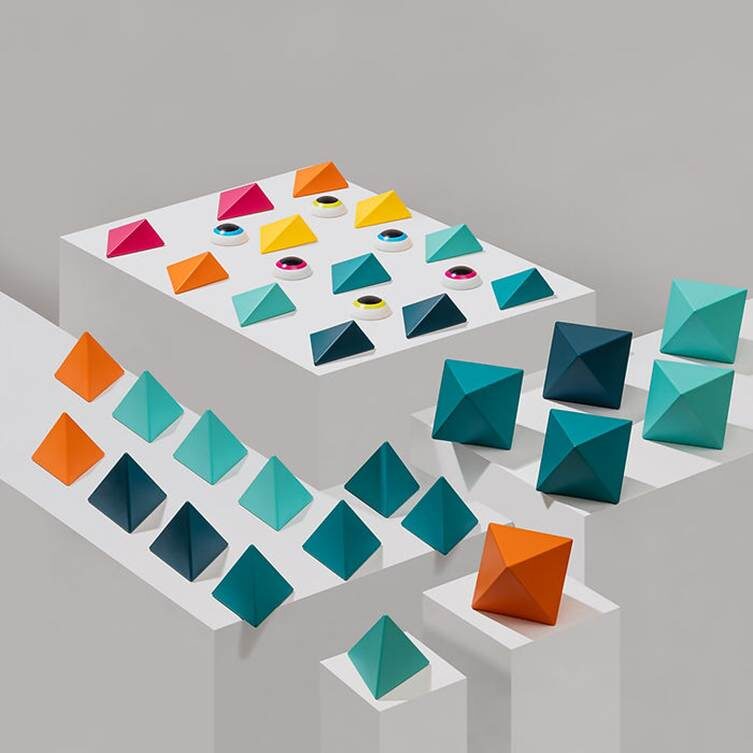
At the heart of every Laguna set are TRIDO’s distinctive geometric forms. Octahedrons, tetrahedrons and half-tetrahedrons, each engineered to connect on every side. Strong internal magnets mean pieces snap together effortlessly, giving complete freedom to explore form, balance and symmetry without frustration.
There are no instructions to follow and no final model to replicate. Instead, children are encouraged to experiment, rebuild and refine. It turns play into a creative process rather than a task, which is a refreshing change from many construction toys that funnel children towards a single outcome.
Why This Minimalist Magnetic Toy Is Taking Over Creative Play
A Toy That Feels at Home in Grown-Up Spaces
One of the standout aspects of the Laguna range is its visual design. The calm, modern colourway feels deliberate and considered, making it something that happily lives in a family space rather than being hidden away in a toy box.
This is a magnetic construction toy that invites display. Finished builds feel sculptural, and with the included magnetic eyes, creations can become expressive characters as well as abstract forms. It blurs the line between toy, art object and learning tool in a way that feels genuinely thoughtful.
Why This Minimalist Magnetic Toy Is Taking Over Creative Play
Open-Ended Play With Real Benefits
Laguna is designed for children aged three and up, and the benefits go well beyond entertainment. Open-ended play supports imagination, confidence and problem-solving, while naturally introducing early STEM concepts such as geometry and spatial awareness.
Fine motor skills are developed through precise placement and balance, and the lack of rules makes it equally suitable for independent play or collaborative family sessions. It is also completely screen free, which feels increasingly important in modern homes.
All pieces are made from durable, non-toxic ABS plastic with smooth, rounded edges, designed to last through years of use without losing their appeal.
Three Sizes to Grow With Your Creativity
The Laguna range is available in three sizes, making it easy to choose a set that fits both budget and ambition.
Laguna Small
A compact introduction to TRIDO, ideal for younger children, travel or gift giving.
12 pieces. £44.90
Laguna Medium
More pieces allow for more complex designs, characters and storytelling.
24 pieces. £79.90
Laguna Large
The most expansive set, perfect for collaborative play, classrooms or long creative sessions.
34 pieces. £129.00
Each size builds on the same core idea, meaning sets can be combined as creativity grows.
More Than a Magnetic Construction Set
TRIDO Laguna shows that magnetic construction toys do not have to be about speed or destruction. By focusing on art, imagination and thoughtful design, it creates something that grows with the child and continues to feel relevant well beyond the early years.
Laguna Small, Medium and Large are available now from trido.uk. For families looking for a toy that encourages creativity without noise or screens, this minimalist magnetic set makes a very strong case for itself.
If you grew up in the 1980s, you’ll remember that unmistakable feeling of loading a game on your ZX Spectrum, Commodore 64, or BBC Micro. The hypnotic screech of the cassette loading, the colour bars flickering on screen, and that eternal moment of suspense — would it load this time, or had the tape stretched just enough to doom you to a R Tape Loading Error?
Loading the KLF Adventure
Fast forward to the 2020s and, somewhere between my love of retro computing, The KLF’s music, and an itch to make something creative, I decided: I’m going to write a text adventure game. Not just any text adventure, but one dripping with late-night 80s energy, pop culture references, and a healthy dose of KLF mythology.
The KLF Adventure Begins
It started innocently enough — I wanted to relive the magic of the Scott Adams-style adventures I played as a kid. Those games weren’t about graphics; they were about imagination. Every location, every object, every strange instruction was something you had to picture in your head. And if you were a bit obsessive (guilty), you’d spend hours mapping every room on graph paper.
Finding the Right Ingredients
The KLF have always been masters of mystery — their story threads through pop hits, art projects, strange performances, and burning a million pounds on a remote Scottish island. That mix of chaos, humour, and myth-making was perfect for a game world.
I started building a map: fictional places merged with real ones from KLF history. Bold Street in Liverpool. The Cavern Club in the 1960s. A boathouse with a roaring fire. And, naturally, Trancentral — the spiritual HQ of The KLF. I even included surreal locations like the “Little Fluffy Cloud Factory” and “Maze of Caves” for that dreamlike adventure feel.
Travel Back in Time to The Cavern Club in 1961
The NPCs? Oh, they had to be special. Sigmund Freud gives cryptic instructions. Ivan Pavlov demands you “Lie Down” before telling you to “Keep Calm”. Even Denzil the Baker makes an appearance, along with other nods that KLF fans will appreciate.
Building It Like It’s 1984 — With a 2025 Twist
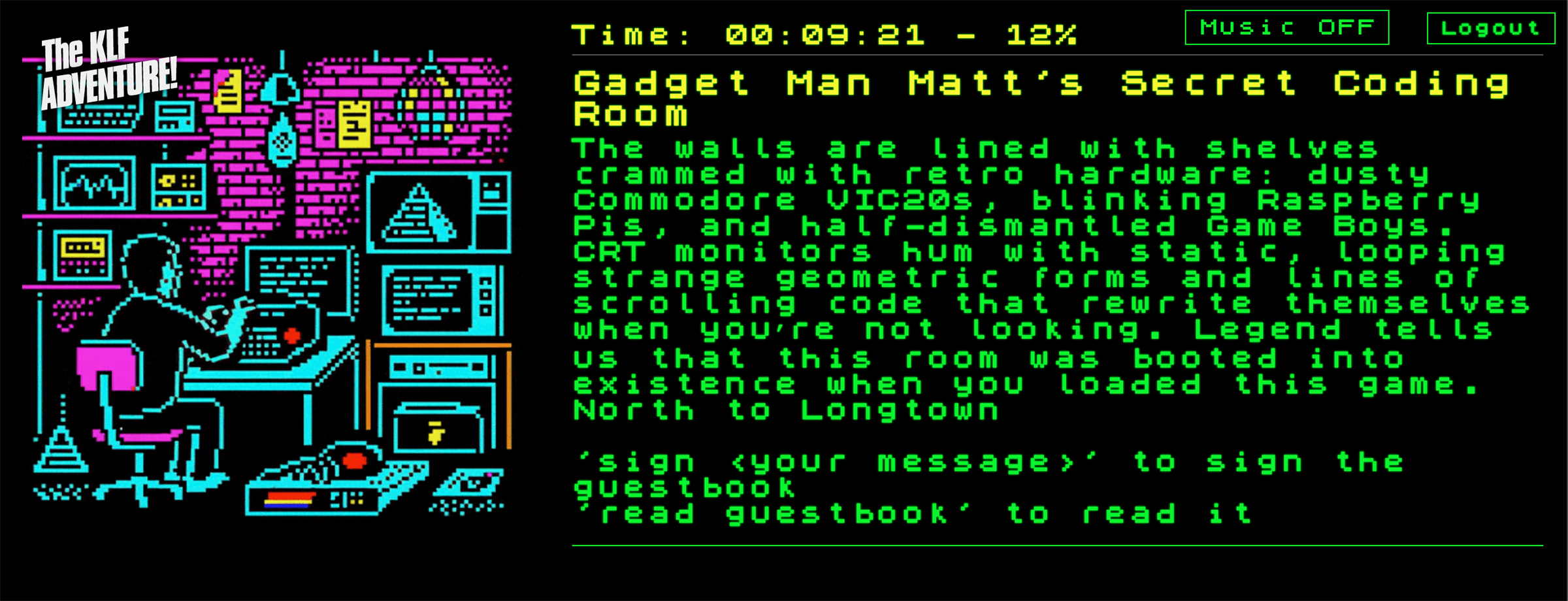
I didn’t just want to write about the 80s — I wanted it to feel like the 80s. So I coded the game in a modern environment but kept the old-school constraints: short descriptions, tight vocabulary, and a parser that understands commands like GO NORTH, GET TICKET, or SAY CHILLOUT.
Don’t get stuck in the record industry execs meeting!!!
But here’s the twist — I didn’t do it alone. My coding partners were Gemini CLI and OpenAI Codex, coding with me directly in my command line. The imagery was created using ChatGPT, with animations by Midjourney. The music came courtesy of Suno, while the sound effects were crafted by ElevenLabs. Together, these AI tools became my team of coders, designers, composers, and consultants, enabling me to bring this game to life in a way that would have been impossible on my own.
And because I couldn’t resist going full retro, I’ve also been experimenting with encoding the game into audio so it can be loaded into a ZX Spectrum emulator straight from a physical cassette tape. Because why not?
Timeslips abound in Bold Street with alternate timelines showing Mick Hucknall driving the Ice Kream Van!
The Result
What emerged is The KLF Adventure — part game, part interactive art piece, and part love letter to the days when imagination did the heavy lifting. It’s an 80s-inspired world you can explore, puzzle over, and get gloriously lost in. It rewards curiosity, nods knowingly to KLF lore, and might just make you say “What Time Is Love?” at least once.
For me, this wasn’t just a coding project. It was a way of reconnecting with that kid who sat cross-legged in front of a rubber-keyed Spectrum, waiting for the next adventure to begin. Only now, I’m the one writing the adventure — with a 21st-century team of AIs by my side.
You can even find me in the game… But where?
If you fancy diving in, the game is live at klfgame.co.uk. Just remember: keep your wits about you, don’t trust every whisper, and above all… CHILLOUT. Twice.