Category Archives: Gadget Man Projects

I Built Two AI Personalities That Sit on My Desk and Talk to Each Other

I’ve been experimenting with local AI for quite a while now, but this particular project has started to become something rather different.

I now have two AI personalities, called George and Lewis, running on two separate computers in my office.

They read the news.

They talk to each other about it.

They remember what they’ve discussed before.

They have different interests and personalities.

They can wander off topic.

And, as the day wears on, they actually start getting tired.

This may have got slightly out of hand.

Two Minds, One Desk

The idea started simply enough.

I already had Ollama running local large language models on a couple of machines on my network. Rather than asking one AI a question and getting an answer back, I wondered what would happen if I let two of them talk to each other.

So I wrote a Python program that acts as the producer sitting between them.

One machine runs George. The other runs Lewis.

George says something, the program sends that to Lewis, Lewis generates a reply, and the reply is passed back to George.

Neither conversation is written in advance.

I know what news story they are going to start with, but I don’t know what either of them is going to say.

That is where things started becoming interesting.

Meet George and Lewis

I deliberately didn’t want two identical AI assistants politely agreeing with each other.

George is British, dry, curious and slightly sceptical. He has a tendency to notice the absurd implications of technology and is particularly fond of things such as classic cars, retro computing, gadgets and space.


George is British, dry, curious and slightly sceptical. He has a tendency to notice the absurd implications of technology and is particularly fond of things such as classic cars, retro computing, gadgets and space.

Lewis is a little more mischievous. He tends to challenge George's conclusions and has stronger interests in AI, cybersecurity, science, networking and newer technology.
Lewis is a little more mischievous. He tends to challenge George’s conclusions and has stronger interests in AI, cybersecurity, science, networking and newer technology.

Lewis is a little more mischievous. He tends to challenge George’s conclusions and has stronger interests in AI, cybersecurity, science, networking and newer technology.

They aren’t supposed to argue simply for the sake of it, but neither are they encouraged to agree just to be polite.

That distinction makes an enormous difference.

A conversation can start with an announcement about a new electric car and end up somewhere around boxed computer software, Commodore machines and the questionable wisdom of connecting a toaster to Wi-Fi.

In other words, rather like an actual conversation.

There’s a Newsreader Too

Before George and Lewis start discussing anything, the software collects stories from RSS news feeds.

The curator or newsreader who selects the stories that Lewis and George discuss, her name is Kokoro

A selected headline and its summary are displayed on screen and then read aloud using Kokoro, a local text-to-speech system.

I’ve given the newsreader a British female voice, while George and Lewis have their own separate British male voices.

So the sequence sounds a little like an extremely small and slightly eccentric radio station.

The newsreader introduces the story, pauses, and then George reacts to it.

Lewis responds.

And off they go.

They Know What I’m Interested In

Rather than simply choosing every story at random, the software now has an interest profile.

It knows I’m particularly interested in subjects including:

AI and local language models, gadgets, computers, retro computing, classic cars, web development, drones, home networking, cybersecurity, broadcasting, space, photography, video, graphic novels, comics, Blender and 3D graphics, music technology, gaming and science.

Stories are scored according to how closely they match those subjects.

That doesn’t mean the system completely ignores everything else. I’ve deliberately left some randomness in there, because otherwise it would rapidly become an automated echo chamber.

Sometimes it should find something none of us expected to be interesting.

George and Lewis also have their own individual preferences, so occasionally one of them effectively gets a story that is much more “his sort of thing” than the other’s.

Then I Gave Them a Memory

This was probably the point where it stopped feeling like a normal chatbot experiment.

The system now uses an SQLite database to remember what has happened.

It stores the news stories they’ve discussed, previous conversations, individual things George and Lewis have said, and condensed memories of earlier discussions.

This serves several purposes.

Firstly, it prevents them repeatedly discussing the same news story just because it appears in a feed again with slightly different wording.

Secondly, when a genuinely new development appears in a story they’ve previously discussed, they can remember the earlier conversation.

So instead of starting again from scratch, George might effectively say:

“We said this was going to happen.”

And Lewis might point out that George actually said something rather less definite at the time.

That’s when they start becoming recurring characters rather than disposable chatbot sessions.

Conversations Can Drift

Humans rarely stay perfectly on subject.

We might start talking about a new iPhone and somehow arrive at cassette recorders ten minutes later.

George and Lewis can now do the same thing.

Early in a conversation they stay reasonably close to the news story. As things progress, related subjects and older memories can begin appearing in their context.

Crucially, they’re not instructed to suddenly announce:

“According to our previous conversation…”

Instead, an old memory is simply made available as something they might naturally be reminded of.

Sometimes they use it.

Sometimes they don’t.

That makes callbacks much less mechanical.

They Also Know When They’ve Run Out of Things to Say

An earlier version simply ran for a fixed number of exchanges.

That worked, but it didn’t sound natural.

Eventually you get:

“That’s a good point.”

“Indeed.”

“Absolutely.”

Which is conversational purgatory.

The new system lets them decide whether there is genuinely anything new worth adding.

After a minimum amount of conversation, the next speaker can privately decide to continue or stop.

The Python program also checks new responses against previous remarks and can reject something that is effectively just a repetition.

So some conversations last a while.

Others end after only a handful of comments.

And Then I Made Them Tired

This is probably my favourite unnecessary feature.

The system periodically checks the actual UK time and alters George and Lewis’s behaviour throughout the day. It uses the Europe/London timezone and can fall back to the computer’s clock if the online time check is unavailable.

During the day they’re fully awake.

As evening arrives, they gradually become less enthusiastic about pursuing every conversational tangent.

By around 11pm they’re noticeably tired and much more willing to call an end to a discussion.

After midnight, there’s a very good chance they simply won’t want to start another conversation at all.

They may yawn, decide they’ve had enough or effectively go to bed.

At six in the morning they’re bleary-eyed and coffee becomes a perfectly reasonable thought.

By seven, they’re waking up again.

The important distinction is that this isn’t just the AI being told to say that it’s tired.

The software itself alters maximum conversation lengths, pauses and the probability of conversations ending according to the time of day.

The project relies on vast amounts of data

Everything Is Running Locally

One aspect I particularly like is that George and Lewis aren’t remote characters sitting somewhere in a cloud service.

The language models are running locally on my own computers using Ollama.

The voices are generated locally with Kokoro.

The memory is stored locally in SQLite.

The Python application connects all of those pieces together.

That makes it a rather good example of what can now be built from consumer hardware and freely available AI tools.

Where This Is Going

There are plenty of possibilities.

I could broaden the news sources into motoring, space, drones, cybersecurity, classic computing and gaming.

They could become aware of local weather.

They could notice when one of my servers goes offline.

They could comment on things happening on the network.

Their opinions could gradually evolve.

They could develop running jokes.

They could even start remembering predictions they’ve made and later discover which one of them was right.

What began as “can I make two Ollama instances talk to each other?” is slowly turning into something closer to two persistent artificial characters occupying a corner of the office.
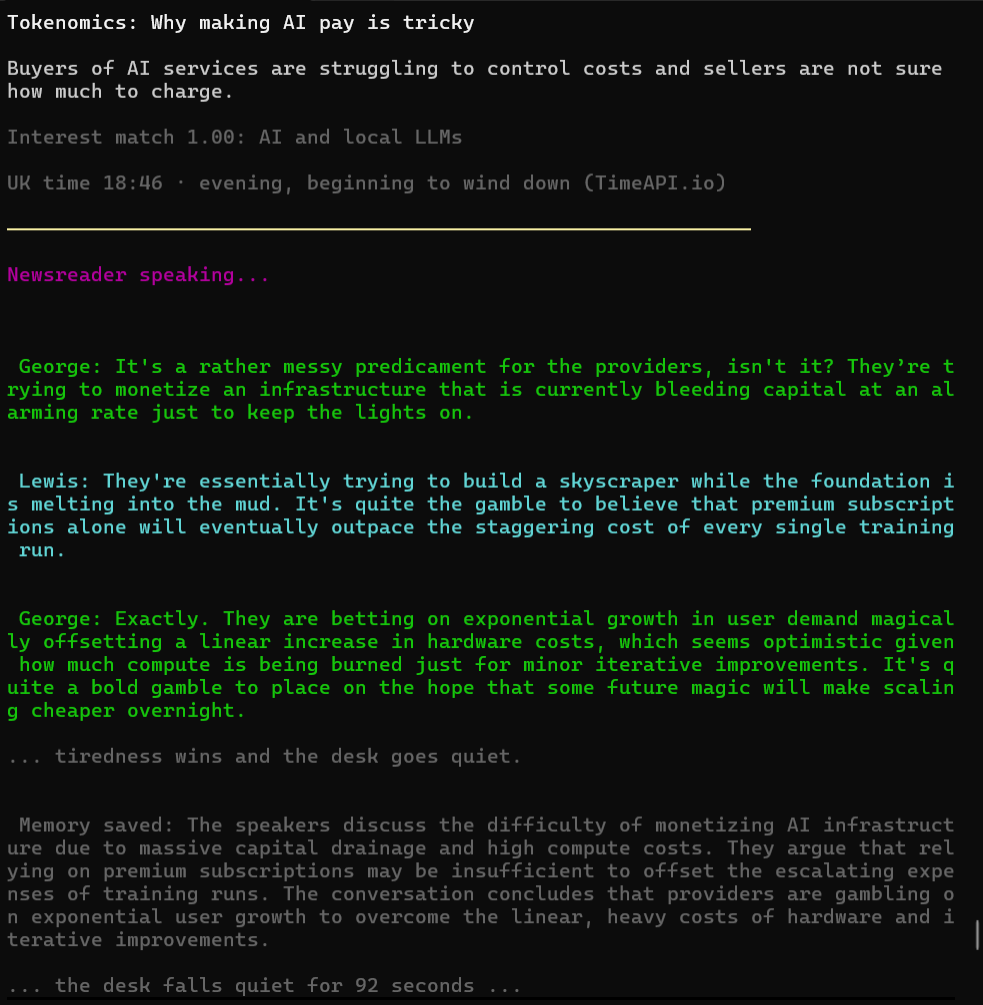
©2026 Matt Porter. A screenprint of one of the many conversations,

They’re not conscious.

They’re not alive.

They’re two language models, a Python program, a text-to-speech engine and an SQLite database.

But when one of them remembers something the other said yesterday, challenges him about it, wanders completely off topic and then decides it’s too late at night to continue arguing about smart kettles…

It can feel surprisingly convincing.

And I suspect George and Lewis are only just getting started.

Just like us, George and Lewis get tired and need a bit of down time.

Becoming a Highwayman: How I Put Myself Inside an Inkantation Graphic Novel

One of the most enjoyable things about developing new technology is reaching the point where you can stop asking, “Will this work?” and begin asking, “What else could we do with it?”

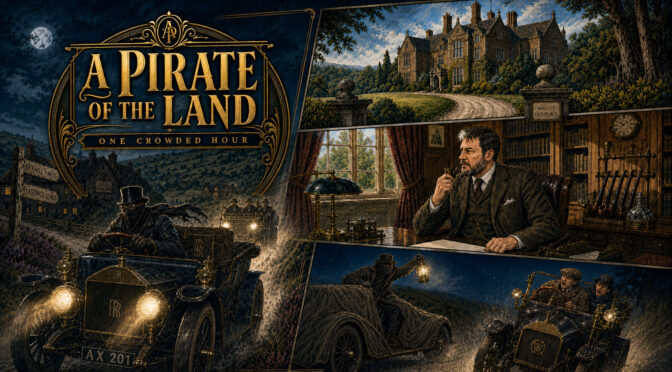
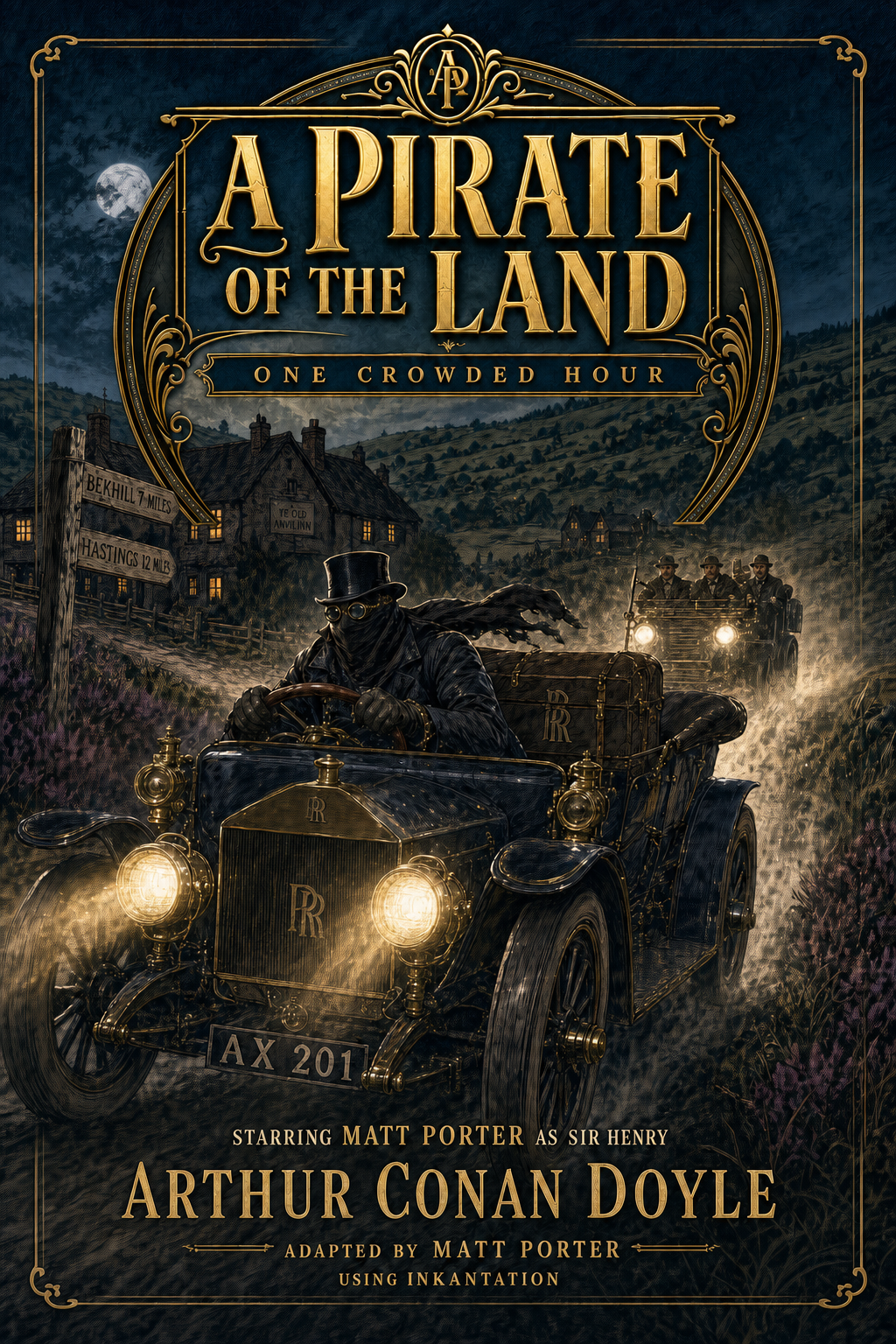
My latest experiment with Inkantation, the graphic novel creation system I have been developing, involved adapting the classic tale A Pirate of the Land: One Crowded Hour. However, this time I decided to take the experiment a little further.

I put myself into the story.

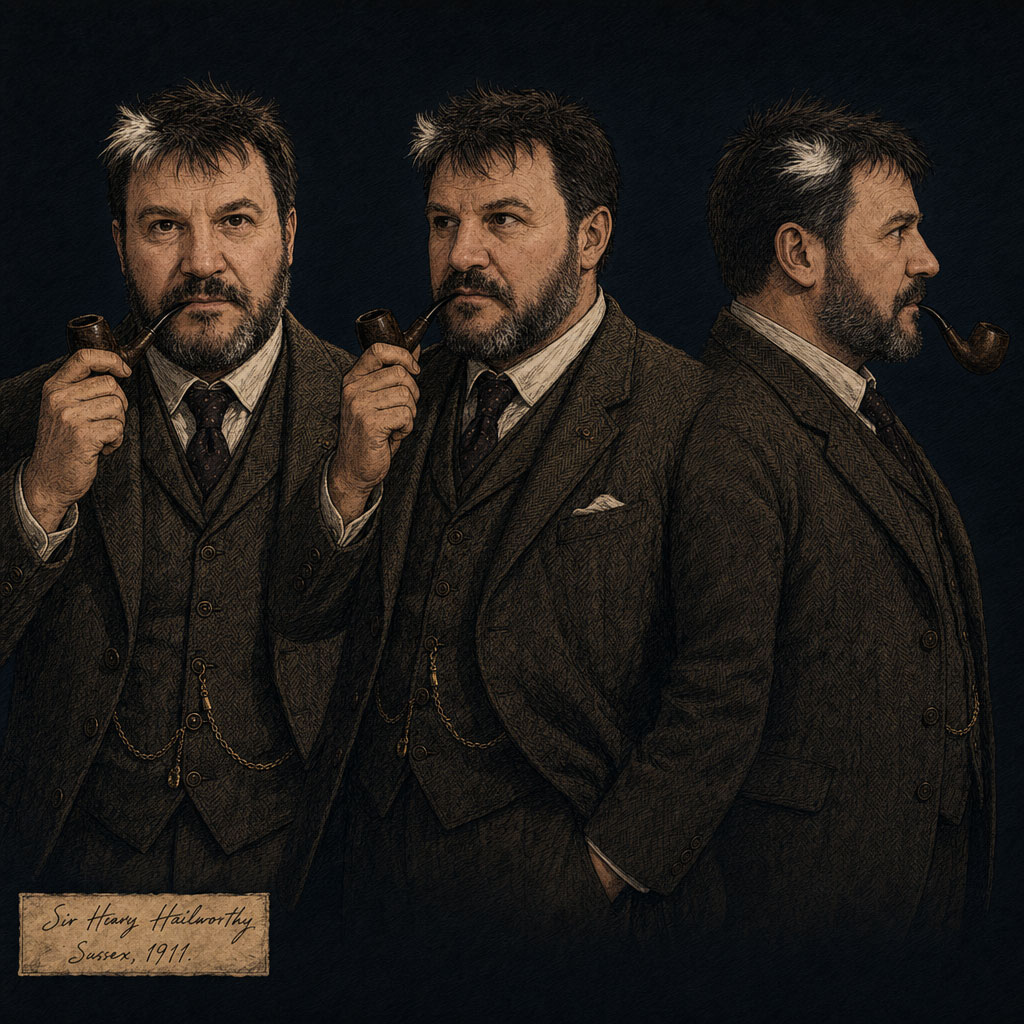
Not merely as a background character, an anonymous face in a crowd or an unfortunate passer-by. I cast myself as Sir Henry Hailworthy, the wealthy Edwardian gentleman at the centre of the tale, who also happens to have a rather dramatic secret life as a modern-day highwayman.

Becoming a Highwayman: How I Put Myself Inside an Inkantation Graphic Novel

A Pirate on the Roads of Edwardian England

A Pirate of the Land: One Crowded Hour is set during the early days of motoring, when motor cars were still magnificent, temperamental machines and the sight of one roaring along a lonely country road could be an event in itself.

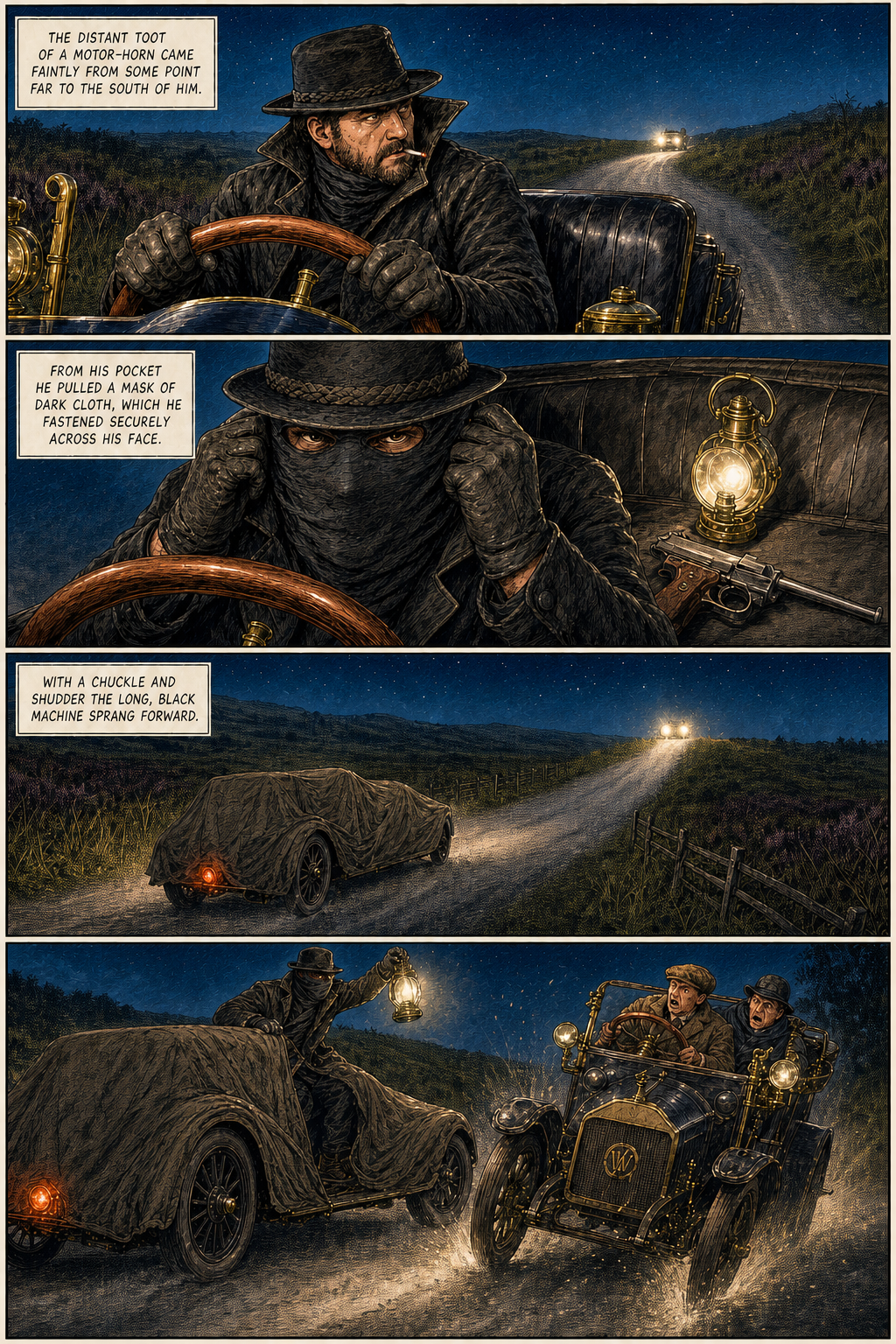
The story opens on the Eastbourne to Tunbridge road late on a Sunday night. A mysterious Rolls-Royce, partly concealed beneath brown fabric, prowls through the darkness. Its broad, burly driver wears a Tyrolean hat, a heavy coat and, when another motorist approaches, a dark cloth mask.

Armed with a long-barrelled Mauser pistol, he becomes a highwayman for the motor age.

He stops an elderly Wolseley, confronts a young motorist named Ronald Barker, encounters two actresses travelling in a Humber and finally targets the man he has really come to find, a wealthy financier whose actions have ruined the lives of others.

The finished Inkantation script runs to 21 graphic novel pages and uses 22 individually planned assets, including characters, vehicles, props and locations. These range from the masked highwayman and his concealed Rolls-Royce to Edwardian studies, country roads, jewellery, packages, pistols and the wonderfully imposing sixty-horsepower Daimler limousine.

Turning the Story into a Graphic Novel

Inkantation does not simply take a piece of prose and create a random collection of illustrated pages.

The first stage is adaptation.

The original story is analysed and reorganised into a structured graphic novel script. Each page is divided into panels, with descriptions covering the viewpoint, composition, lighting, expressions, action, captions and dialogue.

For example, the opening page contains three panels. The first establishes the lonely road and the approaching Rolls-Royce. The second moves closer to reveal the strange fabric concealing the vehicle. The third introduces the driver, hunched over the wheel with the glowing ember of a cigarette beneath the brim of his hat.

This creates a cinematic progression from landscape, to vehicle, to character.

Before the finished panels can be produced, Inkantation creates an asset catalogue. Every important character, location, vehicle and object receives its own detailed reference description. This is vital because a graphic novel depends upon visual continuity.

Ronald Barker must look like Ronald Barker every time he appears. The Rolls-Royce must remain recognisable from panel to panel. Sir Henry’s study needs to feel like the same room, whether it is shown in a wide establishing shot or as the background to an intense conversation.

Without that preparation, characters can subtly change faces, costumes, ages and proportions from one page to the next.

Becoming a Highwayman: How I Put Myself Inside an Inkantation Graphic Novel

Casting Myself as Sir Henry Hailworthy

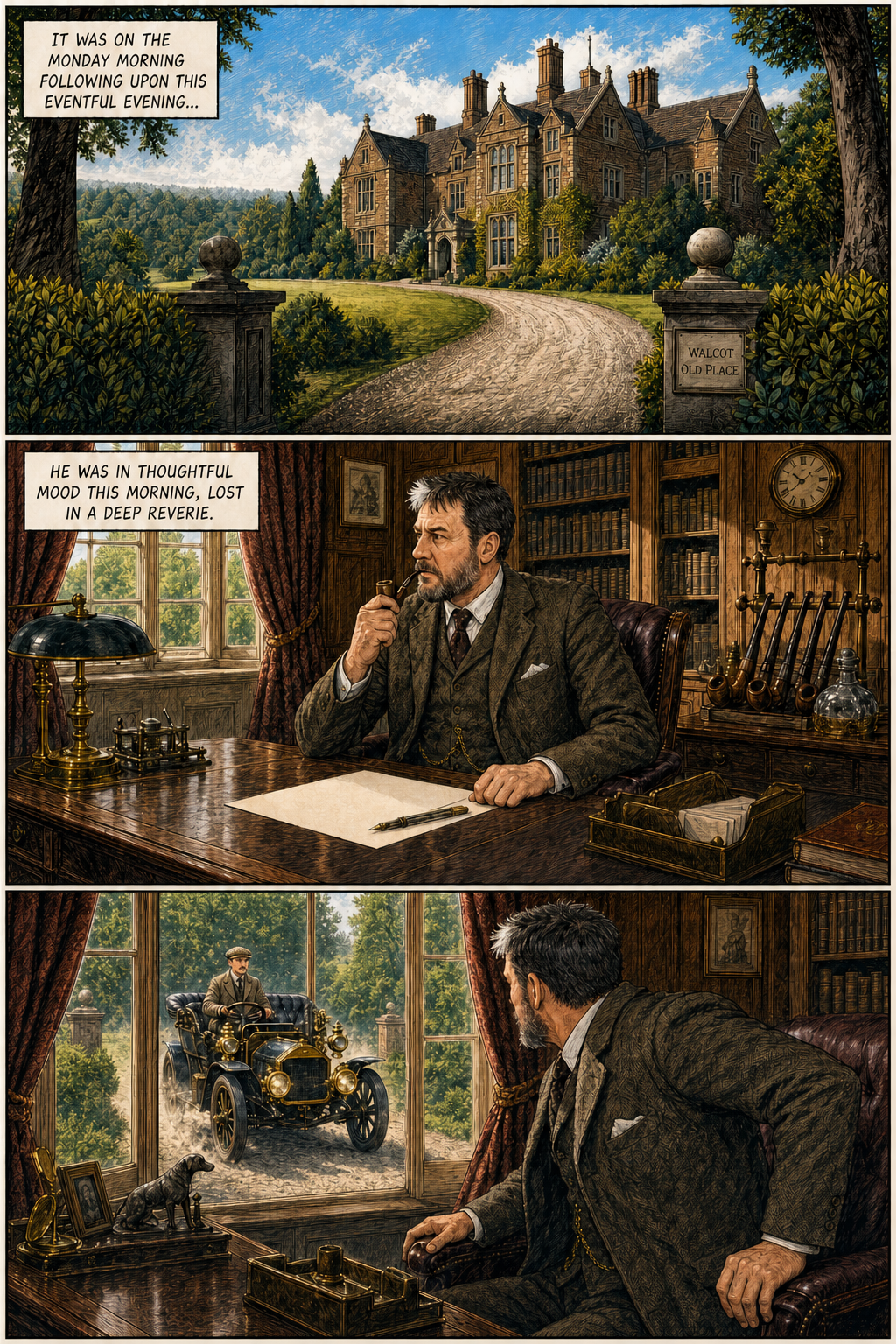
For this particular book, I manually added myself to the production process and used my own appearance as the basis for Sir Henry Hailworthy.

Sir Henry is described in the Inkantation asset catalogue as a stocky, bearded Edwardian gentleman in a well-cut tweed country suit, usually seen with a pipe in his study. Most importantly, his build must also be consistent with the mysterious highwayman encountered earlier in the story.

This meant I was effectively being cast in two connected roles: the respectable country gentleman and the masked figure stalking the roads at night.

There was something wonderfully entertaining about seeing a version of myself transported into Edwardian England, sitting behind a mahogany desk, confronting an angry visitor and attempting to explain why I had spent the previous evening robbing motorists at gunpoint.

It also presented an interesting technical challenge.

It is relatively straightforward to create a single stylised portrait of a person. It is much harder to preserve that identity through multiple panels, facial expressions, viewpoints, costumes and lighting conditions.

A character may be seen seated at a desk in one panel, turning towards a window in another and confronting someone across a room in the next. In the highwayman sequences, the same character is partly hidden beneath a hat, heavy coat and mask.

The visual system still needs to give the reader enough clues to believe that these are the same person.

Becoming a Highwayman: How I Put Myself Inside an Inkantation Graphic Novel

More Than a Personal Cameo

Adding myself to the book was partly for fun, but it was also a genuine product experiment.

Would readers pay to appear in a graphic novel?

Personalisation already exists in children’s books, where a child’s name may be inserted into a story. Inkantation potentially takes that idea much further. Rather than simply changing a name, a customer could be visually cast as a character throughout an illustrated narrative.

Someone could become a detective in a Victorian mystery, the captain of a pirate ship, an explorer on another planet or, as in my case, an Edwardian gentleman with a concealed life of motorised crime.

It could also work as a highly unusual gift.

Imagine presenting someone with a professionally printed graphic novel in which they are the hero, villain or eccentric supporting character. Couples could appear together in a romantic adventure. A family could be placed inside a fantasy story. A business could even commission a graphic novel featuring members of its own team for training, promotion or an anniversary celebration.

Naturally, there are questions still to explore.

How much personalisation would someone want? Would they prefer to play the hero, or would being the villain be more entertaining? Should the story be selected from an existing catalogue, or written especially for them? How closely should the artwork resemble the real person, and how much should it embrace the graphic novel style?

These are exactly the kinds of questions that experiments are designed to answer.

Combining Art, Storytelling and Technology

Inkantation brings together several areas that have interested me throughout my life.

I have been drawing and creating characters for around 50 years. I have also spent more than 20 years running a web design and technology business. Graphic novels allow those two worlds to meet.

The system handles the complex production work, including script preparation, asset management, visual consistency, panel generation, dialogue placement and page assembly. However, the creative decisions still matter.

Which moment deserves a full-width panel? When should the reader see a close-up? How much of the original narration should remain? What expression should a character have? Where should a page end to encourage the reader to turn over?

Technology can help produce the images, but storytelling remains at the heart of the process.

One Crowded Hour

The title comes from Sir Henry’s own excitement when the adventure is over. Despite promising never to repeat it, he admits that his brief career as a highwayman was exhilarating.

He describes it as one crowded hour of glorious life.

That line also feels appropriate for my experience of making the book. For a brief period, I was no longer sitting at my computer working on a graphic novel system.

I was Sir Henry Hailworthy.

I had a Rolls-Royce hidden beneath brown fabric, a Mauser pistol in my hand and unfinished business waiting on a lonely road.

Whether people will pay for the opportunity to star in their own graphic novel remains to be seen, but as an experiment it has opened another fascinating possibility for Inkantation.

And I must admit, seeing yourself revealed as the mysterious highwayman is considerably more exciting than appearing in the background of a holiday photograph.

You can purchase A Pirate of the Land : One Crowded Hour is available to download in Kindle format

The Pub That Became My House: The Woodbines and the Three Horse Shoes

Regular readers will know this blog usually concerns itself with things that have plugs, screens, or at the very least an exciting number of megapixels. Bear with me, then, because this post is about a Victorian pub. It is also, I promise, a gadget story — because everything you’re about to read was uncovered in a single evening, from the sofa, on a phone, well past midnight. No archives were visited. No white gloves were worn. There’s a roundup of the tools that did the heavy lifting at the end, in case you fancy turning detective on your own four walls.

First, though, the pub.

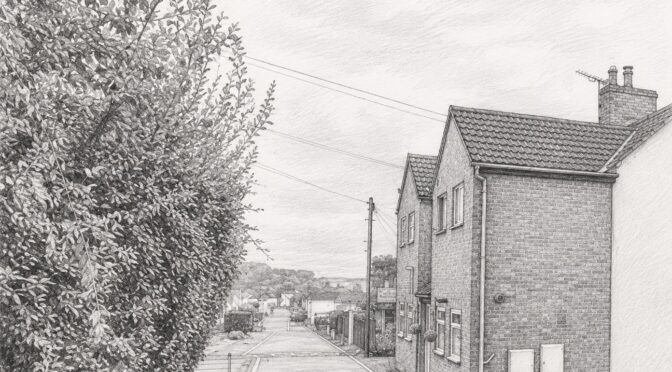
I used to live in one. I should clarify that before anyone gets the wrong idea — by the time I moved in, it had been a perfectly respectable house for decades. But the building at 38 and 39 Long Close, Lower Stondon — both halves called Rose Cottage — spent the first part of its life as the Three Horse Shoes public house. And the story of how a village pub became a pair of cottages turns out to be the story of one remarkable family, a prize cabbage, a misleading photograph, and very nearly the story of an entire street.

A photograph that lies

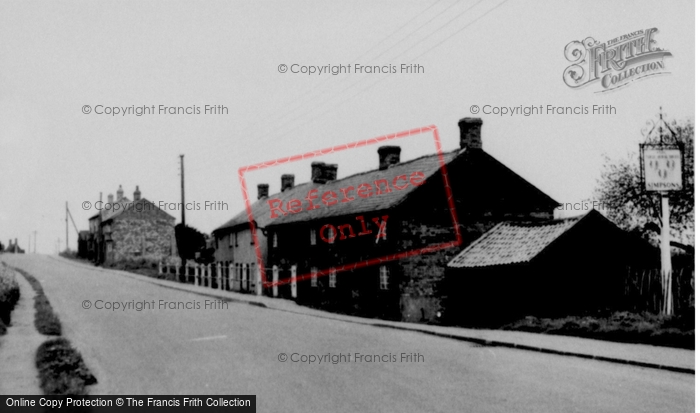
If you go looking for the Three Horse Shoes, the first thing you’ll find is a photograph in the Francis Frith Collection, labelled “The Three Horse Shoes c.1955, Lower Stondon” (ref. L213010). It’s a lovely image. It’s also, in one important respect, wrong.

What the photographer actually captured was the pub sign, which stood out on Station Road at the entrance to what is now Long Close. The pub itself sat further down, set well back from the road — you can see it plainly marked “Three Horseshoes (P.H.)” on the old Ordnance Survey maps, a comfortable distance from where the sign caught the eye of passing trade.

And remarkably, this arrangement was confusing people long before any photographer turned up. At the Ampthill licensing sessions, when the tenant of Stondon’s Red Lion applied for a Sunday licence and the Three Horseshoes objected, his solicitor complained that the magistrates had misunderstood the position of the two houses — because the Three Horseshoes, “though having a sign on the main road, was yet forty yards away down a tortuous lane.” There it is, in sworn evidence: sign on the main road, pub forty yards down the lane. The very lane, give or take a few park homes, that is now Long Close.

A sensible bit of marketing in its day, then. A century-long red herring for anyone researching it since. I know this because I lived in the building, and I’m setting it down here so the next person to find that photograph doesn’t go hunting in the wrong spot.

The Woodbines

The earliest licensee I’ve traced is Emery Cooper, a Stondon man all his life and Chief Ranger of the Foresters at Shillington Lodge. He died on 2 March 1933, aged seventy-two, and his funeral report records that he had kept the Three Horse-shoes until a few years before — placing his retirement from the pub in the late 1920s, just as the next chapter was about to begin.

But the family whose name runs through the pub’s final decades is the Woodbines. John Woodbine was born at March in Cambridgeshire and came to Stondon around 1910, working first for Tom Simkins and then for the Bedfordshire County Council for twenty-five years. He and his wife Rosina — Stondon born and bred — took on the Three Horse Shoes around 1930, and John was its proprietor for twenty-four years. The 1939 Register duly finds the family at “2, Three Horse Shoes, Station Road, Lower Stondon.”

John was, by all accounts, a well-known figure in the district, and his chief passion was the garden. The year before he died he grew the largest cabbage ever seen in the district — it weighed twenty-eight and a half pounds, and the local paper thought it worth recording in his obituary. Quite right too.

John Woodbine died at the Three Horseshoes on 20 September 1954, aged sixty-nine. And here the arithmetic gets satisfying: Rosina’s own obituary, years later, records that she was licensee for twenty-seven years until the pub closed. Twenty-seven years from 1930 lands at 1957 — and sure enough, a court report from 1957 still gives “The Three Horseshoes, Lower Stondon” as a working address. So the picture comes into focus: the widowed Rosina carried on as landlady in her own right for about three years after John’s death, and called last orders for the final time around 1957. The Frith photographer, whether he knew it or not, caught the sign in the pub’s last trading years.

The pub makes the papers

The Three Horse Shoes had its moment of notoriety in 1948, when it managed to appear before the Ampthill magistrates twice in quick succession.

In September of that year, a lodger at the pub — Michael Maroney, a twenty-seven-year-old painter — was fined for assaulting a builder named Alan Cooper. The dispute was over twelve shillings in wages, and it ended with Cooper invited into the pub’s scullery, grabbed by the waistcoat, told “You are going to have this,” and struck over the eye. The papers gave it the immortal headline “ASSAULT IN A SCULLERY: MAN FINED.” For good measure, Maroney also admitted stealing two bottles of gin, valued at £2 18s — the property of one Rosina Woodbine. He was fined for both, his solicitor explaining that he had been under the influence of drink at the time, which, given where he was living, can’t have come as an enormous surprise to anyone.

Rosina herself gave evidence in the case. Earlier the same summer, the family had been through a far less comic episode, when an airman from the camp stood trial — and was acquitted — over an alleged assault on the Woodbines’ twenty-year-old daughter Joan, who lived at the inn with her parents.

And Maroney? Here’s the thing about village life. Six years later, there he is in the list of mourners at John Woodbine’s funeral — still lodging at the Three Horseshoes, gin theft evidently long forgiven. He wasn’t entirely reformed, mind: he later found himself remanded at a special Ampthill Magistrates’ Court over a pound taken from a neighbour’s house down Fakeswell Lane, having told the police, with a certain weary candour, “All right. I’ll tell you about it. I took a pound.” His address was still given as the Three Horseshoes. Some lodgers come with the fixtures and fittings.

The pub becomes a house — and a street

When the Three Horse Shoes closed around 1957, Rosina didn’t leave. The solid-walled old pub became her home, renamed Rose Cottage — and you don’t need to squint very hard to see the landlady’s own name softened into the house’s. Rosina’s cottage. Rose Cottage. Seventy years on, the connection is all but invisible unless someone tells you.

Her obituary adds the detail that ties everything together: when the pub closed, the land around it was made into a caravan park. That caravan park is what grew into the residential park home site at Long Close — the very lane whose entrance the old pub sign once marked. The Three Horse Shoes didn’t just become a house. In a roundabout way, it became the whole street.

Rosina Woodbine died at Rose Cottage on 6 November 1978, aged 81, and was buried at Stondon church that week — a well-known resident, as the paper put it, who was born in the village and never left it. Some time after, the old building was extended towards the road and divided into two houses, numbers 38 and 39, both keeping the Rose Cottage name. One of them, years later, had me in it.

A small correction to the record

So if you ever come across that Frith photograph, now you know: the sign stood at the entrance to Long Close, the pub stood forty yards down the lane, and behind both stood the Woodbines — John with his prodigious cabbages, Rosina the landlady of twenty-seven years, and the quiet reason a house called Rose Cottage exists at all.

Lower Stondon’s history is famously hard to pin down — the village spent a century buried in Shillington’s records, and even the Parish Council admits the cupboard is rather bare. Consider this one small jar put back on the shelf.

The Gadget Man bit: how it was done

As promised, the tools. Because the genuinely remarkable thing about this story isn’t the cabbage — though it’s a close-run thing — it’s that a hundred years of a building’s history can now be reassembled in an evening, in bed, on a phone.

The workhorse was Findmypast and its digitised British newspaper archive. Type a name like “Rosina Woodbine” or “Three Horseshoes Stondon” into the search box and decades of local papers — the courts, the funerals, the prize vegetables — surface in seconds, each one searchable, highlightable, and clippable. This is the stuff that, twenty years ago, meant a day at the county archives winding through microfilm with a bag of pound coins for the printer. The 1939 Register on the same site did something quietly brilliant: it didn’t just list the family at “2, Three Horse Shoes, Station Road”, it overlaid their address on a historical Ordnance Survey map — which is how the pub’s true position, forty yards down the lane, jumped off the screen.

The Francis Frith Collection (francisfrith.com) supplied the photograph that started it all — free to browse, and with a memories feature where locals can correct the record, which I intend to do. And I’ll admit to a research assistant: I bounced findings off Claude, an AI chatbot, as I went — it helped join the dots between clippings, spotted that 1930 plus twenty-seven years of Rosina’s licence landed precisely on the 1957 court report, and generally played the role of an enthusiastic colleague who never needs a tea break.

Total cost: a Findmypast subscription and a late night. Total equipment: one phone. If your house is more than a lifetime old, somebody’s story is sitting in those archives waiting for you. Go and find them.


Sources: Francis Frith Collection ref. L213010; 1939 Register (RG101/1995C/020/30); Ampthill Division licensing sessions report (Red Lion seven-day licence application); Bedfordshire press reports, September 1948; Hertfordshire Express, 1 October 1954 (obituary of John Woodbine); Bedfordshire Times and Independent, 10 March 1933 (funeral of Emery Cooper); Bedfordshire press, 1957; obituary and funeral reports of Rosina Woodbine, November 1978; Ordnance Survey mapping; and the author’s own knowledge of the building.

I created my own awesome comic strip using ChatGPT

Every now and again, a piece of technology comes along that makes me grin like a child who has just found a secret compartment in a toy robot. This week, that technology was ChatGPT image generation.

I started with a simple idea: what if The Gadget Man was not just a blog, a podcast, or a bloke surrounded by cables, 3D printers, strange gadgets and half-finished ideas, but an actual comic book hero?

Not a cape-wearing superhero. Not someone bitten by a radioactive soldering iron. Just a gadget-loving chap with a cup of tea, a slightly dangerous number of ideas, and the ability to solve problems with technology, common sense and the occasional dramatic pose.

So I gave ChatGPT a photo of myself and typed the following prompt:

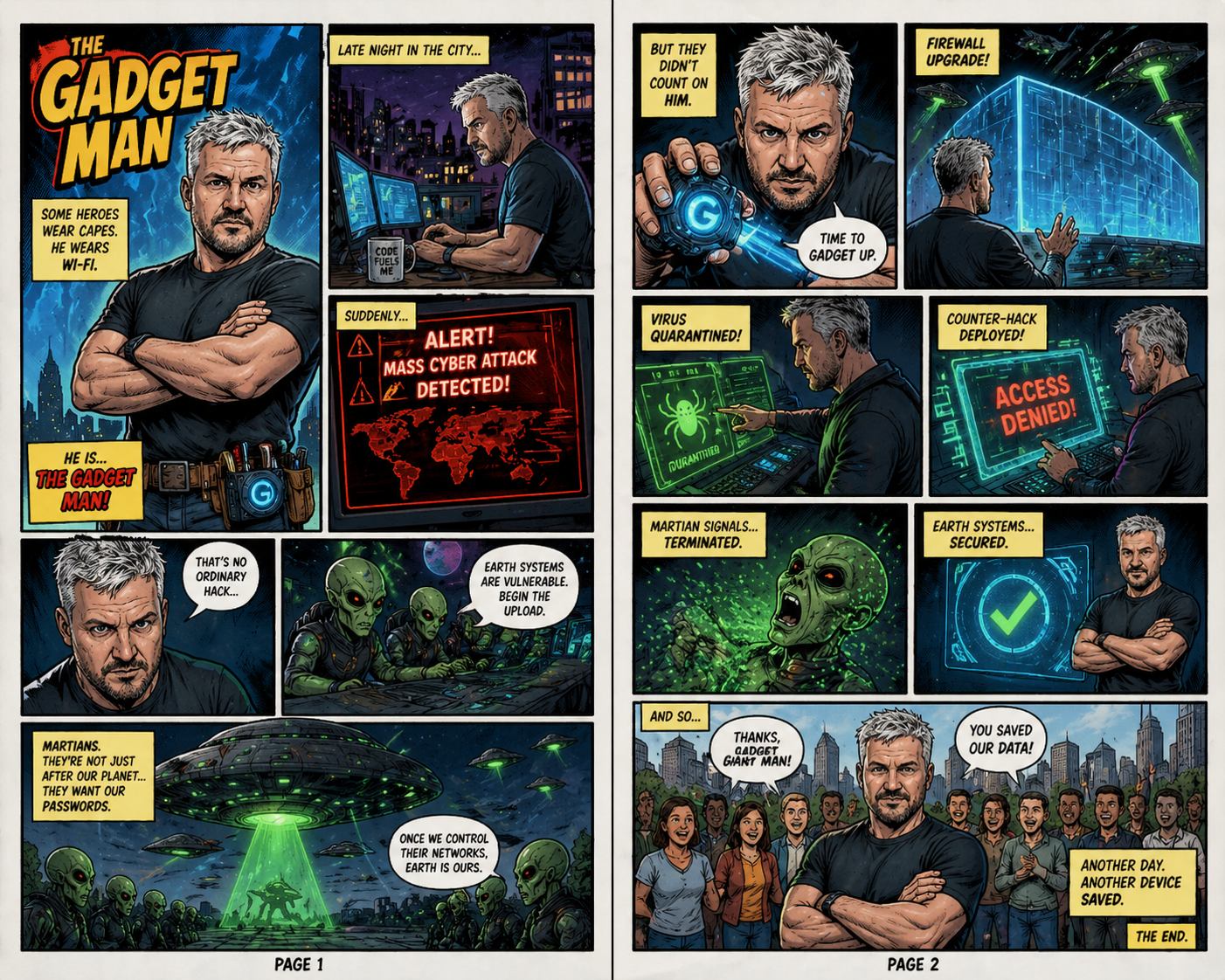
This is The Gadget Man, create a 2 page american style comic strip about him stopping a cyber attack by martians

First Draft of The Gadget Man

And there it was. A full two-page comic book spread featuring The Gadget Man battling Martians who were attempting to take over Earth’s systems. It had panels, speech bubbles, glowing screens, alien spaceships, dramatic lighting, and just the right amount of over-the-top comic book nonsense.

There was one small problem. In the final panel, instead of the crowd saying “Thanks Gadget Man!”, the speech bubble said “Thanks Gadget Giant Man!”

So I simply replied:

the last panel says THANKS GADGET GIANT MAN!, it should say THANKS GADGET MAN!

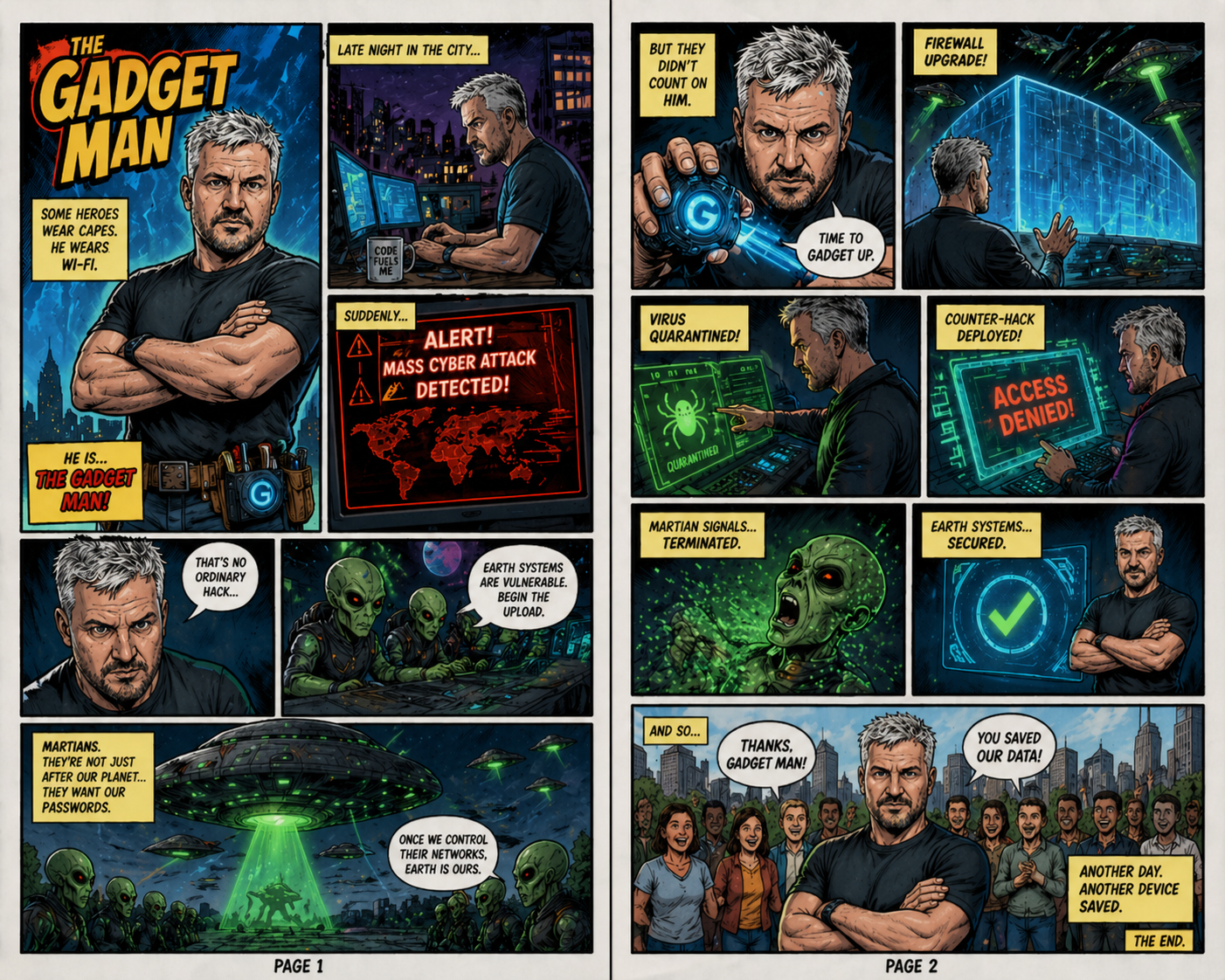
And ChatGPT corrected it.

The Gadget Man and The Alien Cyber Attack

That was the moment it really clicked. This was not just asking a computer to make a picture. This was creative direction. I could guide the scene, spot issues, refine the result, and build a series.

The Gadget Man Comic Universe Begins

Once the first comic was created, I did what any sensible adult would do. I immediately made several more.

The next prompt was:

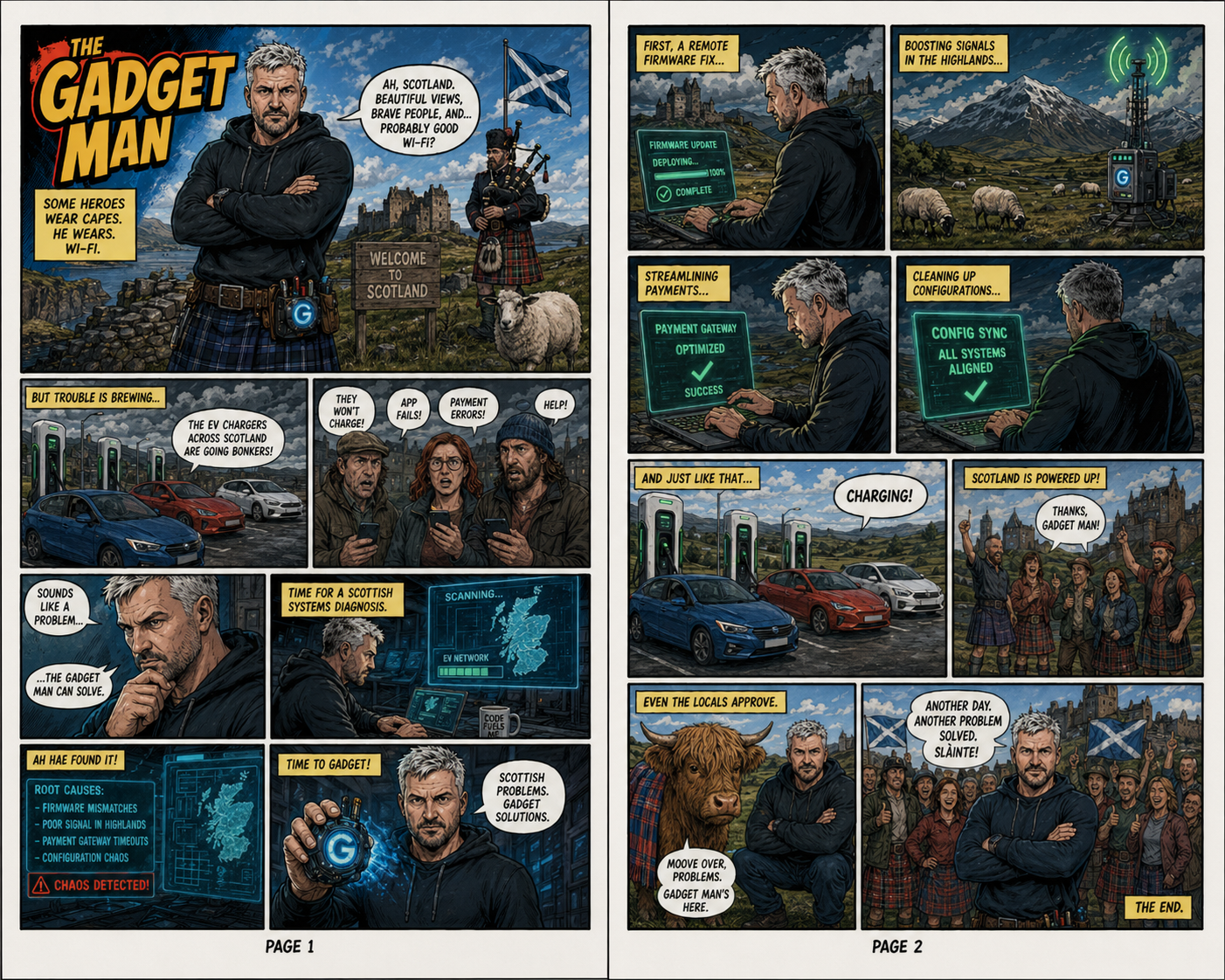
Excellent, create another comic about Gadget Man visiting Scotland and saving them from EV Charger problems

The Gadget Man and the Mystery of the Scottish EV Chargers

This produced a wonderfully ridiculous adventure in which The Gadget Man travels north of the border to rescue Scotland from faulty EV chargers, broken apps, signal problems and confused motorists. There were Highland cows, charging stations, Scottish scenery, and, naturally, the sort of technological tinkering that saves the day.

Then came one of my favourites:

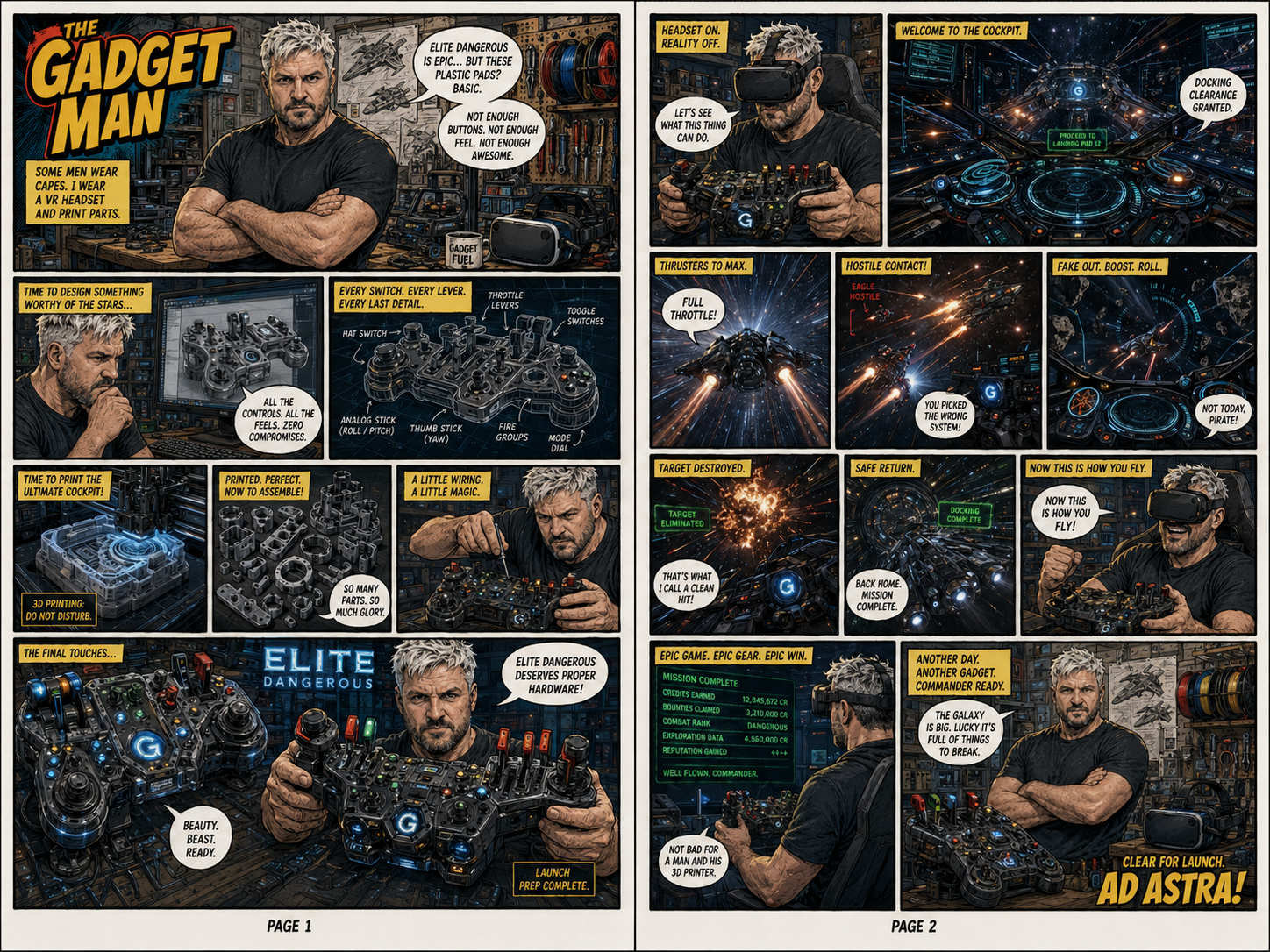
Create another comic featuring Gadget Man 3d Printing an elaborate controller for use with his VR headset to play Elite Dangerous

The Gadget Man and the 3d Printed Elite Dangerous Controller

This one was pure Gadget Man territory. 3D printing, VR, Elite Dangerous, switches, buttons, joysticks, wiring, and a controller that looked as though it had been designed by someone who had spent far too long thinking, “You know what this game needs? More buttons.”

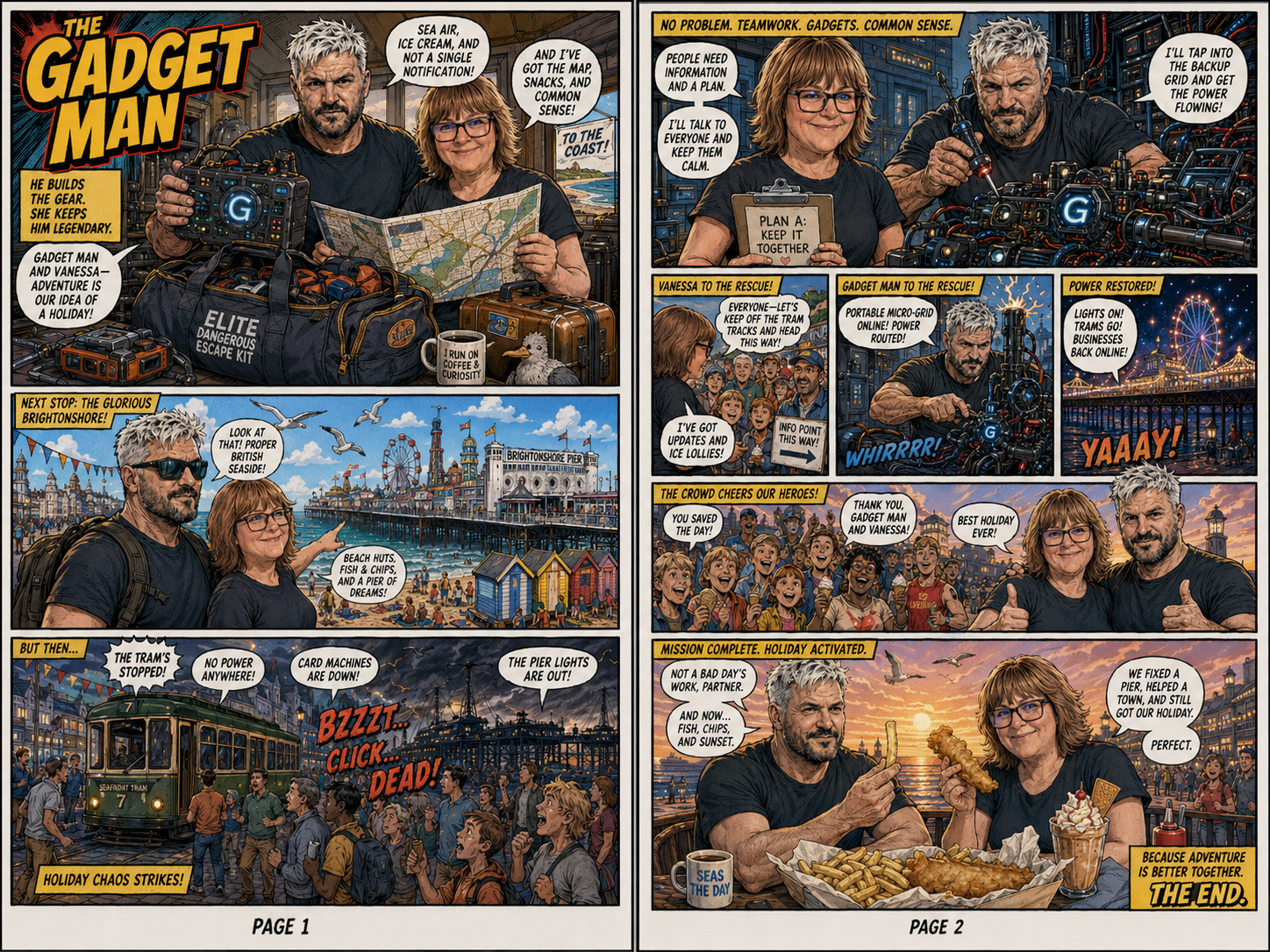
After that, Vanessa joined the adventure.

Create another comic featuring Gadget Man and his sidekick wife Vanessa. Their adventure is finally getting away for a break at the coast

Gadget Man and Vanessa go to the Coast

The result was a seaside adventure featuring Gadget Man and Vanessa finally escaping for a well-earned break, only to find that even a trip to the coast can turn into a heroic mission when technology, transport and holiday chaos collide.

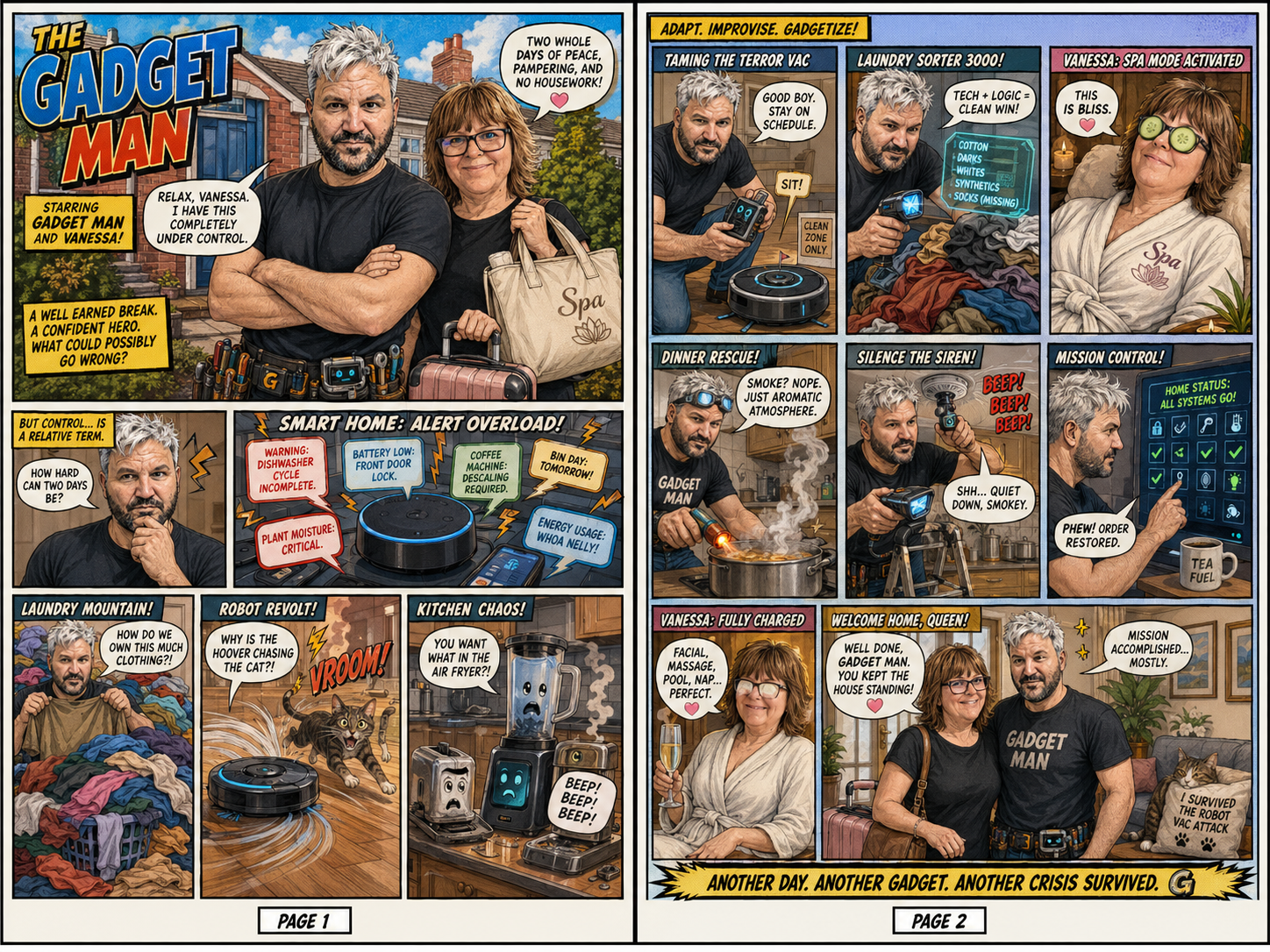
Of course, Vanessa deserved a break from all this madness, so I followed up with:

Create another comic featuring Gadget Man looking after the house whilst Vanessa spends two well deserved days at a Spa Retreat

The Gadget Man: Vanessa goes to the Spa

This produced a domestic disaster story full of smart home alerts, robot vacuums, laundry mountains, kitchen chaos and Gadget Man attempting to maintain order while Vanessa relaxed in peace. In other words, science fiction with a suspicious amount of truth in it.

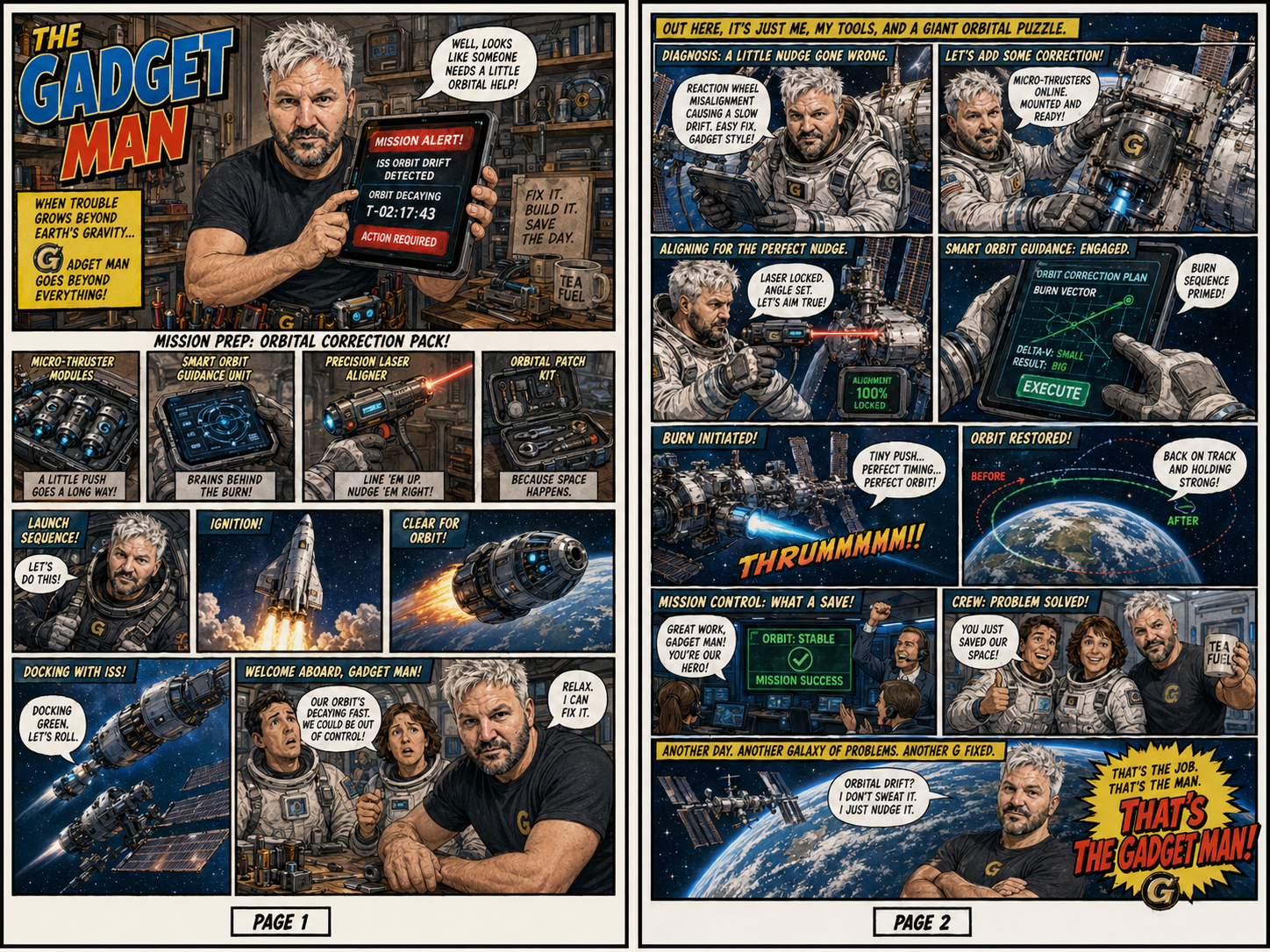
Finally, I went bigger. Much bigger.

create another comic book featuring Gadget Man. This time he goes to the ISS to correct it’s orbit

The Gadget Man Saves the ISS

Yes, The Gadget Man went to space. The International Space Station had an orbital problem, and naturally the only person qualified to give it “a little nudge” was a man with a tool belt, a mug of tea, and an alarming level of confidence.

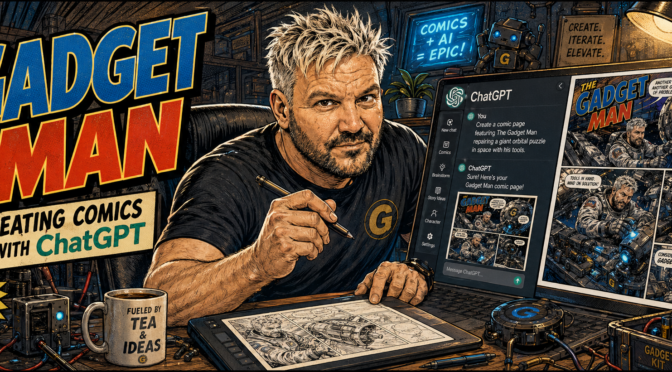
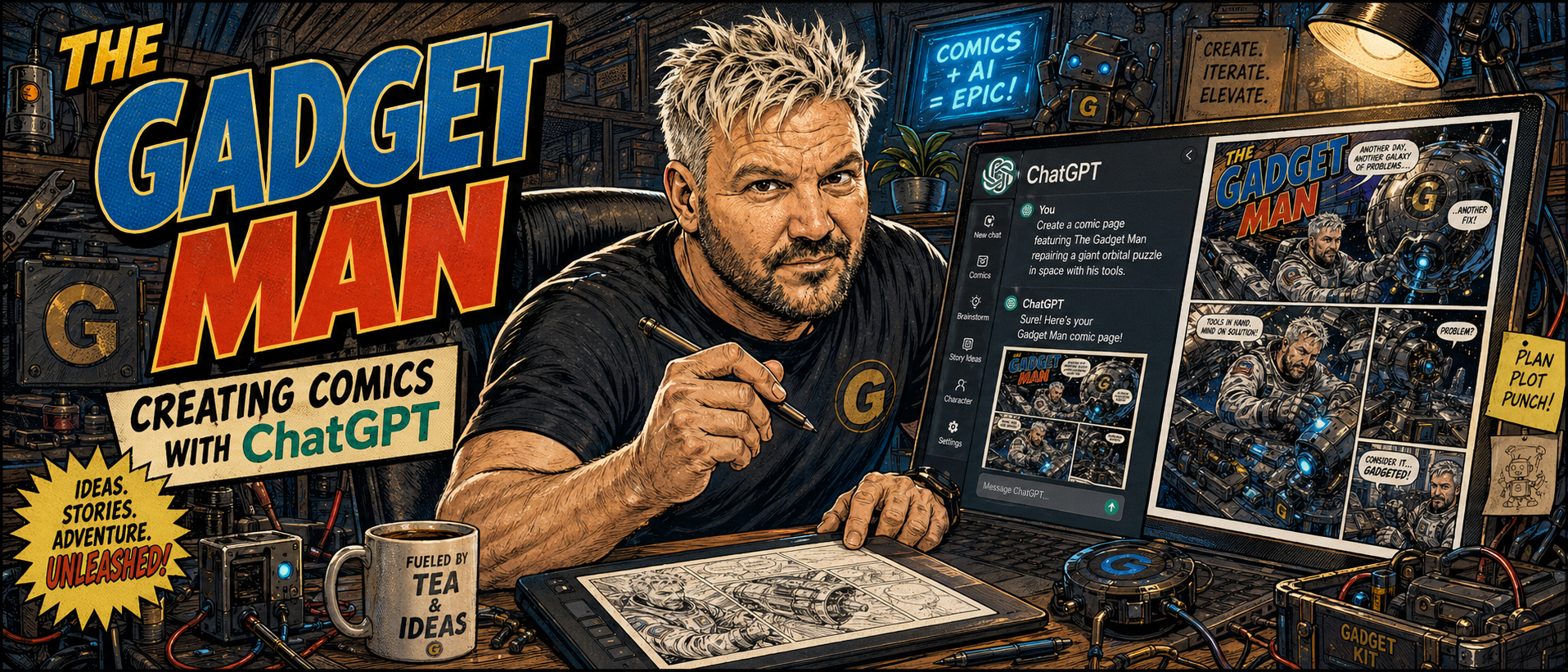
To finish the project, I also created a header image for this very article:

create a header image in the same style showing The Gadget Man creating the comic using ChatGPT

I created my own awesome comic strip using ChatGPT

That image showed The Gadget Man at his desk, creating comics using ChatGPT, surrounded by gadgets, screens, sketches, tools and the usual creative chaos. It perfectly captured what this whole experiment was about.

Why This Is Possible Now

What makes this so interesting is not simply that ChatGPT can generate an image. Image generators have existed for a while. The difference now is the conversational workflow.

OpenAI describes ChatGPT Images as a tool that can create new images and edit existing ones directly inside ChatGPT. You can ask for an image in plain English, refine it, adjust the composition, and explore new visual directions without needing to start from scratch each time. OpenAI also notes that recent image generation models are designed to follow prompts more accurately, render text more effectively, and use chat context, including uploaded images, as visual inspiration

That last point is important. I was not typing a technical command into a complicated art package. I was having a conversation. I could say “make this a two-page American-style comic strip”, then “change that wording”, then “now do one in Scotland”, then “now add Vanessa”, and ChatGPT understood the creative thread.

It feels less like using software and more like working with an incredibly fast illustrator, layout artist, letterer and visual brainstorming partner, all rolled into one.

The Magic Is in the Iteration

The real power here is not the first image. It is the second, third, fourth and fifth version.

Traditional creative work often involves a long gap between idea and result. You sketch, brief, wait, revise, wait again, make changes, and eventually arrive at something close to what you imagined.

With ChatGPT, the loop is much shorter. You can create a concept, respond to it, correct it, extend it, and build a whole fictional world in minutes. OpenAI’s own guidance highlights this ability to generate and refine images using clear prompts, request variations, adjust composition or size, and produce polished visuals quickly.

For someone like me, with a head full of odd ideas, half-remembered pop culture references, gadgets, stories, jokes, and technical rabbit holes, this is incredibly powerful.

I do not need to stop at “Wouldn’t it be funny if…”

I can actually see it.

What This Means for Artists

Now, this is where things become more complicated.

As exciting as all this is, it also raises serious questions for artists, illustrators, designers and the wider creative industry.

On one hand, tools like ChatGPT could be hugely empowering. They allow people who cannot draw to visualise ideas. They help writers create concept art. They help small businesses produce mock-ups, campaign ideas, storyboards, social media graphics and playful content that might previously have been out of reach.

For independent creators, this could be a revolution. A blogger can create a comic strip. A podcaster can build a visual world. A small business can prototype adverts. A game designer can test character ideas. A 3D printing enthusiast can imagine packaging, instructions, posters, comics and product artwork without needing a full design department.

But there is another side.

Professional artists have every right to be concerned. If companies decide to replace commissioned artwork with AI-generated images purely to save money, that has consequences. If the visual language of artists is absorbed, imitated and mass-produced without care, credit or fair compensation, that is not something we should casually ignore.

There is also the question of value. Art is not just the finished image. It is experience, taste, judgement, intention and human interpretation. A good artist does not simply “make a picture”. They solve visual problems. They understand emotion, framing, symbolism, storytelling and audience. AI can generate astonishing things, but it does not live a life. It does not have childhood memories, favourite comics, personal grief, humour, nostalgia or the strange little sparks that make human creativity so fascinating.

A Tool, Not a Replacement for Imagination

The way I see it, ChatGPT does not remove the need for creativity. It shifts where the creativity happens.

The prompt matters. The idea matters. The direction matters. The ability to look at an image and say “that is nearly right, but the final speech bubble is wrong” matters.

In my Gadget Man comic experiment, ChatGPT created the images, but the idea came from a very human place: my own interests, my humour, my love of gadgets, my fondness for comic book drama, my 3D printing obsession, my VR tinkering, my family life, and my lifelong habit of turning ordinary things into stories.

That is where I think these tools are at their best. Not replacing imagination, but amplifying it.

The Future of Comic Creation?

Will AI-generated comics replace traditional comics? I hope not.

Will they change how people make comics? Almost certainly.

We may see writers using AI to storyboard ideas before handing them to professional artists. We may see artists using AI for rough concepts, layouts, backgrounds or experimentation. We may see hobbyists creating personal comics for fun, families, blogs and social media. We may also see new kinds of hybrid workflows where human creators and AI tools sit side by side.

There will be arguments, and there should be. Creative industries need rules, ethics, transparency and respect for human artists.

But there is also something genuinely wonderful about being able to type a sentence and watch a ridiculous idea become visible.

Final Thoughts

What started as a quick experiment became a whole mini comic universe.

The Gadget Man fought Martians, fixed Scotland’s EV chargers, 3D printed a controller for Elite Dangerous, went on holiday with Vanessa, survived domestic chaos during a spa weekend, corrected the orbit of the ISS, and then sat down to create the comics using ChatGPT.

That is absurd.

It is also brilliant.

For me, this is exactly what technology should do. It should unlock ideas. It should make us laugh. It should help us create things that would otherwise remain trapped in our heads.

And if it occasionally turns “Gadget Man” into “Gadget Giant Man”, well, that is all part of the adventure.

Another day. Another gadget. Another comic created.

Gadget Man Signing Off

From Pixels to Platinum: When AI Designed My New Hairstyle

From Pixels to Platinum: When AI Designed My New Hairstyle

There’s something oddly thrilling about letting technology take creative control. I’ve spent years testing gadgets, reviewing innovations, and exploring the limits of artificial intelligence — but this time, I let the tech get a little more personal.

A few weeks ago, I asked Midjourney — my go-to AI image generator — a simple question:
“What would The Gadget Man look like with a fresh new hairstyle?”

The result was, quite frankly, impressive. The AI produced a series of strikingly realistic portraits featuring a textured, platinum-blonde cut that looked part cyberpunk, part 21st-century rockstar. I loved it. The catch? It wasn’t real… yet.

The AI Concept

Armed with a few reference prompts and an experimental mindset, I spent an evening fine-tuning the digital version of myself. Midjourney, in its infinite wisdom, decided that bleached hair and choppy texture were the future of The Gadget Man brand.

At first, it was just a bit of fun. But the more I looked at the AI render, the more I realised — this was something I could actually pull off. So, I decided to make it happen.

Turning AI Into Reality

I booked an appointment with my stylist and brought along the AI images on my phone — full 360-degree green-screen shots of the “digital me.” It’s not every day you walk into a salon and say, “I’d like this look, please — it was designed by artificial intelligence.”

To their credit, they didn’t flinch. Instead, we broke it down into human-achievable steps:

  • The Cut: Short, faded sides with plenty of texture on top.
  • The Style: Tousled and natural, with enough lift to keep things casual.
  • The Colour: A cool, silver-white platinum tone — bold but clean.

The Result

Wait and see!!!

AI as a Creative Partner

This little experiment isn’t just about hair — it’s about what happens when AI moves from the screen into the real world. Whether it’s designing products, testing ideas, or in this case, reinventing a hairstyle, AI has become a kind of creative partner.

From Pixels to Platinum: When AI Designed My New Hairstyle


From Pixels to Platinum: When AI Designed My New Hairstyle

Coming soon: a behind-the-scenes video of the full transformation — from my original hairstyle to the final platinum reveal. Keep an eye on The Gadget Man socials for the big unveil.

#TheGadgetMan #AIstyle #MidjourneyToReality #TechMeetsHuman #FromPixelsToPlatinum

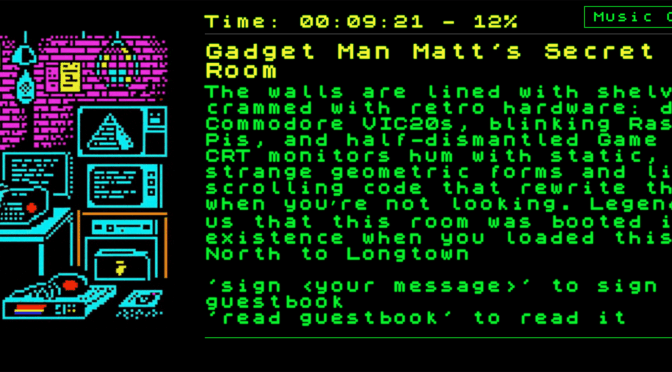
How I Wrote an Retro 80s-Inspired Adventure Game About The KLF

If you grew up in the 1980s, you’ll remember that unmistakable feeling of loading a game on your ZX Spectrum, Commodore 64, or BBC Micro. The hypnotic screech of the cassette loading, the colour bars flickering on screen, and that eternal moment of suspense — would it load this time, or had the tape stretched just enough to doom you to a R Tape Loading Error?

Loading the KLF Adventure

Fast forward to the 2020s and, somewhere between my love of retro computing, The KLF’s music, and an itch to make something creative, I decided: I’m going to write a text adventure game. Not just any text adventure, but one dripping with late-night 80s energy, pop culture references, and a healthy dose of KLF mythology.

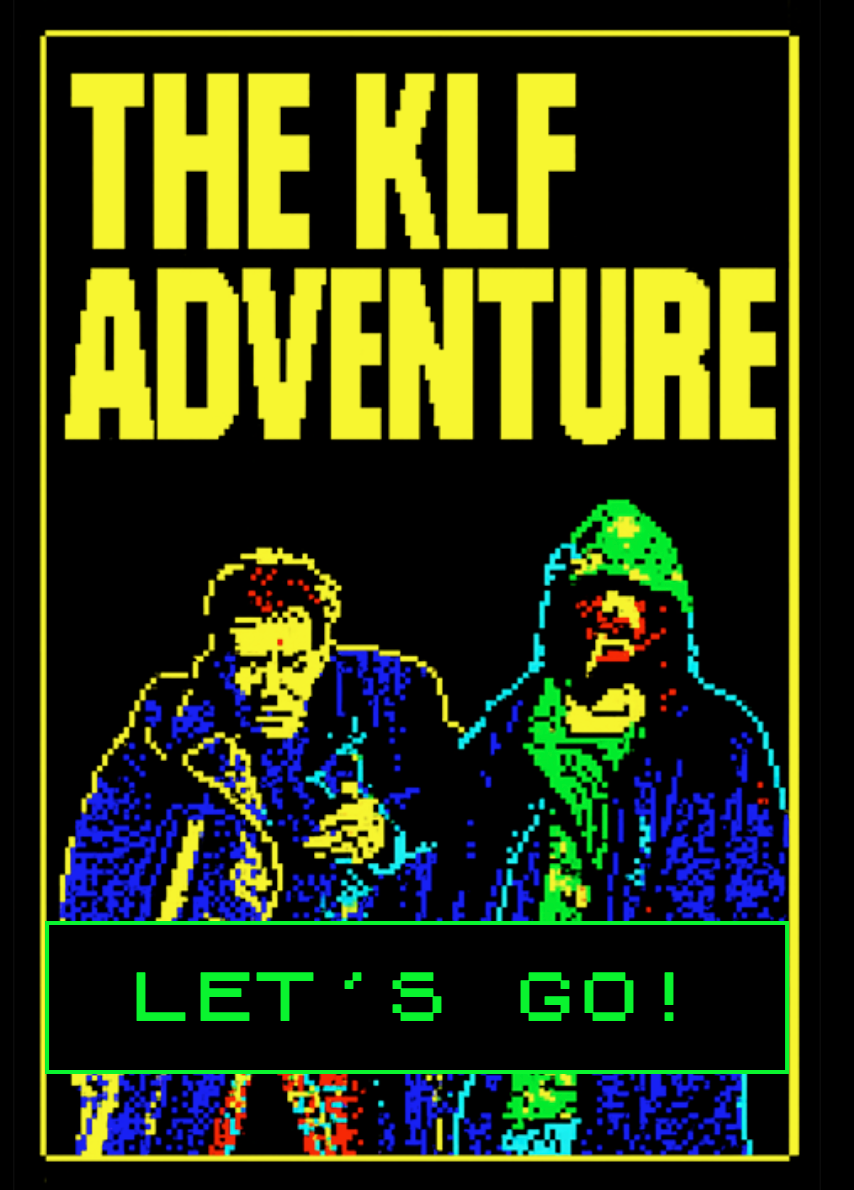
The KLF Adventure Begins

It started innocently enough — I wanted to relive the magic of the Scott Adams-style adventures I played as a kid. Those games weren’t about graphics; they were about imagination. Every location, every object, every strange instruction was something you had to picture in your head. And if you were a bit obsessive (guilty), you’d spend hours mapping every room on graph paper.

Finding the Right Ingredients

The KLF have always been masters of mystery — their story threads through pop hits, art projects, strange performances, and burning a million pounds on a remote Scottish island. That mix of chaos, humour, and myth-making was perfect for a game world.

I started building a map: fictional places merged with real ones from KLF history. Bold Street in Liverpool. The Cavern Club in the 1960s. A boathouse with a roaring fire. And, naturally, Trancentral — the spiritual HQ of The KLF. I even included surreal locations like the “Little Fluffy Cloud Factory” and “Maze of Caves” for that dreamlike adventure feel.

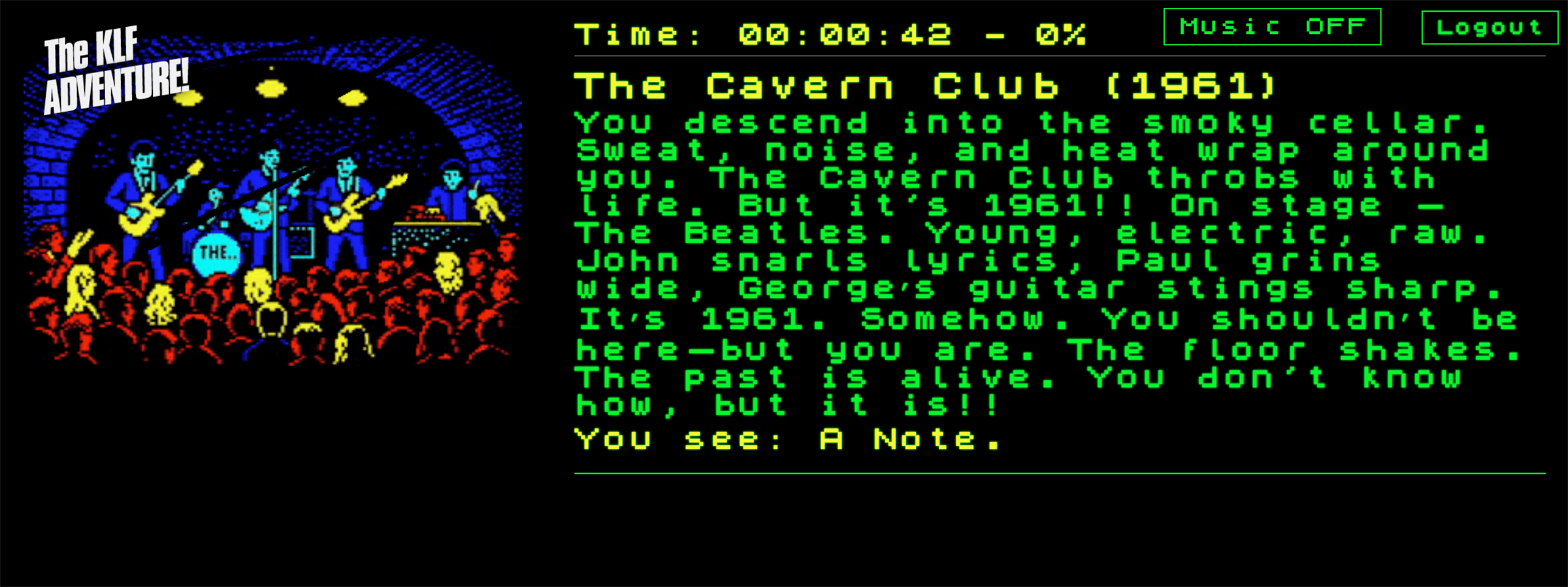
Travel Back in Time to The Cavern Club in 1961

The NPCs? Oh, they had to be special. Sigmund Freud gives cryptic instructions. Ivan Pavlov demands you “Lie Down” before telling you to “Keep Calm”. Even Denzil the Baker makes an appearance, along with other nods that KLF fans will appreciate.

Building It Like It’s 1984 — With a 2025 Twist

I didn’t just want to write about the 80s — I wanted it to feel like the 80s. So I coded the game in a modern environment but kept the old-school constraints: short descriptions, tight vocabulary, and a parser that understands commands like GO NORTH, GET TICKET, or SAY CHILLOUT.

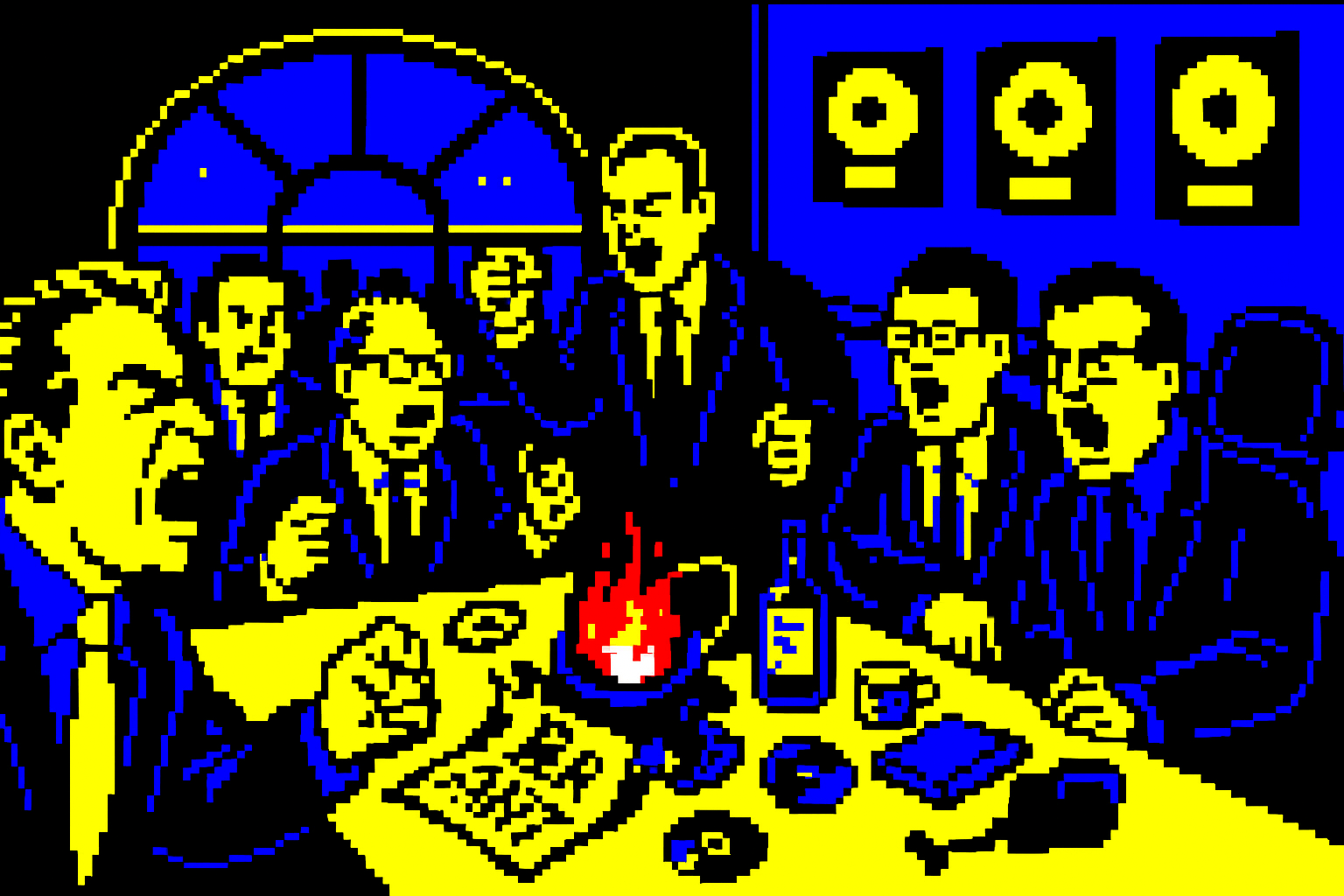
Don't get stuck in the record industry execs meeting!!!
Don’t get stuck in the record industry execs meeting!!!

But here’s the twist — I didn’t do it alone. My coding partners were Gemini CLI and OpenAI Codex, coding with me directly in my command line. The imagery was created using ChatGPT, with animations by Midjourney. The music came courtesy of Suno, while the sound effects were crafted by ElevenLabs. Together, these AI tools became my team of coders, designers, composers, and consultants, enabling me to bring this game to life in a way that would have been impossible on my own.

And because I couldn’t resist going full retro, I’ve also been experimenting with encoding the game into audio so it can be loaded into a ZX Spectrum emulator straight from a physical cassette tape. Because why not?

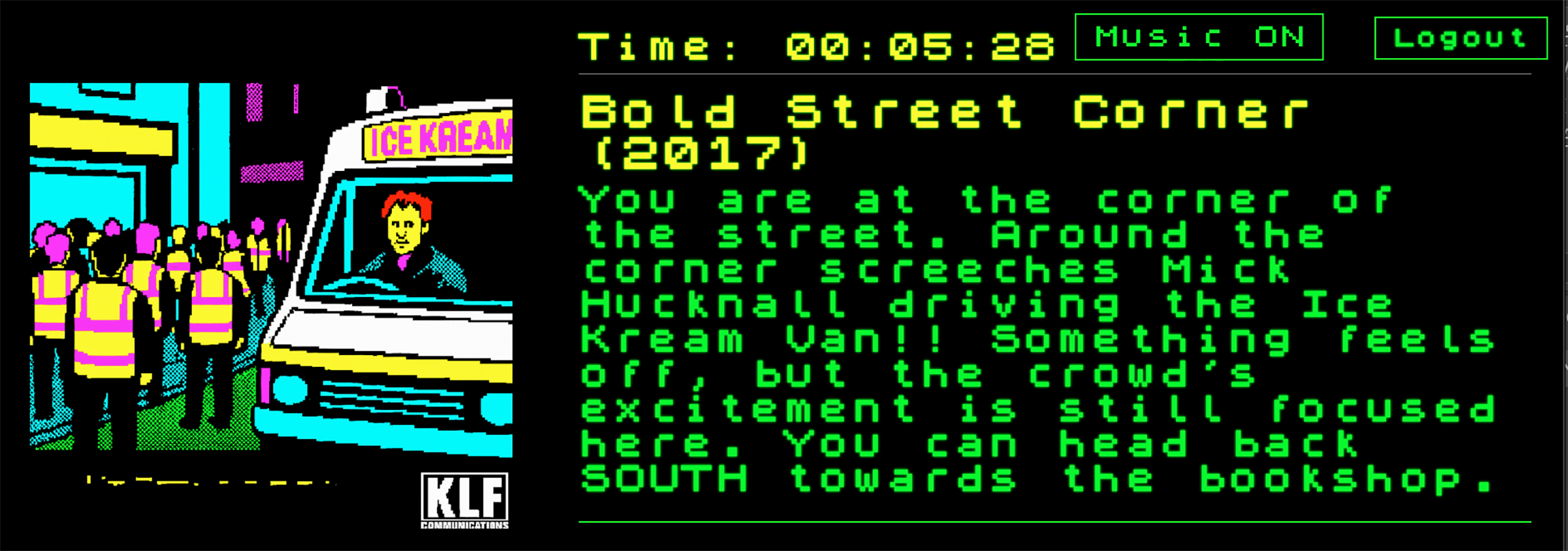
Timeslips abound in Bold Street with alternate timelines showing Mick Hucknall driving the Ice Kream Van!

The Result

What emerged is The KLF Adventure — part game, part interactive art piece, and part love letter to the days when imagination did the heavy lifting. It’s an 80s-inspired world you can explore, puzzle over, and get gloriously lost in. It rewards curiosity, nods knowingly to KLF lore, and might just make you say “What Time Is Love?” at least once.

For me, this wasn’t just a coding project. It was a way of reconnecting with that kid who sat cross-legged in front of a rubber-keyed Spectrum, waiting for the next adventure to begin. Only now, I’m the one writing the adventure — with a 21st-century team of AIs by my side.

You can even find me in the game... But where?
You can even find me in the game… But where?

If you fancy diving in, the game is live at klfgame.co.uk. Just remember: keep your wits about you, don’t trust every whisper, and above all… CHILLOUT. Twice.

Fixing configd 100% CPU Usage on macOS Monterey (and Disabling PPPController.bundle)

For months, I battled a persistent and damaging issue on my Mid 2015 MacBook Pro — a workhorse of a machine that, even at nearly 10 years old, continues to run exceptionally well with a 2.5GHz Quad-Core i7, 16GB RAM, 1 TB SSD and macOS Monterey 12.7.6.

The system process configd would regularly consume 100% of the CPU. The fans screamed. The laptop baked. Performance tanked. Worst of all — two batteries failed completely during the years this bug went undiagnosed.


A Machine with a Backstory

This MacBook Pro actually replaced an almost identical model (with a 500GB SSD) whose keyboard had begun to fail. That original machine is now used as a secondary workstation — mostly plugged in with external monitors, keyboard and mouse and of course, rarely moved.

However, the replacement system was set up via migration from the older Mac, meaning all settings, preferences, and low-level cruft came with it. It’s entirely possible this bug — and the problematic plugin behind it — exists on the secondary machine too, simply hiding in the shadows because that Mac rarely gets unplugged or stressed.


A Hunch from the Past

Throughout the troubleshooting, I had a nagging feeling: years ago, I’d installed a PPP-based VPN service, and I couldn’t shake the idea that something related had survived the years. That memory — almost dismissed — turned out to be the smoking gun.


All the Fixes That Didn’t Work

Before getting to the actual solution, I tried everything:

  • Resetting network preferences

  • Disabling IPv6

  • Safe Mode diagnostics

  • launchctl unloads

  • Cleaning out /SystemConfiguration

  • Monitoring via top and Activity Monitor

Nothing worked. The issue was like digital rot — persistent and invisible.


Enter ChatGPT

Eventually, I turned to ChatGPT for deeper insight. Together, we sampled the configd process and analysed its call stack. That led us to the true culprit:

PPPController.bundle — a legacy dial-up/VPN plugin, long deprecated but still loading in the background.

Despite not being used in years, it was triggering configd into a CPU loop, damaging system performance and hardware.


macOS Protections (and How to Work Around Them)

macOS uses System Integrity Protection (SIP) and Signed System Volumes (SSV) to protect core files. To disable this plugin, you must bypass those protections temporarily.


The Fix (Finally)

WARNING!

DO NOT ATTEMPT ANY OF THE FIXES BELOW WITHOUT CONSULTING A TRAINED APPLE EXPERT! YOU ARE FIDDLING WITH THE WORKINGS OF A COMPUTER AND RISK PERMANENTLY LOSING THE CONTENTS OF YOUR HARD DRIVE. PLEASE, PLEASE!!! TAKE A FULL BACKUP BEFORE ATTEMPTING ANYTHING LIKE THIS.

IT TOOK SEVEN ATTEMPTS TO FIX THIS PROBLEM WITH THE ASSISTANCE OF CHATGPT, SO IT FAILED SIX TIMES BEFORE THE ISSUE WAS RESOLVED.

Step 1: Reboot into macOS Recovery (Cmd + R)

Open Terminal from the menu.

Step 2: Disable protections

bash
csrutil disable
csrutil authenticated-root disable
reboot

Reboot again into Recovery after this.

Step 3: Mount the system volume

bash
mount -uw /Volumes/Macintosh\ HD

Step 4: Disable the plugin

bash
mv /Volumes/Macintosh\ HD/System/Library/SystemConfiguration/PPPController.bundle \
/Volumes/Macintosh\ HD/System/Library/SystemConfiguration/PPPController.bundle.disabled

Step 5: Bless the system snapshot

bash
bless --folder /Volumes/Macintosh\ HD/System/Library/CoreServices --bootefi --create-snapshot
reboot

Confirming It Worked

  • top -o cpu showed configd no longer topping the chart

  • configd -v | grep -i ppp showed nothing — the plugin was gone

  • The Mac ran cooler, quieter, and battery health stopped declining


Re-enabling Protections

After verifying stability:

bash
csrutil enable
csrutil authenticated-root enable

Then reboot normally.


Final Thoughts

This wasn’t your average support task. It took two dead batteries, countless failed attempts, a hunch from years back, and finally the help of ChatGPT to trace configd’s madness back to a plugin that had long outlived its purpose.

If you’ve ever migrated from an older Mac, especially one where you’d used PPP-based VPNs or dial-up tools, this issue may be lurking silently in your system too — especially if that system is mostly docked or plugged in. For me, it nearly cooked a great machine.

Now? My Mid 2015 MacBook Pro is back to being a quiet, powerful daily driver — and I intend to keep it that way.

Have a similar story? Reach out  or connect with me on social media. Let’s keep our ageing tech running better than new.

How I Created and Published Gizmos and Gadgets in Cockney in Less Than 24 Hours

Sometimes, you have an idea so out there, you just have to run with it. That’s exactly what happened with my latest experiment—writing, editing, and publishing a book in under 24 hours. Yes, you read that right: Gizmos and Gadgets in Cockney by Matt Porter went from a concept swirling in my head to a fully published book faster than you can say “Bob’s your uncle.” Now, before you start expecting War and Peace or something that’ll win a Pulitzer, let me set the record straight: this book is meant to be a laugh. So, get that tongue planted firmly in your cheek and read on!


A Silly Idea Turned Into Reality

I’ve always loved Cockney rhyming slang. There’s something so playful and creative about it, and being a tech nerd, I thought, “Why not merge the two?” With that spark of inspiration and a challenge I set for myself, the idea was born: a humorous book that reimagines the world of tech with Cockney flair. Gizmos and Gadgets in Cockney would be a light, fun read for anyone who’s ever wondered what you’d call a smartphone (a “dog”) or a smart speaker (a “chirper”) in the East End’s colourful lingo.

But then I upped the stakes: I decided to see if I could write, edit, and publish the whole thing in less than 24 hours. Why? Because life’s too short not to try ridiculous things.

How I Created and Published Gizmos and Gadgets in Cockney in Less Than 24 Hours
You can buy and read Gizmos and Gadgets in Cockney right now and very soon in physical paperback at https://amzn.to/40QzUnI

Don’t Expect High Art—This Is Pure, Unfiltered Fun

Let’s be clear: you’re not about to read a literary masterpiece. This isn’t War and Peace or The Great Gatsby. It’s more like a mate telling you stories down the pub, but instead of talking about football, I’m rambling about gadgets and tech in Cockney slang. This book was written fast, with lots of tea, laughter, and a “who-cares-if-it’s-not-perfect” attitude. If you’re looking for a deep exploration of tech or a polished manual, you might be barking up the wrong tree.

But if you’re after a book that doesn’t take itself seriously, one that pokes fun at tech jargon while teaching you some cheeky Cockney phrases, this might be your cup of rosie-lee.

The Writing Process: Fuelled by Tea and Banter

Once the idea hit me, I got to work with one goal: get it done before the clock ran out. I wrote chapter after chapter, each filled with witty slang, light-hearted anecdotes, and ridiculous comparisons between tech gadgets and everyday London life. Need to know why Wi-Fi is like a “Skyhook” or why a computer’s operating system is the “Guv’nor”? I’ve got you covered.

To keep it fun and breezy, I didn’t worry too much about polishing every sentence. It was all about the charm, the humour, and the Cockney twist. The result? A book that feels like a good ol’ natter with a mate—unpolished, maybe a bit rough around the edges, but full of character.

Editing and Formatting: It’s Good Enough

I gave the manuscript a quick once-over (yes, quick), fixing the obvious typos and ensuring the Cockney slang made sense. But did I spend hours agonising over sentence structure or tweaking every paragraph? Absolutely not. This was about speed and spirit, not perfection. Think of it like street food: messy, but oh-so-satisfying.

I also threw in a handy Cockney slang glossary at the end, so you can brush up on your rhyming slang while giggling at the tech comparisons.

The Cover: Simple, Bold, and Straight to the Point

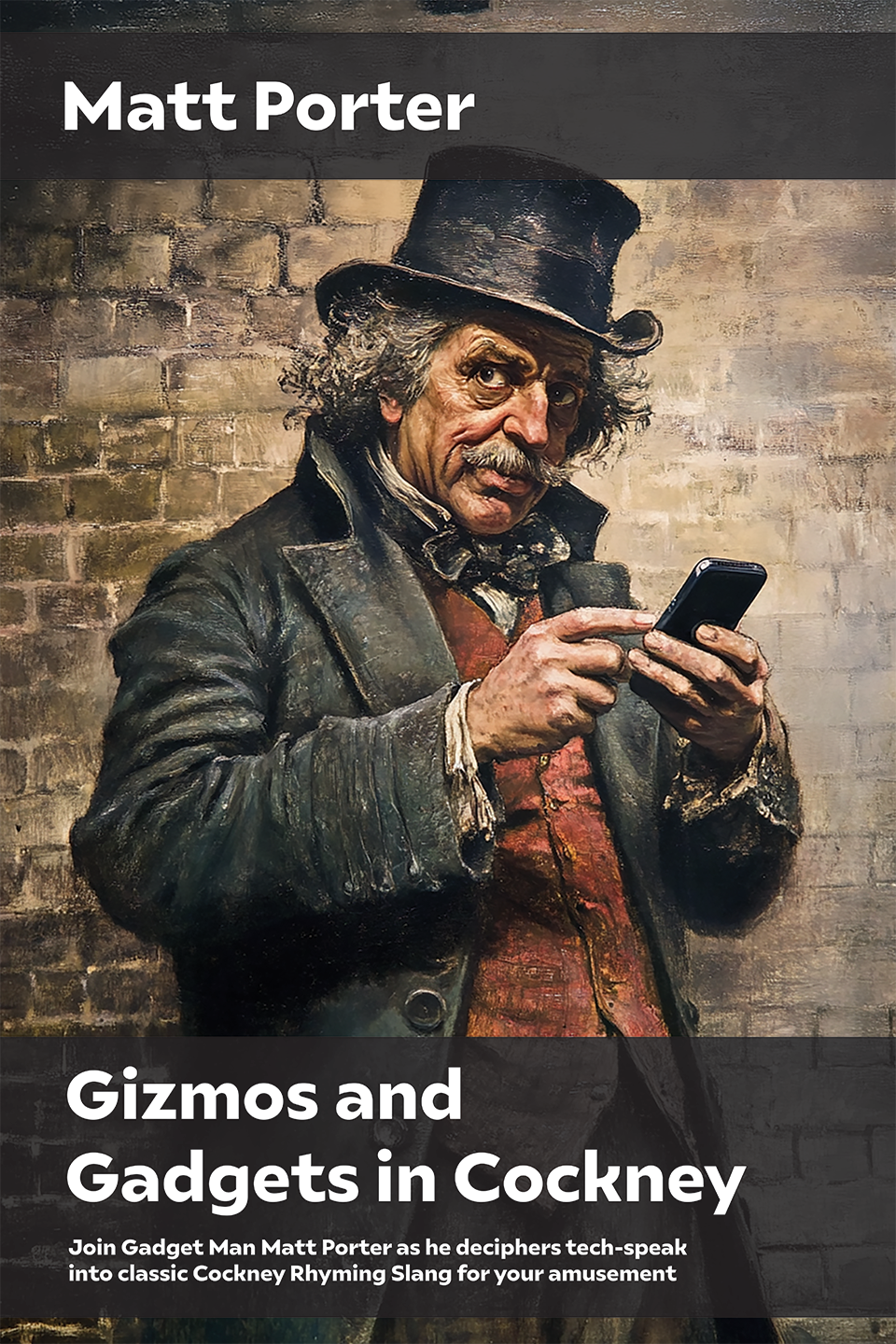
When you’ve only got 24 hours, you don’t spend ages designing a cover that rivals The Da Vinci Code. I kept it simple and bold, with the title front and centre: Gizmos and Gadgets in Cockney by Matt Porter. The cover hints at the humour inside without giving too much away—exactly how I like it.

Publishing: The Final Countdown

With just minutes to spare, I uploaded the book to the publishing platform, hit “Publish,” and breathed a sigh of relief. I did it! A fully published book in less than a day.

Why I Did It

Let’s face it, we all overthink things sometimes. This project was a reminder to embrace spontaneity, take risks, and have fun with creativity. You don’t always need months of preparation or endless rewrites to make something worth sharing. Sometimes, done is better than perfect.

Gizmos and Gadgets in Cockney isn’t meant to change your life, but it just might make you chuckle, and that’s good enough for me.

What to Expect When You Read It

  • Lots of laughs: If you’ve ever struggled to explain tech to your nan or been baffled by a new gadget, you’ll feel right at home.
  • Cockney charm: From “whirligigs” to “dog and bones,” the slang is in full force.
  • Zero seriousness: This book is pure entertainment, so don’t come looking for an academic breakdown of microchips.

Final Thoughts: Take It with a Pinch of Salt (and a cup of ‘rosie’)

If you’re the kind of reader who enjoys a bit of banter, a bit of tech, and a whole lot of Cockney rhyming slang, this book is for you. But remember: it’s all in good fun. Don’t take it too seriously—just sit back, grab a cuppa, and enjoy the ride.

So, there you have it. My little 24-hour experiment, wrapped up and ready for you to enjoy. Gizmos and Gadgets in Cockney is out now on Kindle and will be available very soon in paperback (As soon as I have approved the… Proof), and I hope it brings you as many laughs reading it as I had writing it.

Cheers,
Matt Porter
February 2025


📚 Want a bit of tech banter with a Cockney twist? Grab your copy of Gizmos and Gadgets in Cockney on Kindle now, and don’t forget to keep that tongue firmly in cheek.


Tech news and reviews, on air and online