Tag Archives: graphic novel

Becoming a Highwayman: How I Put Myself Inside an Inkantation Graphic Novel

One of the most enjoyable things about developing new technology is reaching the point where you can stop asking, “Will this work?” and begin asking, “What else could we do with it?”

My latest experiment with Inkantation, the graphic novel creation system I have been developing, involved adapting the classic tale A Pirate of the Land: One Crowded Hour. However, this time I decided to take the experiment a little further.

I put myself into the story.

Not merely as a background character, an anonymous face in a crowd or an unfortunate passer-by. I cast myself as Sir Henry Hailworthy, the wealthy Edwardian gentleman at the centre of the tale, who also happens to have a rather dramatic secret life as a modern-day highwayman.

Becoming a Highwayman: How I Put Myself Inside an Inkantation Graphic Novel

A Pirate on the Roads of Edwardian England

A Pirate of the Land: One Crowded Hour is set during the early days of motoring, when motor cars were still magnificent, temperamental machines and the sight of one roaring along a lonely country road could be an event in itself.

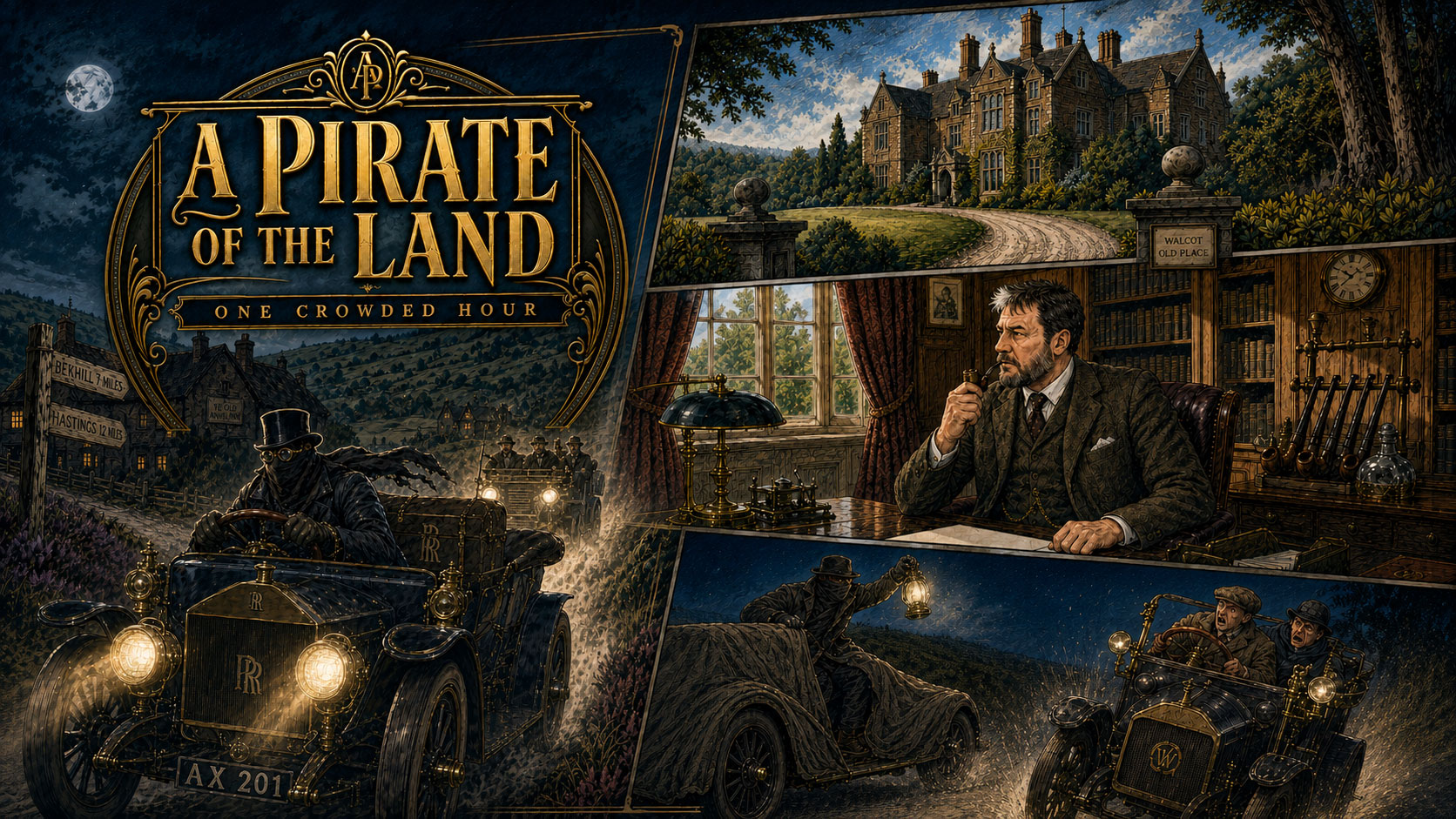
The story opens on the Eastbourne to Tunbridge road late on a Sunday night. A mysterious Rolls-Royce, partly concealed beneath brown fabric, prowls through the darkness. Its broad, burly driver wears a Tyrolean hat, a heavy coat and, when another motorist approaches, a dark cloth mask.

Armed with a long-barrelled Mauser pistol, he becomes a highwayman for the motor age.

He stops an elderly Wolseley, confronts a young motorist named Ronald Barker, encounters two actresses travelling in a Humber and finally targets the man he has really come to find, a wealthy financier whose actions have ruined the lives of others.

The finished Inkantation script runs to 21 graphic novel pages and uses 22 individually planned assets, including characters, vehicles, props and locations. These range from the masked highwayman and his concealed Rolls-Royce to Edwardian studies, country roads, jewellery, packages, pistols and the wonderfully imposing sixty-horsepower Daimler limousine.

Turning the Story into a Graphic Novel

Inkantation does not simply take a piece of prose and create a random collection of illustrated pages.

The first stage is adaptation.

The original story is analysed and reorganised into a structured graphic novel script. Each page is divided into panels, with descriptions covering the viewpoint, composition, lighting, expressions, action, captions and dialogue.

For example, the opening page contains three panels. The first establishes the lonely road and the approaching Rolls-Royce. The second moves closer to reveal the strange fabric concealing the vehicle. The third introduces the driver, hunched over the wheel with the glowing ember of a cigarette beneath the brim of his hat.

This creates a cinematic progression from landscape, to vehicle, to character.

Before the finished panels can be produced, Inkantation creates an asset catalogue. Every important character, location, vehicle and object receives its own detailed reference description. This is vital because a graphic novel depends upon visual continuity.

Ronald Barker must look like Ronald Barker every time he appears. The Rolls-Royce must remain recognisable from panel to panel. Sir Henry’s study needs to feel like the same room, whether it is shown in a wide establishing shot or as the background to an intense conversation.

Without that preparation, characters can subtly change faces, costumes, ages and proportions from one page to the next.

Becoming a Highwayman: How I Put Myself Inside an Inkantation Graphic Novel

Casting Myself as Sir Henry Hailworthy

For this particular book, I manually added myself to the production process and used my own appearance as the basis for Sir Henry Hailworthy.

Sir Henry is described in the Inkantation asset catalogue as a stocky, bearded Edwardian gentleman in a well-cut tweed country suit, usually seen with a pipe in his study. Most importantly, his build must also be consistent with the mysterious highwayman encountered earlier in the story.

This meant I was effectively being cast in two connected roles: the respectable country gentleman and the masked figure stalking the roads at night.

There was something wonderfully entertaining about seeing a version of myself transported into Edwardian England, sitting behind a mahogany desk, confronting an angry visitor and attempting to explain why I had spent the previous evening robbing motorists at gunpoint.

It also presented an interesting technical challenge.

It is relatively straightforward to create a single stylised portrait of a person. It is much harder to preserve that identity through multiple panels, facial expressions, viewpoints, costumes and lighting conditions.

A character may be seen seated at a desk in one panel, turning towards a window in another and confronting someone across a room in the next. In the highwayman sequences, the same character is partly hidden beneath a hat, heavy coat and mask.

The visual system still needs to give the reader enough clues to believe that these are the same person.

Becoming a Highwayman: How I Put Myself Inside an Inkantation Graphic Novel

More Than a Personal Cameo

Adding myself to the book was partly for fun, but it was also a genuine product experiment.

Would readers pay to appear in a graphic novel?

Personalisation already exists in children’s books, where a child’s name may be inserted into a story. Inkantation potentially takes that idea much further. Rather than simply changing a name, a customer could be visually cast as a character throughout an illustrated narrative.

Someone could become a detective in a Victorian mystery, the captain of a pirate ship, an explorer on another planet or, as in my case, an Edwardian gentleman with a concealed life of motorised crime.

It could also work as a highly unusual gift.

Imagine presenting someone with a professionally printed graphic novel in which they are the hero, villain or eccentric supporting character. Couples could appear together in a romantic adventure. A family could be placed inside a fantasy story. A business could even commission a graphic novel featuring members of its own team for training, promotion or an anniversary celebration.

Naturally, there are questions still to explore.

How much personalisation would someone want? Would they prefer to play the hero, or would being the villain be more entertaining? Should the story be selected from an existing catalogue, or written especially for them? How closely should the artwork resemble the real person, and how much should it embrace the graphic novel style?

These are exactly the kinds of questions that experiments are designed to answer.

Combining Art, Storytelling and Technology

Inkantation brings together several areas that have interested me throughout my life.

I have been drawing and creating characters for around 50 years. I have also spent more than 20 years running a web design and technology business. Graphic novels allow those two worlds to meet.

The system handles the complex production work, including script preparation, asset management, visual consistency, panel generation, dialogue placement and page assembly. However, the creative decisions still matter.

Which moment deserves a full-width panel? When should the reader see a close-up? How much of the original narration should remain? What expression should a character have? Where should a page end to encourage the reader to turn over?

Technology can help produce the images, but storytelling remains at the heart of the process.

One Crowded Hour

The title comes from Sir Henry’s own excitement when the adventure is over. Despite promising never to repeat it, he admits that his brief career as a highwayman was exhilarating.

He describes it as one crowded hour of glorious life.

That line also feels appropriate for my experience of making the book. For a brief period, I was no longer sitting at my computer working on a graphic novel system.

I was Sir Henry Hailworthy.

I had a Rolls-Royce hidden beneath brown fabric, a Mauser pistol in my hand and unfinished business waiting on a lonely road.

Whether people will pay for the opportunity to star in their own graphic novel remains to be seen, but as an experiment it has opened another fascinating possibility for Inkantation.

And I must admit, seeing yourself revealed as the mysterious highwayman is considerably more exciting than appearing in the background of a holiday photograph.

You can purchase A Pirate of the Land : One Crowded Hour is available to download in Kindle format