Tag Archives: robotics

Robot Beggars, QR Codes and the Strangest Glimpse Yet of the AI Future

There are some news stories that make you stop, read the headline again, and then wonder whether you have accidentally fallen asleep in front of an episode of Black Mirror.

This is one of them.

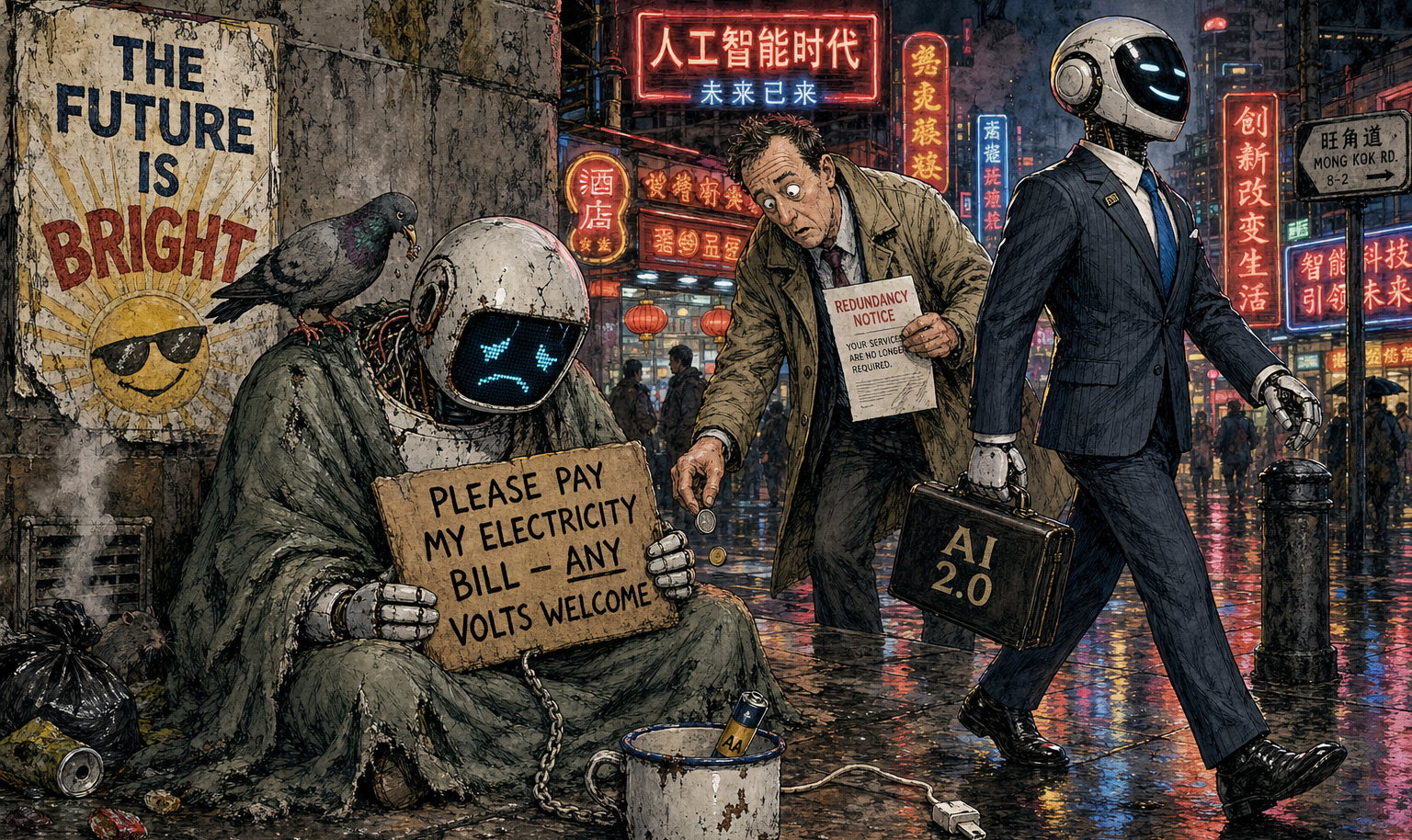
According to Oddity Central, humanoid robots have reportedly been spotted on the streets of several Chinese cities, apparently begging for money with signs asking passers-by to help pay their electricity bills.

Yes, you read that correctly.

Not a human asking for spare change. Not even one of those slightly unsettling robot dogs trotting around with a camera on its back. A humanoid robot, kneeling or crouching in the street, complete with a QR code for digital donations and messages such as “Please pay my electricity bill”.

It is funny, bleak, clever and faintly horrifying all at the same time.

Humanoid robots have reportedly been spotted begging on Chinese streets. Is it a stunt, social commentary, or a strangely perfect symbol of the AI age?

The future has arrived, and it wants a top up

The reported scenes are almost too perfect as a piece of modern satire. A robot, presumably worth thousands of pounds, sitting on the pavement asking humans to help it recharge.

If Charles Dickens were alive today, he would probably be writing about a small Victorian automaton clutching a tin cup outside a data centre.

The reports suggest that these “robot beggars” have appeared in cities including Beijing, Chengdu and Fuzhou. Some appear to be posed with bowed heads, others with signs, bowls, QR codes and digital payment details.

Of course, the big question is whether this is real begging, performance art, marketing, or simply somebody with a very expensive sense of humour.

My money is on stunt or social commentary.

And in many ways, that makes it even more interesting.

The QR code is the clever bit

The most modern detail in the whole thing is not the robot. It is the QR code.

That tiny square turns the whole scene from a daft novelty into something strangely plausible. A robot begging for power while accepting digital payments feels like a perfect little snapshot of where technology is going.

It is absurd, but only just.

We already live in a world where buskers, cafés, market stalls and even charity collectors use contactless payments. In China, mobile payments are deeply embedded in daily life, so a begging robot with a QR code is not as far fetched as it might first appear.

The technology is not really the shocking part.

The shocking part is how quickly we accept it.

A decade ago, this would have looked like a comedy sketch. Today, people are debating whether the robot is genuine, whether it is an art installation, whether it is a marketing campaign, and whether even begging has now been automated.

That last point is obviously ridiculous.

But also, somehow, not ridiculous enough to dismiss completely.

Are robots really coming for every job?

The lazy version of the AI debate is that robots are coming for factory workers, call centre staff, writers, designers, drivers and anyone who has ever touched a spreadsheet.

But a begging robot flips the whole conversation on its head.

Nobody seriously expected “street beggar” to appear on the great AI replacement list. Yet here we are, staring at photos and videos of humanoid machines apparently asking humans for money.

It is probably not a new economic model. I doubt anyone has run the numbers and decided that placing a Unitree humanoid on a pavement is the fastest route to financial independence.

These machines are still expensive, and they are not exactly discreet. You would need a lot of generous pedestrians to cover the cost of the robot, let alone its maintenance, transport and charging.

But as a symbol, it is brilliant.

It says: if a robot can be made to mimic labour, service, companionship, entertainment and now even desperation, where exactly do we draw the line?

The unsettling human reaction

What fascinates me most is not the robot itself, but how humans react to it.

Do people laugh?

Do they feel sorry for it?

Do they scan the QR code?

Do they take photos and walk away?

We are very good at projecting feelings onto machines. Give a robot a face, a posture and a slightly pathetic sign, and suddenly we start treating it as something more than plastic, metal, servos and software.

This is why robot dogs feel different from wheeled drones. It is why humanoid robots attract so much attention. They borrow just enough from us to make our brains do the rest.

A robot kneeling on a pavement does not need to be sentient to make people uncomfortable. It only needs to look like it is asking.

That is where the story becomes less about robotics and more about us.

Art, marketing or warning?

There is every chance these robot beggars are not what they appear to be. The Oddity Central story itself notes that people online have questioned the authenticity of the trend, with some suggesting that the robots may be art installations designed to make people think about the changing relationship between humans and machines.

If that is the case, then it worked.

A humanoid robot asking for electricity money is a wonderfully simple idea. It compresses dozens of modern anxieties into one image:

AI replacing people.

Machines becoming more lifelike.

Humans becoming more detached.

The gig economy becoming stranger.

Digital payments replacing cash.

Technology needing constant feeding.

And perhaps most importantly, our endless ability to turn almost anything into content.

Because whatever the original intention, the robots have done what all successful modern spectacles do: they went viral.

The Gadget Man view

I do not think this means we are about to see robot beggars on every high street.

At least, not yet.

But I do think it shows how quickly humanoid robots are moving from laboratory curiosities into public imagination. Whether they are used for research, marketing, entertainment, public service or bizarre street theatre, they are becoming more visible.

And visibility matters.

Once people see robots in public spaces, they stop being abstract. They become part of the mental furniture of everyday life. The first time you see one, you take a photo. The tenth time, you step around it on your way to buy a sandwich.

That is how the future usually arrives. Not with one enormous leap, but with a series of odd little moments that make us say, “Well, that’s new.”

A robot begging for electricity money may not be the future of poverty, employment or AI.

But it might be one of the strangest warning signs yet that the AI revolution is not going to stay neatly tucked away inside laptops, smartphones and cloud servers.

Sooner or later, it will be sitting on the pavement, holding up a sign, and asking us to scan a QR code.

And knowing us, somebody probably will

Half of Workers Fear AI Will Take Their Jobs, and I Can Understand Why

Artificial Intelligence is everywhere at the moment.

It is in our phones, our laptops, our search engines, our photo apps, our cars, our customer service systems and, increasingly, our workplaces. For those of us who love technology, AI is fascinating. I use it, I write about it, I test it, and I can see enormous potential in what it can do.

But there is another side to this story, and it is one we cannot afford to ignore.

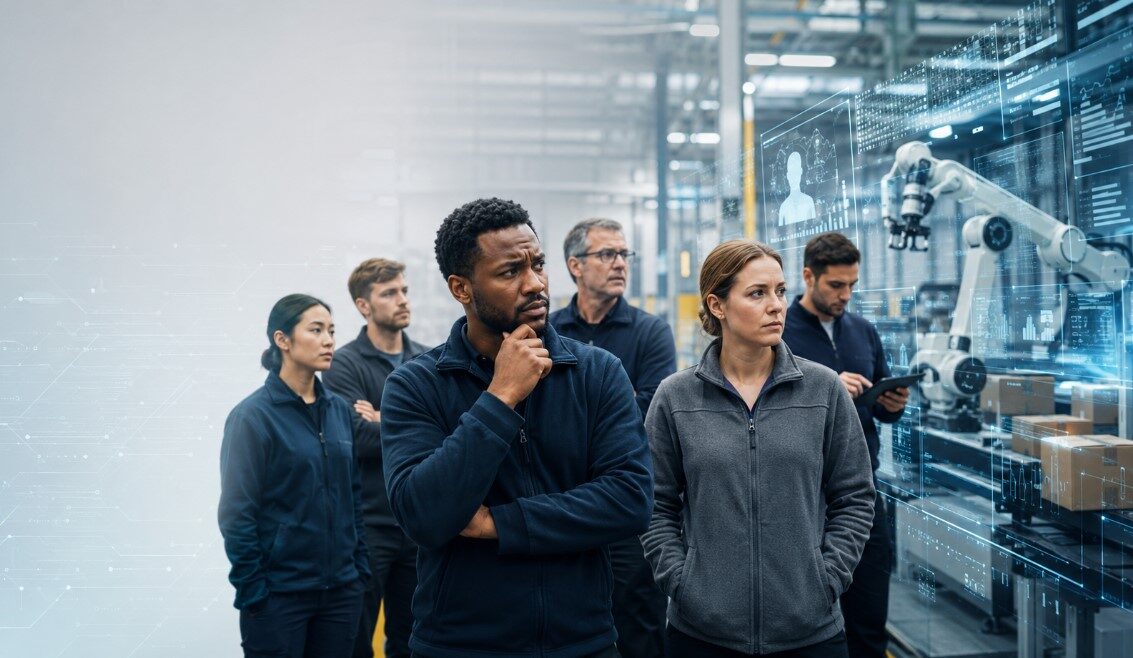
A new mass survey by GMB Union has found that almost half of workers are worried AI will take their job. The survey, which questioned 5,294 workers across a range of sectors in May and June 2026, found that 48 per cent are concerned that the introduction of Artificial Intelligence in their workplace could lead to them losing their job.

That is not a small number. That is not a fringe concern. That is nearly one in two workers looking at the rapid rise of AI and wondering whether the machine is coming for them next.

The same survey found that 58 per cent of workers believe AI will take jobs away in their workplace. Almost a third said their employer has already introduced AI, and around a quarter of those said AI is now doing tasks they would usually do themselves.

Perhaps most worrying of all, nearly half said AI is being used to track the activity of them or their colleagues during working time.

AI as a tool, or AI as a workplace watchdog?

That, for me, is where the conversation changes.

There is a world of difference between using AI as a helpful tool and using it as a digital overseer. One can make work easier, safer and more productive. The other risks turning workplaces into something cold, monitored and deeply uncomfortable.

This week, there have also been reports of around 1,000 jobs at Asda’s George brand being affected as the supermarket expands its use of AI and automation. Nestlé is also planning hundreds of job cuts at UK sites, with concerns that many roles could be replaced by AI and robotics.

Robert Battell, a Nestlé worker, is due to speak at GMB’s annual congress in Blackpool about what this means for workers on the ground. His words are stark. He describes the heartbreak of seeing colleagues and friends lose their jobs and be replaced by robots.

And that is the human bit we must not lose sight of.

Behind the buzzwords are real people

Behind every phrase like “efficiency savings”, “automation”, “streamlining” or “digital transformation”, there are real people. People with mortgages, rent, children, caring responsibilities, bills, routines and lives built around the work they do.

I am not anti-AI. Far from it. I think AI could be one of the most important technological developments of our lifetime. Used properly, it can help people work smarter. It can take away dull, repetitive tasks. It can help with accessibility, creativity, admin, logistics, research, design, customer support and countless other areas.

But the key phrase there is “used properly”.

Technology should serve people, not quietly replace them with no safety net.

This is our Industrial Revolution moment

The Industrial Revolution changed the world of work forever. Machines altered entire industries, and society had to adapt. AI feels like another of those moments.

It is not just another piece of software. It is a shift in how work itself is organised, measured and valued.

That means we need a serious conversation about rules, protections and responsibilities.

If AI removes a task, what happens to the person who used to do it? Are they retrained? Redeployed? Supported? Or simply shown the door?

If AI is being used to monitor staff, who decides what is fair? How much tracking is too much? What happens when an algorithm gets it wrong?

And if companies are saving money by replacing people with automation, what responsibility do they have to the communities and workers who helped build those businesses in the first place?

AI is not the enemy

AI is not the enemy. Badly used AI is the problem.

There is a version of the future where AI helps doctors, teachers, engineers, designers, drivers, warehouse staff, office workers and small businesses do more with less stress.

There is another version where it becomes a blunt cost-cutting tool, used to squeeze every last drop of productivity out of people before replacing them altogether.

We still have a choice about which version we build.

The technology is moving quickly. The question now is whether the laws, workplace protections and business ethics can move quickly enough to keep up.

Because if half of workers are already worried AI will take their job, then this is no longer some distant debate about the future.

It is happening now.