Tag Archives: economic impact

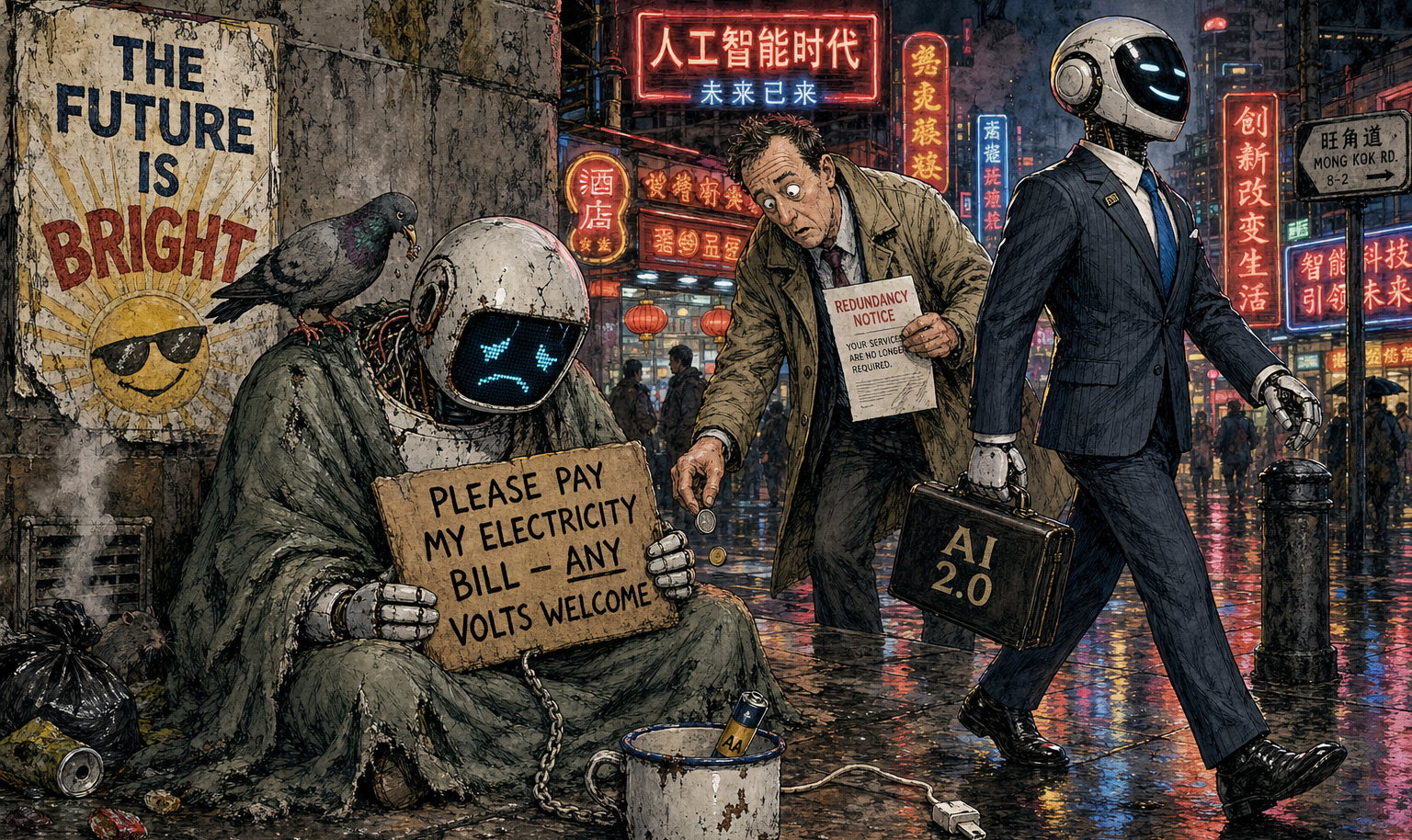
Robot Beggars, QR Codes and the Strangest Glimpse Yet of the AI Future

There are some news stories that make you stop, read the headline again, and then wonder whether you have accidentally fallen asleep in front of an episode of Black Mirror.

This is one of them.

According to Oddity Central, humanoid robots have reportedly been spotted on the streets of several Chinese cities, apparently begging for money with signs asking passers-by to help pay their electricity bills.

Yes, you read that correctly.

Not a human asking for spare change. Not even one of those slightly unsettling robot dogs trotting around with a camera on its back. A humanoid robot, kneeling or crouching in the street, complete with a QR code for digital donations and messages such as “Please pay my electricity bill”.

It is funny, bleak, clever and faintly horrifying all at the same time.

Humanoid robots have reportedly been spotted begging on Chinese streets. Is it a stunt, social commentary, or a strangely perfect symbol of the AI age?

The future has arrived, and it wants a top up

The reported scenes are almost too perfect as a piece of modern satire. A robot, presumably worth thousands of pounds, sitting on the pavement asking humans to help it recharge.

If Charles Dickens were alive today, he would probably be writing about a small Victorian automaton clutching a tin cup outside a data centre.

The reports suggest that these “robot beggars” have appeared in cities including Beijing, Chengdu and Fuzhou. Some appear to be posed with bowed heads, others with signs, bowls, QR codes and digital payment details.

Of course, the big question is whether this is real begging, performance art, marketing, or simply somebody with a very expensive sense of humour.

My money is on stunt or social commentary.

And in many ways, that makes it even more interesting.

The QR code is the clever bit

The most modern detail in the whole thing is not the robot. It is the QR code.

That tiny square turns the whole scene from a daft novelty into something strangely plausible. A robot begging for power while accepting digital payments feels like a perfect little snapshot of where technology is going.

It is absurd, but only just.

We already live in a world where buskers, cafés, market stalls and even charity collectors use contactless payments. In China, mobile payments are deeply embedded in daily life, so a begging robot with a QR code is not as far fetched as it might first appear.

The technology is not really the shocking part.

The shocking part is how quickly we accept it.

A decade ago, this would have looked like a comedy sketch. Today, people are debating whether the robot is genuine, whether it is an art installation, whether it is a marketing campaign, and whether even begging has now been automated.

That last point is obviously ridiculous.

But also, somehow, not ridiculous enough to dismiss completely.

Are robots really coming for every job?

The lazy version of the AI debate is that robots are coming for factory workers, call centre staff, writers, designers, drivers and anyone who has ever touched a spreadsheet.

But a begging robot flips the whole conversation on its head.

Nobody seriously expected “street beggar” to appear on the great AI replacement list. Yet here we are, staring at photos and videos of humanoid machines apparently asking humans for money.

It is probably not a new economic model. I doubt anyone has run the numbers and decided that placing a Unitree humanoid on a pavement is the fastest route to financial independence.

These machines are still expensive, and they are not exactly discreet. You would need a lot of generous pedestrians to cover the cost of the robot, let alone its maintenance, transport and charging.

But as a symbol, it is brilliant.

It says: if a robot can be made to mimic labour, service, companionship, entertainment and now even desperation, where exactly do we draw the line?

The unsettling human reaction

What fascinates me most is not the robot itself, but how humans react to it.

Do people laugh?

Do they feel sorry for it?

Do they scan the QR code?

Do they take photos and walk away?

We are very good at projecting feelings onto machines. Give a robot a face, a posture and a slightly pathetic sign, and suddenly we start treating it as something more than plastic, metal, servos and software.

This is why robot dogs feel different from wheeled drones. It is why humanoid robots attract so much attention. They borrow just enough from us to make our brains do the rest.

A robot kneeling on a pavement does not need to be sentient to make people uncomfortable. It only needs to look like it is asking.

That is where the story becomes less about robotics and more about us.

Art, marketing or warning?

There is every chance these robot beggars are not what they appear to be. The Oddity Central story itself notes that people online have questioned the authenticity of the trend, with some suggesting that the robots may be art installations designed to make people think about the changing relationship between humans and machines.

If that is the case, then it worked.

A humanoid robot asking for electricity money is a wonderfully simple idea. It compresses dozens of modern anxieties into one image:

AI replacing people.

Machines becoming more lifelike.

Humans becoming more detached.

The gig economy becoming stranger.

Digital payments replacing cash.

Technology needing constant feeding.

And perhaps most importantly, our endless ability to turn almost anything into content.

Because whatever the original intention, the robots have done what all successful modern spectacles do: they went viral.

The Gadget Man view

I do not think this means we are about to see robot beggars on every high street.

At least, not yet.

But I do think it shows how quickly humanoid robots are moving from laboratory curiosities into public imagination. Whether they are used for research, marketing, entertainment, public service or bizarre street theatre, they are becoming more visible.

And visibility matters.

Once people see robots in public spaces, they stop being abstract. They become part of the mental furniture of everyday life. The first time you see one, you take a photo. The tenth time, you step around it on your way to buy a sandwich.

That is how the future usually arrives. Not with one enormous leap, but with a series of odd little moments that make us say, “Well, that’s new.”

A robot begging for electricity money may not be the future of poverty, employment or AI.

But it might be one of the strangest warning signs yet that the AI revolution is not going to stay neatly tucked away inside laptops, smartphones and cloud servers.

Sooner or later, it will be sitting on the pavement, holding up a sign, and asking us to scan a QR code.

And knowing us, somebody probably will

AI and the Future of Work: Are We Excited, Terrified, or Just Trying to Keep Up?

There are moments in technology when you can almost hear the gears of history turning.

I remember when having a computer in the office made you “the computer person”. I remember dial-up modems, fax machines, early websites, clunky email systems, and the strange magic of watching a machine do something that previously required a drawer full of paper, a telephone call, and usually someone called Janet who knew where everything was filed.

Artificial intelligence feels like one of those moments, except this time the machine is not just helping us type the letter. It is writing the letter, summarising the meeting, drawing the logo, coding the website, generating the video, and quietly eyeing up half the tasks we thought were safely ours.

AI and the Future of Work: Are We Excited, Terrified, or Just Trying to Keep Up?

A new report from The Policy Institute at King’s College London, AI and the Future of Work, gives a fascinating snapshot of how the British public, workers, students and employers are feeling about all this.

And the overall picture is not simple optimism. It is more like standing in front of a very clever robot vacuum cleaner that has suddenly learned accountancy.


We are wary, but we know it is coming

One of the most interesting findings is that the public are more negative than positive about AI, yet many people still expect to use it.

Almost half of the public say they would rather avoid AI-based technologies, 41% say they are afraid of AI, and only 24% think AI is positive for humanity. Yet 43% agree they will use AI in the future.

That feels very human to me.

It is the same feeling we had when smartphones began taking over our pockets. We complained about them, worried about them, said they were ruining attention spans, then used them to check the weather, order a takeaway, find a route, take photos of the dog and pay for parking.

AI may be following the same path, only with rather larger consequences.

Parents are looking at this very differently

The part of the report that really lands is the section about parents.

Half of parents with children under 30 say they are worried about how AI will affect their children’s career prospects. Yet only around three in ten parents of 11 to 29-year-olds have actually had a conversation with their child about how AI might affect their future career, and a similar number have encouraged them to learn how to use AI tools.

That gap matters.

Because whether we like AI or not, pretending it is not happening is not a strategy. The best advice we can give young people is probably not “avoid AI”, but “understand it, question it, and learn how to use it better than the next person”.

When I was younger, knowing your way around a computer gave you an edge. Then knowing the web gave you an edge. Then knowing social media, search engines, ecommerce, video, and automation gave you an edge.

Now the edge may come from knowing how to work alongside AI without becoming completely dependent on it.

The fear is not just science fiction

The report also shows that concern about jobs is widespread.

Seven in ten people are worried about the economic impact of job losses caused by AI, and majorities of the general public, young people, university students and workers believe AI will eliminate far more jobs than it creates.

That is not a small worry. That is not people muttering about robots in the pub. That is a mainstream concern.

There is also a particularly sharp anxiety around entry-level roles. The report notes that many people believe AI could eliminate half of all entry-level white-collar jobs within five years.

This is where I think the real danger lies. Not necessarily in AI replacing every professional overnight, but in it quietly removing the first rung of the ladder.

Most of us learned by doing the boring stuff first. We answered support calls, updated spreadsheets, wrote simple copy, fixed small bugs, processed orders, filed things, checked things, tested things, and gradually became useful.

If AI takes away the junior work, where exactly do the next generation learn?

You cannot become experienced without first being inexperienced.

Employers are more optimistic, but even they are worried

Employers are generally more positive about AI than the wider public, but they are not blindly cheerful.

According to the report, 63% of employers are worried about the economic impact of job losses caused by AI, even while many are excited about new jobs opening up.

That is the strange contradiction at the heart of this whole debate.

AI is both an opportunity and a threat. It can help small businesses move faster, reduce admin, improve customer service, generate ideas, speed up research and make previously expensive tasks accessible to people working from a spare room.

But it can also concentrate power.

One of the starkest findings is that 65% of the public think the economic benefits of AI will mainly go to wealthy investors and large companies, while just 7% think the benefits will be shared fairly across society.

That is probably the bit we should be talking about more.

The question is not simply “will AI be clever?” It clearly will be. The question is “who benefits?”

My view from the Gadget Man shed

I use AI. I find it fascinating, useful, occasionally infuriating, sometimes astonishing and often a little unsettling.

It can be like having an enthusiastic assistant who has read everything, forgotten where it read it, and sometimes confidently hands you a screwdriver when you asked for a banana.

But used properly, it is powerful.

For people like me who create websites, write content, tinker with servers, make videos, build odd little systems and generally chase ideas down rabbit holes, AI can be a genuine productivity boost.

It can help you get from “I wonder if this is possible?” to “here is a working prototype” much faster than before.

But I do not think we should confuse productivity with progress.

If AI helps a small business survive, brilliant. If it helps a student learn, excellent. If it helps someone with a disability communicate, create, work or live more independently, fantastic.

If it simply allows large companies to employ fewer people while making a handful of shareholders wealthier, then we have built something clever but not necessarily something good.

The future is not automatic

Technology does not arrive with a moral compass fitted as standard. We decide how it is used.

That means schools, parents, businesses and government all have some catching up to do.

Young people need to understand AI not as magic, but as a tool. Workers need training, not vague reassurance. Employers need to think about responsibility as well as efficiency. And the rest of us need to keep asking awkward questions.

AI is coming into the workplace whether we welcome it with open arms or hide behind the photocopier.

The important thing now is not to panic, but not to sleepwalk either.

We have been here before with big technological shifts, but this one feels faster, wider and stranger.

The machine is no longer just on the desk.

It is in the conversation.


Source: King’s College London, The Policy Institute, “AI and the Future of Work”, May 2026.