Tag Archives: Software

When AI Becomes Too Powerful To Export: Anthropic, Fable 5, Mythos 5, and the moment AI became national security

There are moments in technology when you can almost hear the gears of history clicking into place.

Not loudly. Not with fireworks or a bloke in a shiny suit standing on stage telling us that everything has changed. More often, it happens quietly, in a blog post, a government letter, or a hurried statement published late in the day.

This feels like one of those moments.

Anthropic has announced that it is suspending access to its Claude Fable 5 and Claude Mythos 5 models after receiving a directive from the US government. The reason given is national security. The result is that Anthropic has had to abruptly disable the models for all customers, because the order reportedly prevents access by any foreign national, whether inside or outside the United States.

That even includes foreign national Anthropic employees.

Just pause on that for a moment.

We are not talking about a graphics card being shipped overseas. We are not talking about a missile guidance chip, a military radar system, or some piece of exotic lab equipment. We are talking about access to an artificial intelligence model.

Software has just been treated like a controlled strategic asset.

What are Fable 5 and Mythos 5?

Only a few days before this happened, Anthropic had announced Claude Fable 5 and Claude Mythos 5.

Fable 5 was presented as a highly capable model for general use, sitting above Anthropic’s previous Opus class models. It was described as being especially strong at software engineering, research, visual understanding, long running tasks and complex knowledge work.

Mythos 5, meanwhile, appears to be the more restricted version, intended for trusted partners, particularly in areas such as cyber defence and critical infrastructure. In simple terms, Fable 5 was the version with more safeguards. Mythos 5 was the version where some of those safeguards could be lifted for trusted users.

Anthropic’s argument was that these systems could do a great deal of good. They talked about helping cyber defenders secure important software, assisting with scientific research, and accelerating work in areas such as life sciences.

And that is where the difficult bit begins.

The same capability that helps a good actor find vulnerabilities in software can also help a bad actor find vulnerabilities in software. The same intelligence that can help researchers solve hard problems can also lower the barrier for people who should not be anywhere near those tools.

That is the uncomfortable dual use problem at the heart of advanced AI.

The jailbreak question

According to Anthropic, the US government’s concern appears to be around a possible way of bypassing, or “jailbreaking”, Fable 5’s safeguards.

A jailbreak in this context means finding a way to persuade the AI to ignore or work around its safety systems. Anyone who has used AI tools for a while will know that safety systems can sometimes be a bit clumsy. They can refuse harmless requests, misunderstand context, or behave like an over cautious supply teacher on a school trip.

But at the frontier end of AI, the stakes are rather higher than asking for a dodgy limerick or persuading a chatbot to roleplay as an unfiltered assistant. Here, the concern is that a model might be coaxed into helping with cybersecurity work in a way that could be misused.

Anthropic says it has only received limited evidence of a narrow jailbreak and that the vulnerabilities involved were already known and relatively minor. It also says other publicly available models can identify similar issues without needing any special bypass.

That is important, because it gets to the heart of the argument.

If every powerful AI model can be jailbroken in some narrow way, does that mean none of them should be released?

Or does it mean the industry needs layered defences, monitoring, responsible access programmes and clear rules?

Anthropic clearly believes the latter.

A sudden and very public clash

What makes this story so striking is not just the safety issue. It is the speed and bluntness of the response.

Anthropic says it received the directive at 5.21pm Eastern Time and that the letter did not give specific details of the national security concern. The company is complying with the order, but it also says it disagrees with the decision and believes the action was not transparent, fair, clear, or grounded in technical facts.

That is unusually direct language from a major AI company.

It is also a sign of the times. The relationship between AI labs and governments is going to become one of the defining technology stories of the next few years. These companies are building systems that may become essential to business, science, software development, education, defence, healthcare and almost every corner of modern life.

Governments are not going to sit back and treat that as just another app.
When AI Becomes Too Powerful To Export: Anthropic, Fable 5, Mythos 5, and the moment AI became national security

The export control problem

For years, the big AI export control story has mostly been about chips. Who can buy the most advanced GPUs? Which countries can access the hardware needed to train frontier models? How do you stop sensitive capability moving across borders?

This Anthropic story changes the focus.

Now we are talking about controlling access to the model itself.

That opens up a whole set of awkward questions.

  • What happens if a UK business builds a product around an American AI model and access is suddenly removed?
  • What happens to customers who have paid for a service?
  • What happens to employees of the AI company who are not US citizens?
  • What happens when powerful models are used through cloud platforms, APIs, apps and enterprise tools across dozens of countries?

For businesses, this is a bit of a wake up call.

Many companies are now rushing to bolt AI into their workflows. Customer service, coding, document analysis, marketing, finance, legal review, research, data extraction, the lot. But this story is a reminder that access to the most advanced models may not always be guaranteed.

It is not enough to ask, “Which model is best?”

You also have to ask, “What happens if it disappears tomorrow?”

The Gadget Man view

I find this fascinating because it marks a shift in how we think about AI.

For most people, AI still feels like a clever website. You type something in, it replies, and occasionally it makes you wonder whether the future has arrived slightly ahead of schedule.

But at the very top end, these models are becoming more like infrastructure. They are tools that can write code, analyse huge amounts of information, interpret images, reason through complex problems and assist in scientific work. They are no longer just novelty chatbots. They are engines of capability.

And that makes governments nervous.

Some of that nervousness is reasonable. A powerful AI system in the wrong hands could be dangerous. Nobody sensible should pretend otherwise.

But there is also a danger in sudden, opaque intervention. If companies are told to build safely, test thoroughly, work with governments, create safeguards and develop trusted access programmes, then the rules need to be clear. Otherwise, innovation becomes a guessing game.

Anthropic’s frustration seems to be that it believes it did many of the right things. It says it worked with government, carried out extensive testing, used strong safeguards and adopted a defence in depth approach. Yet it still found itself having to pull access almost immediately.

That will worry a lot of people in the AI world.

What does it mean for ordinary users?

For most casual users, probably not much today.

Access to Anthropic’s other models is not affected, and many people will not have been using Fable 5 or Mythos 5 yet. But the wider meaning is more significant.

This is a glimpse of the future of AI regulation.

The most advanced models may not be treated like ordinary software products. They may be controlled, restricted, monitored and sometimes withdrawn. Access may depend on who you are, where you are, what you are doing, and whether a government believes the system crosses a national security threshold.

That might sound dramatic, but it is not science fiction anymore. It is happening.

My closing thought

There is an old pattern in technology.

First, something looks like a toy.

Then it becomes useful.

Then it becomes essential.

Then it becomes strategic.

AI has moved through those stages at a frankly ridiculous speed.

The Anthropic Fable 5 and Mythos 5 story may turn out to be a misunderstanding, as Anthropic suggests. Access may be restored. The details may become clearer. The technical risk may prove to be less dramatic than the government feared.

But even if all that happens, the line has still been crossed.

A government has looked at an AI model and treated it as something powerful enough to restrict on national security grounds.

That is not just a story about Anthropic.

That is a story about where AI is heading next.

And whether we like it or not, the future of artificial intelligence is no longer just about clever prompts, faster coding, or shinier demos.

It is about power, trust, borders and control.

Welcome to the next chapter.

 

Global Windows Crash Crisis: Crowdstrike Falcon Sensor Update “Defect” Disrupts Key Sectors Worldwide

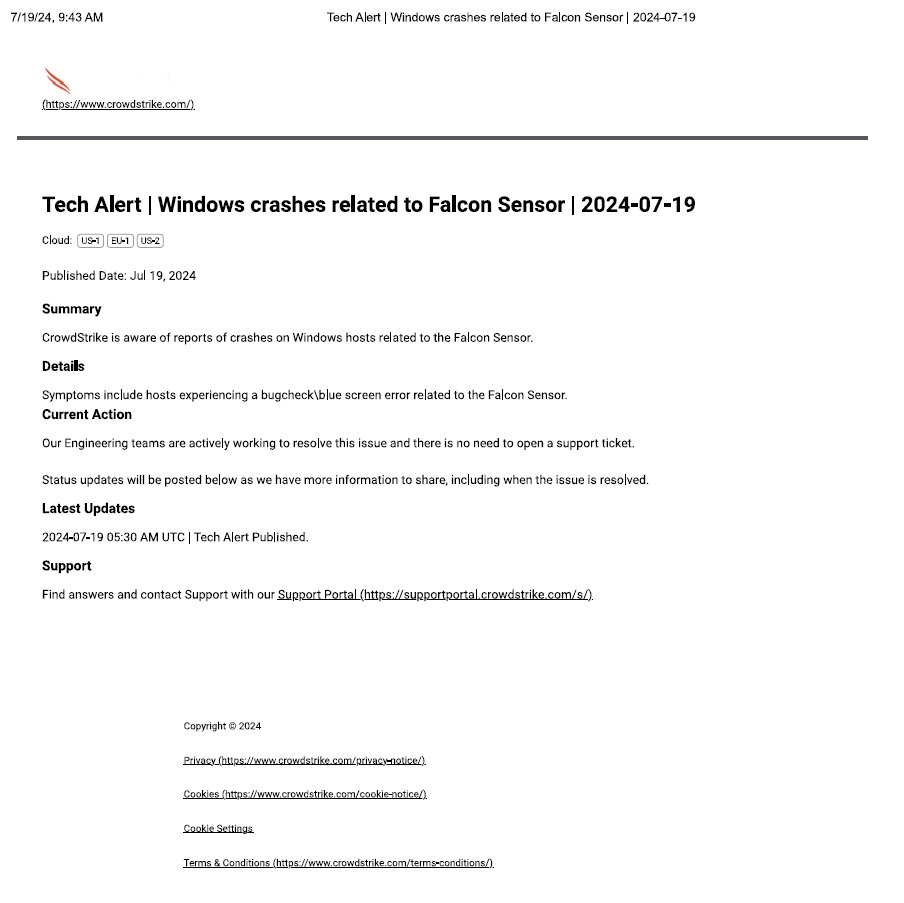
Today, I’m addressing a significant issue affecting numerous Windows users worldwide. Reports have emerged of widespread crashes, commonly referred to as the “blue screen of death,” impacting various critical sectors, from transportation to banking and media.

I spoke with Sarah Julian at BBC Radio WM about the worldwide problems that continue to persist

Understanding the Issue:

The root cause of these crashes has been traced back to an overnight software update for CrowdStrike’s Falcon Sensor. For those unfamiliar, Falcon Sensor is a security tool designed to act as a sentinel for your computer, monitoring and protecting against malicious activities. A single corrupted system file from this update is causing Windows systems to crash upon booting.

Why This Matters:

Windows holds a substantial market share, with 72% of global computers running this operating system. The automatic update to Falcon Sensor has inadvertently introduced a fault, leading to these severe crashes. The update, once applied, seems to corrupt system functionality, causing the dreaded blue screen on countless machines.

Impact Across Sectors:

The ripple effect of this issue is profound. The update has disrupted services across various sectors:

  • Transportation: Both train and plane operations have been hampered.
  • Banking: Financial institutions are facing operational challenges, with payment systems affected.
  • Media: Broadcast systems have been affected, causing interruptions, including Sky News and CBBC.
  • Healthcare: NHS GP surgery systems are impacted, with reports of doctors having to handwrite prescriptions.
  • Emergency Services: Even essential services like emergency call centres have not been spared.
  • Airports: Airports, including Birmingham Airport, have reported issues with check-in services, and operations at the Port of Dover are also impacted.

Al Lakhani, CEO of IDEE, said:

“Many people might be thanking Microsoft for their accidental day off, but countless businesses are suffering due to Microsoft’s and their partners’ failure to maintain their services. This incident underscores the importance of businesses thoroughly researching and vetting their cybersecurity solutions before implementation. Microsoft clearly fell short in this regard, and we are witnessing a cascade of operational failures around the world as a result.”

“CrowdStrike’s platform approach, which relies on a single agent focused on detection, might seem good at first glance, but as we can see, it can create significant issues. For instance, agents require installation and maintenance of software on multiple different OSes, adding layers of complexity and potential points of failure. Moreover, agents can become a single point of failure, as a bad update can compromise the entire network, as seen with the SolarWinds attack.

“The lesson here is blindingly obvious: investing in cybersecurity is not just about acquiring the latest or most popular tools but ensuring those tools are reliable and resilient. This is why businesses must prioritise agentless solutions like MFA 2.0, which reduce the risk of widespread failures and ensure more resilient defences.”

Cloudstrike Falcon Sensor Blue Screen of Death BSOD Global Outage

Current Status and Actions:

Microsoft has acknowledged the problem and stated that a fix is in place. However, this does not immediately rectify the situation for all affected devices. Many computers remain non-functional, and a manual fix may be required. One proposed solution involves removing the corrupted update link to restore system operations.

Security Concerns:

This incident raises critical questions about our reliance on third-party providers and the level of access they have to our systems. The Falcon Sensor update had kernel-level access, the deepest level of system access, which allowed it to cause such widespread disruption.

Tech Alert Windows Crashes Related to Falcon Server

Moving Forward:

As we navigate this challenging situation, it’s essential to stay informed and take proactive steps to secure our systems. Further updates will be provided as new information becomes available and solutions are implemented.

For now, if you’re experiencing issues, consult with your IT department or follow the suggested manual fix to remove the problematic update. Manual intervention is likely to be needed to address the corrupted system file causing the crashes. Stay vigilant and prioritise your system’s security.

The benefits of using HR software

A human resources (HR) software system is a computer-based program that can make it easier to manage staff. From tracking performance and work schedules to monitoring payroll and benefits, HR software can help your HR team manage your staff more efficiently and effectively. This can be particularly useful as your company grows. Below, we explore the benefits of using HR software.

Saves time

HR software can take over routine departmental tasks, saving your team time and allowing them to dedicate themselves to creating a better workplace for your staff. For a start, the software reduces paperwork by ensuring there’s a uniform response to dealing with employee information processes. Plus, by keeping employee information all within the system, you won’t need to sift through physical documents searching for information.

Have important information in one place

HR software keeps important information all within one place. With most companies carrying enormous amounts of data on every employee – much of it confidential – it can take a long time for the HR team to update this manually. With the help of software though, this data is updated quickly allowing your team to focus on more impactful work.

Security

Protecting employee data is crucial. You have a moral duty to protect your staff, and if you fail to then you could end up paying GDPR compensation and a fine should there be a leak. Fortunately, a solid HR software system can bolster your security. Personal information is encrypted to ensure that hackers and unauthorised personell can’t access data even if they manage to get onto the platform.

Track/monitor employees and help them to progress

HR software can also produce sophisticated employee performance data. By tracking this data you and your employees will get instant feedback on performance. This can allow staff to pinpoint precise areas for improvement and also plan ahead with goals to improve towards. With the help of performance data it should help your team consistently become more productive.

Monitor annual leave/sickness

The system can track the number of days an employee is absent without making mistakes – the worry of human error fades away with HR software. Clear management of sick days and leave can avoid time-consuming email trails and ensure that everyone understands the days off they have remaining each year. Again, this can help ease the workload on your HR team so that they can focus on improving the working environment.

The larger your company grows, the more important it is to invest in HR software. As you employ more staff, keeping track of their data becomes less manageable. By using HR software, though, you’ll be well equipped to run an efficient and effective HR team.

Is Your Productivity Tanking While You Work From Home?

A lot of us have been working from home during the COVID-19 crisis, and a lot of us have been finding it comes with its own set of challenges. For some, those challenges are all a matter of mindset or environment. You might be finding it difficult to get used to the fact your coworkers aren’t nearby or have trouble dealing with family and work at the same time. However, a lot of people initially find that it can be a challenge to get as much done from home as they might get in a better catered professional environment. Here, we’re going to look at five technological solutions that can ensure you’re a more productive and efficient worker.

Photo by Vlada Karpovich from Pexels

Know what you’re doing 

First of all, if you’re not certain where to start with your workday, then it’s time to take a strategic look at all of your current deadlines, responsibilities, and projects. Take the time to list out everything you might have to do. Then you can use tools like the https://appfluence.com/productivity/prioritization-matrix/ to see which you should do first. This tool lets you take your to-do list and quickly measure it by which tasks are most crucial and which are most urgent. As such, you won’t be stuck wondering what you should be doing at the start of the day. Five minutes can help you quickly layout the tasks you will be taking care of for the day.

Know when you’re doing it

Once you’ve effectively prioritised your tasks and you know what you’re doing for the day, then it’s all about knowing when you should do it. Workflow management software can help you set aside blocks of time so that you know when you’re going to be working on one thing and when it’s time to move onto the next. It ensures you don’t get stuck on one task for ages but rather you give everything the time that it needs and deserves.

Automate and streamline what you can

If you have any tasks that you have to do on a regular basis or that threaten to become monotonous, it’s important to find a way to standardize them efficiently. If you’re simply chipping away at them bit by bit, it can reduce your engagement with your work in total, making it harder for you to focus even when you get onto another task. There are plenty of tools designed specifically to automate your work, such as https://www.templafy.com/document-automation-software/ that can help you quickly format and standardize documents before you send them off. Look at your most regularly performed processes and see what you can do to automate them.

Make sure you can get what you need from your team

Of course, you’re not going to be doing all of your work, yourself. Most people are going to need to rely on their team at some point and, to that end, quick and effective communication is possible. A decent team collaboration app such as is going to be the basis of many a remote team’s communications. It gives you a centralised space to check your messages, talk about projects, or request help when you need it. If it’s not centralised, then it becomes all too easy to lose track of. After all, people have different communication preferences, be it by using IMs, sending emails, calling directly or otherwise. By centralising it, you get everyone using the same tools and following the same standards, reducing the chances of missed messages and miscommunication.

Get rid of any type of distraction

When it comes to distractions, there are two main types: external and internal. For the external, such as outside noise, you need to make sure you secure the work environment and ask that your family (or whoever you live with) respects your need for privacy and alone time when working. For internal distraction, you need to know what you’re most prone to be distracted by and to block it off. When it comes to working on digital technology, it’s usually the internet. However, there are plenty of tools like https://selfcontrolapp.com/ that you can use to set permissions, blocking your access to websites and social media within work hours. You can even block them entirely on your work device if that would make you feel more comfortable.

The above tech tools should hopefully help you get much more engaged and better organized with the work you do from home. Sometimes, the solution isn’t technological, however, so you need to take a better look at your work environment, too.

The Smart Ebike from Mercedes Benz – Update July 2020

Thanks for visiting this page, which is one of the most popular on my blog. If you would like to help support the us, please consider visiting my Amazon Store. Thanks again for visiting, Matt


Hyuhome Electric Bikes for Adult, Magnesium Alloy Ebikes Bicycles All Terrain,26" 36V 350W 13Ah Removable Lithium-Ion Battery Mountain Ebike for Mens
ADVERTISEMENT: Hyuhome Electric Bikes for Adult, Magnesium Alloy Ebikes Bicycles All Terrain,26″ 36V 350W 13Ah Removable Lithium-Ion Battery Mountain Ebike.

Smart eBike Support in the UK – 1 July 2020

I get quite a large number of messages in the UK requesting assistance with the Smart eBike. Whilst I am also an eBike owner, I also fall into the category of everyone else with regard to problem-solving and troubleshooting issues with our bikes. I have actually reached out to Mercedes Benz and highlighted the issue of ongoing support from them on these bikes, which of course cost all of us a fairly hefty sum of money at the time of purchase. 

Personally, I have struggled to get support with my bike and had to bend several peoples eardrums to get a result after feeling left high-and-dry in the event of needing assistance. I personally was successful getting the repair work done on my Smart eBike whilst also having a Firmware update to boot. The technician at Smart was very helpful and in fact, was excited to be involved in the maintenance of a vehicle that was no longer manufactured. This involved the installation of software on his PC and connection directly to the bike. It might well be a good time for Smart to release this software into the public domain to allow for their customers to continue to maintain their bikes for years to come.

This does continue to feel unfair as I have (like many others) approached bike repair shops for assistance and have got absolutely nowhere! So indeed the only port of call continues to be Mercedes Benz themselves.

So, the official line is that in event of any issues with your Smart eBike, you should contact Mercedes-Benz Customer Care on the following email address [email protected].  I am reliably informed that you will be assisted with your query.

You can also view the Smart eBike Owners manual online using this link. Now read on!!

Matt Porter – 1 July 2020


Last Saturday I visited Lancaster Mercedes in Ipswich, an hour later I left with a beautifully designed and engineered German machine. But this wasn’t an AMG SLK, this was the ‘smart e-bike’.
Continue reading The Smart Ebike from Mercedes Benz – Update July 2020