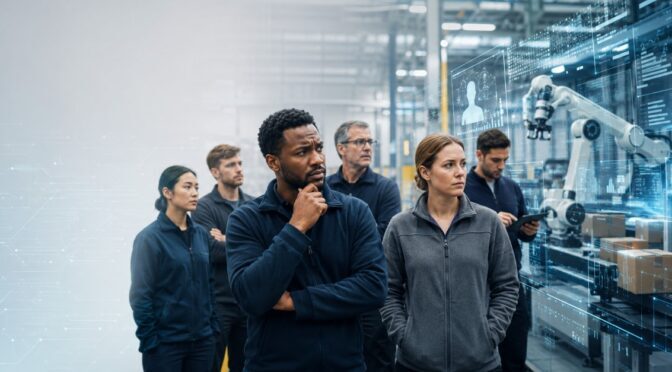
Artificial Intelligence is everywhere at the moment.
It is in our phones, our laptops, our search engines, our photo apps, our cars, our customer service systems and, increasingly, our workplaces. For those of us who love technology, AI is fascinating. I use it, I write about it, I test it, and I can see enormous potential in what it can do.
But there is another side to this story, and it is one we cannot afford to ignore.
A new mass survey by GMB Union has found that almost half of workers are worried AI will take their job. The survey, which questioned 5,294 workers across a range of sectors in May and June 2026, found that 48 per cent are concerned that the introduction of Artificial Intelligence in their workplace could lead to them losing their job.
That is not a small number. That is not a fringe concern. That is nearly one in two workers looking at the rapid rise of AI and wondering whether the machine is coming for them next.
The same survey found that 58 per cent of workers believe AI will take jobs away in their workplace. Almost a third said their employer has already introduced AI, and around a quarter of those said AI is now doing tasks they would usually do themselves.
Perhaps most worrying of all, nearly half said AI is being used to track the activity of them or their colleagues during working time.
AI as a tool, or AI as a workplace watchdog?
That, for me, is where the conversation changes.
There is a world of difference between using AI as a helpful tool and using it as a digital overseer. One can make work easier, safer and more productive. The other risks turning workplaces into something cold, monitored and deeply uncomfortable.
This week, there have also been reports of around 1,000 jobs at Asda’s George brand being affected as the supermarket expands its use of AI and automation. Nestlé is also planning hundreds of job cuts at UK sites, with concerns that many roles could be replaced by AI and robotics.
Robert Battell, a Nestlé worker, is due to speak at GMB’s annual congress in Blackpool about what this means for workers on the ground. His words are stark. He describes the heartbreak of seeing colleagues and friends lose their jobs and be replaced by robots.
And that is the human bit we must not lose sight of.
Behind the buzzwords are real people
Behind every phrase like “efficiency savings”, “automation”, “streamlining” or “digital transformation”, there are real people. People with mortgages, rent, children, caring responsibilities, bills, routines and lives built around the work they do.
I am not anti-AI. Far from it. I think AI could be one of the most important technological developments of our lifetime. Used properly, it can help people work smarter. It can take away dull, repetitive tasks. It can help with accessibility, creativity, admin, logistics, research, design, customer support and countless other areas.
But the key phrase there is “used properly”.
Technology should serve people, not quietly replace them with no safety net.
This is our Industrial Revolution moment
The Industrial Revolution changed the world of work forever. Machines altered entire industries, and society had to adapt. AI feels like another of those moments.
It is not just another piece of software. It is a shift in how work itself is organised, measured and valued.
That means we need a serious conversation about rules, protections and responsibilities.
If AI removes a task, what happens to the person who used to do it? Are they retrained? Redeployed? Supported? Or simply shown the door?
If AI is being used to monitor staff, who decides what is fair? How much tracking is too much? What happens when an algorithm gets it wrong?
And if companies are saving money by replacing people with automation, what responsibility do they have to the communities and workers who helped build those businesses in the first place?

AI is not the enemy
AI is not the enemy. Badly used AI is the problem.
There is a version of the future where AI helps doctors, teachers, engineers, designers, drivers, warehouse staff, office workers and small businesses do more with less stress.
There is another version where it becomes a blunt cost-cutting tool, used to squeeze every last drop of productivity out of people before replacing them altogether.
We still have a choice about which version we build.
The technology is moving quickly. The question now is whether the laws, workplace protections and business ethics can move quickly enough to keep up.
Because if half of workers are already worried AI will take their job, then this is no longer some distant debate about the future.
It is happening now.