Tag Archives: The Gadget Man

UK Government Plans Social Media Ban for Under 16s: A Line in the Sand or a Digital Wake Up Call?

The UK Government has announced what could become one of the most significant changes to children’s online lives in years: a planned ban on social media platforms offering services to children under the age of 16.

Published on 15 June 2026 by the Department for Science, Innovation and Technology, the announcement sets out a bold new direction for online safety, with the Government saying it wants to “give kids their childhood back”.

That is quite a phrase, but it will resonate with many parents. For years, families have been trying to manage smartphones, apps, social media pressure, endless scrolling, online strangers, livestreams, algorithms and, more recently, AI chatbots. It is a lot. In fact, it is probably too much to expect parents to deal with alone.

What is being proposed?

The Government plans to stop social media platforms from offering services to under 16s. According to the announcement, this would include platforms such as Snapchat, TikTok, YouTube, Instagram, Facebook and X.

The proposed model is expected to follow a similar approach to Australia, targeting user to user platforms whose purpose is social interaction, content posting and algorithm driven feeds.

Messaging services such as WhatsApp and Signal are not expected to be included in the social media ban.

The first set of regulations could be brought before Parliament before Christmas, with protections expected to come into force in Spring 2027.

More than just a social media ban

This is not only about banning access to social media apps. The Government is also proposing wider protections around some of the features that can cause harm to children online.

These include restrictions on livestreaming and strangers communicating with children. Importantly, these extra restrictions could apply beyond traditional social media platforms, including gaming sites.

That matters, because a lot of children’s online lives no longer sit neatly inside one app or one category. Social interaction, messaging, livestreaming, gaming and algorithmic recommendations are now all blended together.

The Government says these protections will also be switched on by default for 16 and 17 year olds, to avoid a sudden cliff edge when a child turns 16.

AI companion chatbots are also in the spotlight

One of the most interesting parts of the announcement concerns AI chatbots.

So called AI romantic companion chatbots, designed to simulate sexual relationships or roleplay with users, will be required to enforce a minimum age of 18. Similar intimate features will also be restricted for under 18s on AI chatbots more widely.

This is an important development. AI companion apps are moving incredibly quickly, and many parents may not even know they exist, let alone understand how emotionally persuasive they can be.

As AI becomes more human sounding, more available and more integrated into apps, this area is going to need serious attention. It is not enough to think of online safety as simply blocking rude words or removing harmful posts. We now have systems that can chat, flatter, persuade, roleplay and build emotional dependence.

Age checks will be the difficult bit

The big question, of course, is how this will actually work.

Anyone who has spent more than five minutes around young people and technology knows that children are often extremely good at finding ways around restrictions. The Government says it will learn from Australia’s experience and introduce highly effective age assurance measures to support compliance.

Ofcom will conduct a rapid study into effective age assurance for checking whether someone is over 16. The Technology Secretary has also asked Ofcom for an urgent review of its enforcement capabilities and a clear enforcement strategy.

This is where the whole thing will either succeed or fall apart.

If the age checks are too weak, children will simply bypass them. If they are too heavy handed, adults may rightly worry about privacy, identity checks and handing more personal data to large technology companies.

Getting that balance right will be crucial.

Parents appear to support action

The Government says the announcement follows one of its biggest national conversations, with more than 116,000 responses from parents, children and experts.

According to the Government, 9 in 10 parents said they would support a social media ban for children under 16. It also says two thirds of young people agreed that children younger than 16 should not be allowed to use at least some social media platforms.

That is significant. This is not just adults shouting at TikTok from the sidelines. Many young people appear to recognise that there is a problem too.

Keir Starmer ©House of Commons

Tech companies have had years to fix this

Prime Minister Keir Starmer said tech companies had “their chance and failed”, while Technology Secretary Liz Kendall said companies had “countless opportunities to keep children safe”.

Whether you agree with the exact form of the ban or not, it is hard to argue that the current system is working well.

Children are growing up in an online environment designed by some of the most powerful companies in the world, using systems built to maximise attention, engagement and screen time. The algorithms do not care whether a child has homework, needs sleep, is anxious, is vulnerable, or is being drawn into something harmful.

They are designed to keep people watching, scrolling, reacting and returning.

The Gadget Man view

As someone who loves technology, I do not think the answer is to pretend the internet is bad and children should be wrapped in cotton wool. Technology can be brilliant. It can educate, connect, entertain and inspire.

But childhood should not be outsourced to algorithms.

There is a huge difference between children using technology creatively and children being pulled into endless feeds, livestream pressure, anonymous messaging, harmful trends and AI driven emotional traps.

The challenge is that the online world has become too powerful, too persuasive and too profitable for parents to manage alone. Many families are trying to set boundaries while their children’s friends are all using the same apps, the same platforms and the same online spaces.

That makes it very difficult for one household to say no.

A national rule changes the conversation. It gives parents something firmer to stand on. It also forces the technology companies to design systems around children’s wellbeing, rather than leaving families to pick up the pieces afterwards.

But enforcement and privacy must be taken seriously

There are still major questions to answer.

How will age verification work? What data will be collected? Who will store it? Will smaller platforms be able to comply? Will children be pushed into less regulated corners of the internet? What happens when a child uses a parent’s account or device?

These details matter.

A poorly designed system could create new risks while trying to solve old ones. A well designed system could mark a genuine turning point in how we treat children’s digital lives.

A cultural shift, not just a technical fix

The Government has framed this as part of a wider effort to reclaim childhood, including more access to sport, creativity, nature and the arts.

That is important, because banning or restricting something only works properly if there is something better to replace it with.

Children need places to go, things to do, people to meet and chances to explore the world beyond a screen. If this policy is going to work, it needs to be part of a bigger cultural change, not just a login screen that says “computer says no”.

Final thoughts

This is a landmark moment for online safety in the UK.

The proposed social media ban for under 16s will be controversial, complicated and difficult to enforce perfectly. But the fact that the Government is now prepared to draw a clear line shows how serious the issue has become.

For years, parents have been told to use parental controls, have conversations, monitor screen time and keep up with every new app. Those things still matter, but they are not enough on their own.

The online world has changed childhood. Now the Government is saying it wants to change the online world in response.

Whether this becomes a successful turning point will depend on the details, but one thing is clear: the days of letting tech companies mark their own homework may finally be coming to an end.


When AI Becomes Too Powerful To Export: Anthropic, Fable 5, Mythos 5, and the moment AI became national security

There are moments in technology when you can almost hear the gears of history clicking into place.

Not loudly. Not with fireworks or a bloke in a shiny suit standing on stage telling us that everything has changed. More often, it happens quietly, in a blog post, a government letter, or a hurried statement published late in the day.

This feels like one of those moments.

Anthropic has announced that it is suspending access to its Claude Fable 5 and Claude Mythos 5 models after receiving a directive from the US government. The reason given is national security. The result is that Anthropic has had to abruptly disable the models for all customers, because the order reportedly prevents access by any foreign national, whether inside or outside the United States.

That even includes foreign national Anthropic employees.

Just pause on that for a moment.

We are not talking about a graphics card being shipped overseas. We are not talking about a missile guidance chip, a military radar system, or some piece of exotic lab equipment. We are talking about access to an artificial intelligence model.

Software has just been treated like a controlled strategic asset.

What are Fable 5 and Mythos 5?

Only a few days before this happened, Anthropic had announced Claude Fable 5 and Claude Mythos 5.

Fable 5 was presented as a highly capable model for general use, sitting above Anthropic’s previous Opus class models. It was described as being especially strong at software engineering, research, visual understanding, long running tasks and complex knowledge work.

Mythos 5, meanwhile, appears to be the more restricted version, intended for trusted partners, particularly in areas such as cyber defence and critical infrastructure. In simple terms, Fable 5 was the version with more safeguards. Mythos 5 was the version where some of those safeguards could be lifted for trusted users.

Anthropic’s argument was that these systems could do a great deal of good. They talked about helping cyber defenders secure important software, assisting with scientific research, and accelerating work in areas such as life sciences.

And that is where the difficult bit begins.

The same capability that helps a good actor find vulnerabilities in software can also help a bad actor find vulnerabilities in software. The same intelligence that can help researchers solve hard problems can also lower the barrier for people who should not be anywhere near those tools.

That is the uncomfortable dual use problem at the heart of advanced AI.

The jailbreak question

According to Anthropic, the US government’s concern appears to be around a possible way of bypassing, or “jailbreaking”, Fable 5’s safeguards.

A jailbreak in this context means finding a way to persuade the AI to ignore or work around its safety systems. Anyone who has used AI tools for a while will know that safety systems can sometimes be a bit clumsy. They can refuse harmless requests, misunderstand context, or behave like an over cautious supply teacher on a school trip.

But at the frontier end of AI, the stakes are rather higher than asking for a dodgy limerick or persuading a chatbot to roleplay as an unfiltered assistant. Here, the concern is that a model might be coaxed into helping with cybersecurity work in a way that could be misused.

Anthropic says it has only received limited evidence of a narrow jailbreak and that the vulnerabilities involved were already known and relatively minor. It also says other publicly available models can identify similar issues without needing any special bypass.

That is important, because it gets to the heart of the argument.

If every powerful AI model can be jailbroken in some narrow way, does that mean none of them should be released?

Or does it mean the industry needs layered defences, monitoring, responsible access programmes and clear rules?

Anthropic clearly believes the latter.

A sudden and very public clash

What makes this story so striking is not just the safety issue. It is the speed and bluntness of the response.

Anthropic says it received the directive at 5.21pm Eastern Time and that the letter did not give specific details of the national security concern. The company is complying with the order, but it also says it disagrees with the decision and believes the action was not transparent, fair, clear, or grounded in technical facts.

That is unusually direct language from a major AI company.

It is also a sign of the times. The relationship between AI labs and governments is going to become one of the defining technology stories of the next few years. These companies are building systems that may become essential to business, science, software development, education, defence, healthcare and almost every corner of modern life.

Governments are not going to sit back and treat that as just another app.

When AI Becomes Too Powerful To Export: Anthropic, Fable 5, Mythos 5, and the moment AI became national security

The export control problem

For years, the big AI export control story has mostly been about chips. Who can buy the most advanced GPUs? Which countries can access the hardware needed to train frontier models? How do you stop sensitive capability moving across borders?

This Anthropic story changes the focus.

Now we are talking about controlling access to the model itself.

That opens up a whole set of awkward questions.

  • What happens if a UK business builds a product around an American AI model and access is suddenly removed?
  • What happens to customers who have paid for a service?
  • What happens to employees of the AI company who are not US citizens?
  • What happens when powerful models are used through cloud platforms, APIs, apps and enterprise tools across dozens of countries?

For businesses, this is a bit of a wake up call.

Many companies are now rushing to bolt AI into their workflows. Customer service, coding, document analysis, marketing, finance, legal review, research, data extraction, the lot. But this story is a reminder that access to the most advanced models may not always be guaranteed.

It is not enough to ask, “Which model is best?”

You also have to ask, “What happens if it disappears tomorrow?”

The Gadget Man view

I find this fascinating because it marks a shift in how we think about AI.

For most people, AI still feels like a clever website. You type something in, it replies, and occasionally it makes you wonder whether the future has arrived slightly ahead of schedule.

But at the very top end, these models are becoming more like infrastructure. They are tools that can write code, analyse huge amounts of information, interpret images, reason through complex problems and assist in scientific work. They are no longer just novelty chatbots. They are engines of capability.

And that makes governments nervous.

Some of that nervousness is reasonable. A powerful AI system in the wrong hands could be dangerous. Nobody sensible should pretend otherwise.

But there is also a danger in sudden, opaque intervention. If companies are told to build safely, test thoroughly, work with governments, create safeguards and develop trusted access programmes, then the rules need to be clear. Otherwise, innovation becomes a guessing game.

Anthropic’s frustration seems to be that it believes it did many of the right things. It says it worked with government, carried out extensive testing, used strong safeguards and adopted a defence in depth approach. Yet it still found itself having to pull access almost immediately.

That will worry a lot of people in the AI world.

What does it mean for ordinary users?

For most casual users, probably not much today.

Access to Anthropic’s other models is not affected, and many people will not have been using Fable 5 or Mythos 5 yet. But the wider meaning is more significant.

This is a glimpse of the future of AI regulation.

The most advanced models may not be treated like ordinary software products. They may be controlled, restricted, monitored and sometimes withdrawn. Access may depend on who you are, where you are, what you are doing, and whether a government believes the system crosses a national security threshold.

That might sound dramatic, but it is not science fiction anymore. It is happening.

My closing thought

There is an old pattern in technology.

First, something looks like a toy.

Then it becomes useful.

Then it becomes essential.

Then it becomes strategic.

AI has moved through those stages at a frankly ridiculous speed.

The Anthropic Fable 5 and Mythos 5 story may turn out to be a misunderstanding, as Anthropic suggests. Access may be restored. The details may become clearer. The technical risk may prove to be less dramatic than the government feared.

But even if all that happens, the line has still been crossed.

A government has looked at an AI model and treated it as something powerful enough to restrict on national security grounds.

That is not just a story about Anthropic.

That is a story about where AI is heading next.

And whether we like it or not, the future of artificial intelligence is no longer just about clever prompts, faster coding, or shinier demos.

It is about power, trust, borders and control.

Welcome to the next chapter.


Half of Workers Fear AI Will Take Their Jobs, and I Can Understand Why

Artificial Intelligence is everywhere at the moment.

It is in our phones, our laptops, our search engines, our photo apps, our cars, our customer service systems and, increasingly, our workplaces. For those of us who love technology, AI is fascinating. I use it, I write about it, I test it, and I can see enormous potential in what it can do.

But there is another side to this story, and it is one we cannot afford to ignore.

A new mass survey by GMB Union has found that almost half of workers are worried AI will take their job. The survey, which questioned 5,294 workers across a range of sectors in May and June 2026, found that 48 per cent are concerned that the introduction of Artificial Intelligence in their workplace could lead to them losing their job.

That is not a small number. That is not a fringe concern. That is nearly one in two workers looking at the rapid rise of AI and wondering whether the machine is coming for them next.

The same survey found that 58 per cent of workers believe AI will take jobs away in their workplace. Almost a third said their employer has already introduced AI, and around a quarter of those said AI is now doing tasks they would usually do themselves.

Perhaps most worrying of all, nearly half said AI is being used to track the activity of them or their colleagues during working time.

AI as a tool, or AI as a workplace watchdog?

That, for me, is where the conversation changes.

There is a world of difference between using AI as a helpful tool and using it as a digital overseer. One can make work easier, safer and more productive. The other risks turning workplaces into something cold, monitored and deeply uncomfortable.

This week, there have also been reports of around 1,000 jobs at Asda’s George brand being affected as the supermarket expands its use of AI and automation. Nestlé is also planning hundreds of job cuts at UK sites, with concerns that many roles could be replaced by AI and robotics.

Robert Battell, a Nestlé worker, is due to speak at GMB’s annual congress in Blackpool about what this means for workers on the ground. His words are stark. He describes the heartbreak of seeing colleagues and friends lose their jobs and be replaced by robots.

And that is the human bit we must not lose sight of.

Behind the buzzwords are real people

Behind every phrase like “efficiency savings”, “automation”, “streamlining” or “digital transformation”, there are real people. People with mortgages, rent, children, caring responsibilities, bills, routines and lives built around the work they do.

I am not anti-AI. Far from it. I think AI could be one of the most important technological developments of our lifetime. Used properly, it can help people work smarter. It can take away dull, repetitive tasks. It can help with accessibility, creativity, admin, logistics, research, design, customer support and countless other areas.

But the key phrase there is “used properly”.

Technology should serve people, not quietly replace them with no safety net.

This is our Industrial Revolution moment

The Industrial Revolution changed the world of work forever. Machines altered entire industries, and society had to adapt. AI feels like another of those moments.

It is not just another piece of software. It is a shift in how work itself is organised, measured and valued.

That means we need a serious conversation about rules, protections and responsibilities.

If AI removes a task, what happens to the person who used to do it? Are they retrained? Redeployed? Supported? Or simply shown the door?

If AI is being used to monitor staff, who decides what is fair? How much tracking is too much? What happens when an algorithm gets it wrong?

And if companies are saving money by replacing people with automation, what responsibility do they have to the communities and workers who helped build those businesses in the first place?

AI is not the enemy

AI is not the enemy. Badly used AI is the problem.

There is a version of the future where AI helps doctors, teachers, engineers, designers, drivers, warehouse staff, office workers and small businesses do more with less stress.

There is another version where it becomes a blunt cost-cutting tool, used to squeeze every last drop of productivity out of people before replacing them altogether.

We still have a choice about which version we build.

The technology is moving quickly. The question now is whether the laws, workplace protections and business ethics can move quickly enough to keep up.

Because if half of workers are already worried AI will take their job, then this is no longer some distant debate about the future.

It is happening now.

Tech Meets Tongues: An AI-Powered Multilingual Journey on The Gadget Man

Hello, tech enthusiasts and language lovers! Today, I’m thrilled to unveil something truly groundbreaking at The Gadget Man – a fusion of cutting-edge AI technology with the art of language translation.

This isn’t just any ordinary video. A few years back, I recorded a clip that has now been transformed into a multilingual marvel, thanks to the brilliant minds at San Francisco-based AI company Sync-labs. My voice, originally in English, has been meticulously analysed and cloned. The audio was transcribed and then translated into an array of languages, and here’s the really clever bit – the translated audio has been engineered to sound exactly like me, but in each respective language.

From Swedish to Urdu, each version maintains a natural tone and inflection unique to its language. The result? An impressively accurate lip-synced video of me speaking to the camera in English, Swedish, Dutch, French, Japanese, German, Ukrainian, Italian, Welsh, Urdu, Arabic, Spanish, Thai, Turkish, and, of course, a special digital voice rendition.

The goal here is not just to showcase the wonders of AI but to connect with our diverse audience. We’re breaking down language barriers while keeping the essence of communication – the personal touch.

Now, here’s where you come in. I invite you, our valued visitors, to be part of this exciting journey. Watch the video and let us know what you think of each translation. How well does the AI capture the nuances of each language? Does it sound natural to you? Your feedback is invaluable, as it helps us understand the effectiveness of this technology from a real-world perspective.

Rate each translation and share your thoughts in the comments below. Whether you’re a native speaker or a language enthusiast, your insights will contribute to a broader understanding of AI’s role in breaking down linguistic barriers.

As we embrace this new era of technological advancements, it’s crucial to remember that at the heart of all innovation lies communication and connection. So, let’s explore together the fascinating intersection of technology and language.

Here’s me telling a joke translated to Chinese

and the same joke in German

Stay tuned for more tech explorations and insights right here on The Gadget Man.

AI Transforms Blogging Efficiency (November 2023)

Using AI to Write Blog Posts

In the rapidly evolving digital landscape, artificial intelligence (AI) is no longer just a buzzword but a practical tool revolutionizing various industries, including content creation. Blogging, an integral part of digital marketing and personal expression, is one area where AI’s impact is notably significant. This post delves into how AI is transforming the way we write blog posts, its advantages, potential challenges, and tips for effectively using AI in blogging.

The Emergence of AI in Blogging

AI in blogging isn’t just about automated content generation; it’s about enhancing the writing process. Tools like OpenAI’s GPT-4 offer advanced language models that can draft text, suggest ideas, and even refine content tone. The integration of AI in blogging platforms simplifies tasks such as keyword optimization, grammar checks, and style improvements.

Key Benefits of Using AI for Blogging

  1. Efficiency and Speed: AI can generate drafts quickly, helping bloggers produce content more frequently.
  2. SEO Enhancement: AI tools can optimize content for search engines, improving blog visibility and reach.
  3. Consistency in Quality: AI maintains a consistent quality and tone, crucial for brand messaging.
  4. Idea Generation: It can suggest topics based on trends and user interests, keeping the content relevant and engaging.
  5. Personalization: AI can tailor content to different audience segments, enhancing reader engagement.

Challenges and Considerations

While AI brings numerous benefits, it also poses challenges:

  • Originality: There’s a risk of producing generic content. Balancing AI assistance with personal insight is key.
  • Over-reliance: Sole reliance on AI can diminish a writer’s skill and creativity.
  • Ethical Concerns: Issues like content authenticity and plagiarism need careful consideration.
AI Transforms Blogging Efficiency (November 2023)

Tips for Using AI in Blog Writing

  1. Start with a Clear Goal: Define what you want from the AI tool – be it generating ideas, creating drafts, or editing.
  2. Blend AI with Personal Touch: Use AI for the heavy lifting, but add your insights and experiences to make the content unique.
  3. Regularly Update AI Parameters: Keep the AI tool aligned with your evolving content strategy and audience preferences.
  4. Monitor Performance: Use analytics to understand how AI-generated content performs and refine your approach accordingly.
  5. Stay Informed: Keep up-to-date with AI advancements to leverage new features and capabilities.

Conclusion

AI in blogging is a powerful tool when used wisely. It can enhance the quality and efficiency of content creation while providing valuable insights into audience preferences. However, the heart of a great blog post still lies in the human touch – the experiences, insights, and personal stories that AI cannot replicate. Balancing AI capabilities with human creativity is the key to successful blogging in the AI era.

In embracing AI, bloggers are not replaced but empowered, equipped with tools to create more impactful, relevant, and engaging content. The future of blogging with AI looks promising, offering endless possibilities for content creators worldwide.

This is an update of the original blog post Using AI to Write Blog Posts and using newer versions of ChatGPT (version 4)  and Midjourney (version 5.2)

This post was written by ChatGPT 4 (AI)
Tags produced by a plugin written by ChatGPT4 which utilises the GPT3.5 Turbo API
Images created using Midjourney (AI)
All cut and pasted by Matt Porter The Gadget Man (Human)

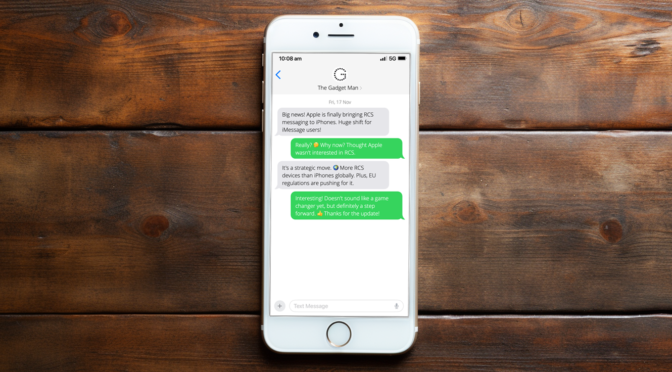
Apple Embraces RCS Messaging on iPhones: A Subtle yet Significant Shift.

Apple’s recent announcement about supporting Rich Communication Services (RCS) on iPhones has caused quite a stir in the tech community. This move, which integrates a standard long-resisted by Apple, signals a significant shift in the company’s approach to messaging services. We delve into the implications of this development, guided by insights from Dario Betti, CEO of the Mobile Ecosystem Forum (MEF).

A Politically Balanced Approach

Dario Betti comments, “Apple had resisted integrating the standard until now: its CEO, Tim Cook, said it did not see customer demand for RCS in 2022. The announcement is a politically balanced approach: it introduces the new technology without celebrating it.” This reflects Apple’s strategy to incorporate new technology while maintaining its stronghold with iMessage and its business messaging ventures. Betti adds, “It is an RCS announcement, and not an ‘RBM’ (RCS Business Messaging), but the news is big – even if expected to an extent.”

Impact on the Messaging Ecosystem

While this announcement marks a notable change, Betti believes it’s too late to unsettle established players like WhatsApp. He states, “The announcement is too late to provide a real worry for a player such as WhatsApp. The change will not affect its usage base immediately.” However, he doesn’t rule out the potential challenges for Meta and other messaging companies if Google and Apple push for deeper integration of RCS in the future.

Why Now? The Driving Factors Behind Apple’s Move

The reasons behind Apple’s decision to support RCS are multifaceted. Betti suggests, “User Experience: SMS/MMS interconnection for advanced messaging was becoming unsustainable for Apple. Messaging is now much more advanced.” He also points out the growing RCS uptake, noting, “MEF announced in October that there are an estimated 1.2 billion devices supporting RCS globally, surpassing the number of iPhones.” Additionally, regulatory pressure from the European Union’s Digital Markets Act, which aims for messaging interconnection, likely played a role in this decision.

Conclusion

Apple’s integration of RCS is more than a mere technical update; it’s a strategic move that balances its existing services with the evolving demands of the market and regulatory pressures. While it might not immediately disrupt the messaging landscape, it lays the groundwork for potential shifts in the future. Apple’s step towards RCS reflects a broader trend in the tech world – the continual evolution and adaptation to changing user needs and regulatory environments.


For more detailed insights on Apple’s RCS announcement, visit 9to5Mac. Stay tuned for more tech updates and analyses at The Gadget Man.

Gadget Man – Episode 175 – The Copper Switch Off: A Necessary Evil or a Step too Far?

This morning, I had an enlightening discussion with Tammy Gooding on BBC Radio Hereford and Worcester regarding the ongoing broadband infrastructure enhancements, particularly in light of the Copper Switch-off as announced by Openreach. This move is all about transitioning from the traditional copper wire systems to a more robust and faster digital infrastructure, aiming to future-proof our towns and villages.

However, not everyone seems to be on board with this tech transition, as exemplified by the recent uproar in the picturesque Worcestershire village of Broadway. The crux of the matter unfurled as broadband poles started sprouting up, much to the dismay of the local populace. It seems Full Fibre, the provider spearheading this initiative, hit a nerve when their wooden poles, standing tall at up to 11 meters, started altering the village skyline.

The discontent among the residents morphed into a full-blown protest, with nearly 80 individuals rallying to halt the erection of these broadband poles in Avrill Close. The agitation escalated when a 75-year-old villager, David Owen, took a stance quite literally by spending more than four hours in one of the lorries brought in by the contractors.

This brings us to the question – is the infrastructural overhaul a necessary leap towards a digital future or an imposition disregarding the public sentiment? I tend to lean towards the necessity of upgrading our digital infrastructure, especially when the world is rapidly shifting towards a more connected existence. The Copper Switch off, as discussed on Openreach’s blog post, is a significant stride towards ensuring that the UK’s telecommunications infrastructure is not left in the digital dust.

The saga in Broadway sheds light on the teething issues that such infrastructural transitions entail. On one side, we have Full Fibre asserting their commitment to addressing concerns and emphasizing the critical nature of their work in upgrading the UK’s digital skeleton. On the flip side, the residents feel slighted, their concerns seemingly brushed under the rug, as they see these poles as nothing more than “ugly eyesores” marring their beautiful village.

Lisa Kelly, a villager, encapsulated the general sentiment by stating that they already have satisfactory broadband speeds and do not see the need for these poles. The word “disenfranchised” was used, painting a picture of a community feeling left out of a decision that directly impacts them.

The episode also invited the presence of West Mercia Police officers to ensure the situation remained under control, illustrating the extent of discord between the advancement of digital infrastructure and public approval.

These infrastructural enhancements are a double-edged sword. They promise a digital leap but at the cost of unsettling the communal harmony, at least temporarily. The Broadway scenario is a microcosm of the broader dialogue between technological advancement and community consent.

The future is exciting, but the path there should be paved with understanding and cooperation.

Using AI to write blog posts

In today’s fast-paced digital world, it’s no surprise that many businesses and individuals are turning to artificial intelligence (AI) to help them with various tasks, including writing blog posts. AI technology has come a long way in recent years, and it has the potential to help bloggers save time and improve the quality of their content.

Using AI to write blog posts - created by Midjourney
Using AI to write blog posts – created by Midjourney

One of the biggest advantages of using AI to write blog posts is that it can help save time. Rather than spending hours researching, outlining, writing, and editing a blog post, you can use AI to quickly generate high-quality content. This can be especially useful if you’re crunched for time or if you need to produce a large volume of content on a regular basis.

Another advantage of using AI to write blog posts is that it can help improve the quality of your content. AI technology can analyze your existing content and use that information to generate new posts that are similar in style and tone. This can be especially useful if you want to maintain a consistent voice and tone throughout your blog. Additionally, AI can use natural language processing to ensure that your content is well-written and easy to read.

Of course, using AI to write blog posts is not without its challenges. One of the biggest challenges is that AI technology is not yet capable of fully replicating human creativity and intuition. As a result, your AI-generated content may not always be as engaging or original as content that is written by a human. Additionally, AI technology is still in its early stages, and it may not always produce error-free content.

Despite these challenges, using AI to write blog posts can be a valuable tool for bloggers who are looking to save time and improve the quality of their content. As AI technology continues to advance, it’s likely that we’ll see even more sophisticated tools that can help bloggers generate high-quality content quickly and easily. In the meantime, it’s worth considering using AI to write blog posts if you’re looking for ways to streamline your content creation process and produce high-quality content on a regular basis.

This post was written by ChatGPT (AI)
Tags produced by ChatGPT (AI)
Images created using Midjourney (AI)
All pasted by Matt Porter The Gadget Man (Human)

New tech solution will address the ‘cocktail party problem’ 

  • Leading listening tech provider, Nuance Hearing, has launched a state-of-the-art directional microphone to help address the ‘cocktail party problem’. 
  • The ‘cocktail party problem’ – an inability to understand speech in a noisy environment – can affect up to 41 per cent of adults, according to research. 
  • The Voice Selector Converse uses built-in microphones and an advanced algorithm to track the source of sounds, allowing the user to easily focus on a conversation and tune out background noise. 
  • In tests, users were able to understand speech on average three times better than without the product. 
Nuance Hearing - New tech solution will address the 'cocktail party problem' 
Nuance Hearing – New tech solution will address the ‘cocktail party problem’

Nuance Hearing, a leading global provider of focused listening technology, has launched a new device that provides powerful relief from auditory distraction and background noise. 

The Voice Selector Converse helps overcome challenging hearing situations for those who struggle with the ‘cocktail party problem’, offering a tech solution to understand conversations in a crowded room, without the need for hearing aids. 

Using cutting-edge beamforming technology, eight built-in microphones track the source of sounds, reducing the level of background noise and enabling the user to focus on the dominant voice. The result is a world-leading directivity index (the relative reduction of overall noise in relation to the target sound) of 15dB in real-time performance, which compares to an industry-standard of 4-5dB. This improvement helps the listener to focus, effortlessly tuning out the sounds that do not matter and tuning into the ones that do. 

In audiology testing, users were able to understand speech on average three times better than without the product. 

Ori Goren, CEO of Nuance Hearing, said: “Since 2015, we have been delivering powerful and advanced hearing solutions that deliver optimum performance. We know that many people in the UK are suffering in silence, unable to feel comfortable or enjoy conversing in busy environments, and are proud to have launched an innovative tech solution to help combat this. Through innovative technological solutions, we are passionate about improving the quality of life for a diverse group of people, making every environment more accessible and helping ensure personal success and empowerment.” 

New research* suggests that 41 percent of all UK adults admit to having the ‘cocktail party problem’ where they struggle to understand speech in a noisy environment. Over a third (36 percent) said noisy environments caused them stress and anxiety and 60 percent of those with hearing problems said they would be open to trying out tech to help them hear in a busy environment.

The Voice Selector Converse has unique auto-steering technology which picks up the dominant speaker, even when they are moving about. Alternatively, the user can manually switch between speakers when conversing a group. 

It also captures, processes, and plays audio at a record speed of six milliseconds (0.006 seconds). It’s a multifunctional device and can be used as a table microphone or remote microphone – ideal for most scenarios where background noise can be an issue. 

Hearing loss currently affects 12 million people in the UK. The World Health Organisation estimates that 1 in 5 people worldwide live with hearing loss, expected to rise to 1 in 4 by 2050. Unaddressed hearing loss can have a devastating impact on people’s ability to communicate, study and earn a living. It can also impact on people’s mental health and their ability to sustain relationships1 and has recently been associated with a faster degree of cognitive decline. On average, people wait ten years before getting help for hearing loss. The ‘cocktail party problem’ where people have difficulty understanding speech in noisy situations can often be the first sign of a hearing loss.                                                                          

Franki Oliver, audiology specialist, RNID, said:“While it might not seem obvious at first, having difficulty understanding speech in background noise is usually one of the early signs of hearing loss. The ‘cocktail party problem’ is the name used to describe the brain’s inability to filter out background noise and tune into what someone is saying in a busy environment. Most people with hearing loss experience difficulty in these situations. 

“It’s important to check your hearing if you start to notice difficulty in background noise, feel that people mumble, or you ask people to repeat themselves. It’s second nature for people to have their eyes checked regularly but we don’t have the same attitude towards getting our hearing checked yet. The sooner hearing loss is identified, the earlier someone can start benefiting from life-changing hearing devices. Hearing loss can also be linked to conditions such as dementia so early intervention is vital.”

Cashing In: First Look at the EV Charger that gives you Rewards and Puts Your on the Road to Net Zero, Simply by Plugging In

The demand for convenient, intelligent, and incentivised electric vehicle charging has been met with the launch of the INDRA Smart Pioneer.

Unveiled to drivers for the first time at Fully Charged OUTSIDE 2021, INDRA’s Smart Pioneer signals a new standard for electric car charging. With a simple plugin and go message for users, the charger is an intuitively smart piece of kit, making it easy for drivers to shift their charging patterns to off-peak times, save money and earn rewards.

Indra Smart PRO at Fully Charged OUTSIDE

Coupling leading technology with reliability, the Smart Pioneer helps drivers to reduce their environmental impact. By managing their charging schedule and shifting up to 80% of energy use to off-peak tariffs, it can lessen the demand on the grid and see customer carbon emissions fall by an average of 20%.

Working in tandem with the ev.energy companion app, the rewards platform automatically taps into the times when energy is at its cheapest, and offers rewards back, meaning drivers can claim over £250* per year in energy savings, retail incentives and get involved in projects like local tree planting to help offset their carbon emissions.

Ben Kelsey, Chief Operating Officer at Indra, chatting to Matt Porter at Fully Charged OUTSIDE

Commenting on the benefits of smart charging sessions Indra’s founder and chief technology officer, Mike Schooling, comments:

“Households that drive a lot of miles on electricity, and charge mostly on electricity, need smart charging to avoid putting more demand on the UK’s power supply. We know that drivers are happy to shift their charging patterns to off-peak times, but they need peace of mind that it will be simple to do and reliable so that when they get in their car at 6 am for work they can get straight on the road.”

Continuing to break down charging barriers, INDRA’s latest product builds on the initial success of its Smart PRO. With an extended 5-year warranty, the Smart Pioneer also offers all the same benefits as the INDRA Smart PRO, including smart-scheduling, house-fuse protection, solar panel integration and advanced safety features – meaning EV drivers can guarantee safety and ultimate utilisation of renewable energy.

INDRA Founder and CTO Mike Schooling, ev energy and Robert Llewellyn with the INDRA Smart Pioneer

Schooling, further adds: “Electric car sales have surged to 17% market share and innovative, smart charging is key to greater uptake of electric cars so that number keeps rising. The launch of our Smart Pioneer is a step-change in the smart optimisation of EV chargers and will be the world’s first commercially available V1G product that rewards customers for being flexible with when they charge their EV at home.”

The Smart Pioneer collaboration between INDRA and ev.energy sees drivers getting rewards passed on from the V1G smart charging technology, something which is a world-first proposition from a charge point company.

V1G charging varies the time and rate at which an electric vehicle is charged to respond to surges in power demand. This type of smart charging can harness extra revenue, above a driver’s tariff savings, by accessing flexibility services across the distribution operator and National Grid.

The Smart Pioneer uses leading technology to aggregate thousands of devices to provide a local or national response to grid events and when revenue is generated, shares those back with drivers.

Nick Wooley, CEO at ev.energy, concludes: “We’ve admired INDRA for a really long time, they have a fantastic history of building great products so we’re really excited to be partnering to bring even more drivers cheaper, greener charging.”

For more information about the Indra Smart Pioneer, visit: https://www.indra.co.uk/smart-pioneer-ev-charger