Gadget Man Dots Logo

AI and the Future of Work: Are We Excited, Terrified, or Just Trying to Keep Up?

There are moments in technology when you can almost hear the gears of history turning.

I remember when having a computer in the office made you “the computer person”. I remember dial-up modems, fax machines, early websites, clunky email systems, and the strange magic of watching a machine do something that previously required a drawer full of paper, a telephone call, and usually someone called Janet who knew where everything was filed.

Artificial intelligence feels like one of those moments, except this time the machine is not just helping us type the letter. It is writing the letter, summarising the meeting, drawing the logo, coding the website, generating the video, and quietly eyeing up half the tasks we thought were safely ours.

AI and the Future of Work: Are We Excited, Terrified, or Just Trying to Keep Up?

A new report from The Policy Institute at King’s College London, AI and the Future of Work, gives a fascinating snapshot of how the British public, workers, students and employers are feeling about all this.

And the overall picture is not simple optimism. It is more like standing in front of a very clever robot vacuum cleaner that has suddenly learned accountancy.


We are wary, but we know it is coming

One of the most interesting findings is that the public are more negative than positive about AI, yet many people still expect to use it.

Almost half of the public say they would rather avoid AI-based technologies, 41% say they are afraid of AI, and only 24% think AI is positive for humanity. Yet 43% agree they will use AI in the future.

That feels very human to me.

It is the same feeling we had when smartphones began taking over our pockets. We complained about them, worried about them, said they were ruining attention spans, then used them to check the weather, order a takeaway, find a route, take photos of the dog and pay for parking.

AI may be following the same path, only with rather larger consequences.

Parents are looking at this very differently

The part of the report that really lands is the section about parents.

Half of parents with children under 30 say they are worried about how AI will affect their children’s career prospects. Yet only around three in ten parents of 11 to 29-year-olds have actually had a conversation with their child about how AI might affect their future career, and a similar number have encouraged them to learn how to use AI tools.

That gap matters.

Because whether we like AI or not, pretending it is not happening is not a strategy. The best advice we can give young people is probably not “avoid AI”, but “understand it, question it, and learn how to use it better than the next person”.

When I was younger, knowing your way around a computer gave you an edge. Then knowing the web gave you an edge. Then knowing social media, search engines, ecommerce, video, and automation gave you an edge.

Now the edge may come from knowing how to work alongside AI without becoming completely dependent on it.

The fear is not just science fiction

The report also shows that concern about jobs is widespread.

Seven in ten people are worried about the economic impact of job losses caused by AI, and majorities of the general public, young people, university students and workers believe AI will eliminate far more jobs than it creates.

That is not a small worry. That is not people muttering about robots in the pub. That is a mainstream concern.

There is also a particularly sharp anxiety around entry-level roles. The report notes that many people believe AI could eliminate half of all entry-level white-collar jobs within five years.

This is where I think the real danger lies. Not necessarily in AI replacing every professional overnight, but in it quietly removing the first rung of the ladder.

Most of us learned by doing the boring stuff first. We answered support calls, updated spreadsheets, wrote simple copy, fixed small bugs, processed orders, filed things, checked things, tested things, and gradually became useful.

If AI takes away the junior work, where exactly do the next generation learn?

You cannot become experienced without first being inexperienced.

Employers are more optimistic, but even they are worried

Employers are generally more positive about AI than the wider public, but they are not blindly cheerful.

According to the report, 63% of employers are worried about the economic impact of job losses caused by AI, even while many are excited about new jobs opening up.

That is the strange contradiction at the heart of this whole debate.

AI is both an opportunity and a threat. It can help small businesses move faster, reduce admin, improve customer service, generate ideas, speed up research and make previously expensive tasks accessible to people working from a spare room.

But it can also concentrate power.

One of the starkest findings is that 65% of the public think the economic benefits of AI will mainly go to wealthy investors and large companies, while just 7% think the benefits will be shared fairly across society.

That is probably the bit we should be talking about more.

The question is not simply “will AI be clever?” It clearly will be. The question is “who benefits?”

My view from the Gadget Man shed

I use AI. I find it fascinating, useful, occasionally infuriating, sometimes astonishing and often a little unsettling.

It can be like having an enthusiastic assistant who has read everything, forgotten where it read it, and sometimes confidently hands you a screwdriver when you asked for a banana.

But used properly, it is powerful.

For people like me who create websites, write content, tinker with servers, make videos, build odd little systems and generally chase ideas down rabbit holes, AI can be a genuine productivity boost.

It can help you get from “I wonder if this is possible?” to “here is a working prototype” much faster than before.

But I do not think we should confuse productivity with progress.

If AI helps a small business survive, brilliant. If it helps a student learn, excellent. If it helps someone with a disability communicate, create, work or live more independently, fantastic.

If it simply allows large companies to employ fewer people while making a handful of shareholders wealthier, then we have built something clever but not necessarily something good.

The future is not automatic

Technology does not arrive with a moral compass fitted as standard. We decide how it is used.

That means schools, parents, businesses and government all have some catching up to do.

Young people need to understand AI not as magic, but as a tool. Workers need training, not vague reassurance. Employers need to think about responsibility as well as efficiency. And the rest of us need to keep asking awkward questions.

AI is coming into the workplace whether we welcome it with open arms or hide behind the photocopier.

The important thing now is not to panic, but not to sleepwalk either.

We have been here before with big technological shifts, but this one feels faster, wider and stranger.

The machine is no longer just on the desk.

It is in the conversation.


Source: King’s College London, The Policy Institute, “AI and the Future of Work”, May 2026.

The Anatomy Of Seamless Colleague Onboarding

If you run a business, you know how hard it can be to get a new colleague up to speed on how your organisation works. There’s a lot of administration and effort involved, and you sometimes wonder whether it’s even worthwhile.

Many companies do a poor job with onboarding. Low-quality firms often leave it mainly to the person who has just joined, expecting them to figure out how things work and what they should do next. That approach is a great way to increase churn. People don’t like staying at companies that don’t appreciate them or show them the ropes.

So, what are some ways you can improve your onboarding and make it easier?

Use pre-onboarding skeleton

Large companies that bring on dozens of new staff every month often have a pre-onboarding skeleton. The goal is to build systems that make onboarding easier.

For example, you could add a lightweight welcome portal to your IT system so that when new staff get their login credentials, they can start work almost immediately and feel productive right away. You can also use administrative de-risking, such as pre-filling forms for banking deposits or benefits enrollment. That can speed up the process and let you get more done faster. If you have blank profiles ready to go, all you need to do is type in the new colleague’s name.

Find a reliable partner

The next step is to find a reliable partner for your onboarding. You need the best ID card printer you can find to ensure you always have the components required to integrate the new staff member. 

Don’t choose the cheapest option, like a lot of brands do. That usually doesn’t lead to the best outcome, and you may end up regretting the day you decided to go with the person offering the lowest price.

Instead, check the quality and make sure you understand your partner thoroughly before bringing them on board. Make sure they can deliver new ID cards and credentials quickly, so you’re not left waiting.

Respect the new colleague’s nervous system

Seamless colleague onboarding means respecting the new team member’s nervous system. Do not dump them into four hours of compliance training right away. They will not be able to absorb that information, along with everything else they need to do that day.

Instead, optimise the day so they feel like they belong. Get them set up on Slack if needed, and assign a welcome ambassador someone they can go to with basic questions, even something as simple as the location of the bathroom.

If you can implement a buddy system, that helps too. When colleagues have a peer mentor who is not their manager, they are better able to get a handle on how the company operates and what they should be doing.

Provide tooling and integration

After the first couple of days, the final task is to provide the new colleague with the tools and integrations they need. This helps build their operational muscle. For example, you could offer short training on your tech stack or provide more clarity on their specific role over the next 90 days.

These Online Shopping Mistakes Could Hurt Your Business’s Reputation

Your business’s reputation always matters, but when you’re in the business of selling things online, hurting the trust in your image can be even more dangerous than usual. Trust is what turns an interested visitor into a converter customer, so you have to be keenly aware of where it can be broken, as well as the steps you can take to prevent that from happening.

Hidden Costs

Customers do not want to be surprised with hidden costs right at the end of checkout. Any unexpected shipping fees, taxes, or service charges are going to leave them feeling misled. Not only can this lead to shopping cart abandonment, but it can also completely undermine any trust you’ve built in your brand, making them less likely to return in the future. Display all costs early and clearly, so customers know precisely what they’re going to pay, and highlight any options they have to adjust those costs, such as delivery options. When customers feel control, they’re a little more willing to accept the reality of fees.

Not Using Business Payment Processors

If you’re using payment methods that are designed and recognised more for personal payments, then it harms your business more than you think. You should stop using Zelle for business, as peer-to-peer apps like those aren’t designed for professional transactions and might lack the protections your customers expect, such as anti-fraud features. Furthermore, they can lack the protections your business needs, as well, leaving you open to chargebacks. You might even be violating the rules of personal payment platforms by using them for business, which can see you losing the account entirely, meaning customers lose their means of paying. Using a dedicated payment processor is much more reliable, secure, and compliant. 

Allowing Poor Website Performance

Nowadays, there really is no excuse for slow or unreliable websites. Customers are easily able to find competitors with pages that load quickly, images that display correctly, and navigation that works without broken links. Take the time to test your website routinely, looking for crashes, glitches, or any broken assets that you can optimise and improve. If you need to upgrade your website host to make sure that it runs effectively, then it’s a cost well worth paying.

Letting Fake Reviews Stand

You’re occasionally going to get negative feedback and reviews. These aren’t great, but if they’re balanced with positive reviews, as well as thoughtful and productive responses from you, then their harm is mitigated. Fake reviews, however, can tilt that balance against you, distorting how people see your business and what you provide, misleading buyers, and losing your sales. If reviews are demonstrably false, then you can report them and have them removed. Moreover, you should encourage customers to leave reviews on sites that include verification services, so any potential future customers are able to see that they’re from those who have legitimate experience with your business.

Your online reputation and the perceived legitimacy of your business are built on trust, established by transparency and consistency. Address the issues mentioned above and focus on a secure and fulfilling customer experience to help your business get the growth it needs.

What Customers Expect From Your Website’s Checkout

When you’re running a business website, the checkout process is the real test of how much your customers are willing to trust and rely on your business. If you’re not able to convince them of your legitimacy or provide the assurances they need that their transactions are secure, then they’re a lot more likely to abandon the shopping cart than at any other point. As such, here, we’re going to look at the factors that need to be in place.

Speed

Delays hurt your business. This is perhaps most demonstrably true when it comes to your checkout process. Customers expect it ot move quickly without long loading times, unnecessary pages, or repeated processes. The more time it takes, the more time doubt has to creep in, and the more customers are likely to abandon their carts. Keep the process simple with easy layouts, as few steps as possible, and by allowing autofill. 

Transparent Pricing

Customers don’t want surprises during checkout. As such, they expect product costs, taxes, delivery charges, discounts, and any additional fees to be clearly stated before they pay. Hidden costs are one of the fastest ways to lose trust and get them to give up on a purchase. Display shipping options and any other factors that are going to affect the price upfront, where possible, giving more transparency and allowing the customer to feel more in control of their costs.

Trusted Payment Methods

When it comes time to actually pay, customers want to be sure that they’re able to trust you with their financial information. Or, rather, they typically would prefer a recognisable and trusted API hosted payment integration to handle the transactions for them. These can offer fraud protection and data encryption that assures customers that their financial details aren’t going to end up in the hands of anyone they can’t trust, and are designed to handle transactions more smoothly, on top of that.

Predictable Navigation

Just as customers want their checkout process to be as efficient and speedy as possible, they also want a good idea of how many more steps it’s going to take. Breadcrumb navigation can help you break up the process into its chief steps, such as cart, shipping, payment, and confirmation, and shows customers which step of the journey they’re on at every point. When they’re able to see the progress they’re making towards the end, they’re more likely to stick it out.

Mobile Friendliness

More and more people are shopping directly from their phones, so you could be ignoring significant portions of your audience if you don’t cater to the mobile shopping experience. Provide checkout pages that work smoothly on smaller screens, with buttons, forms, and payment fields that can adapt to the change in space and layout. Loading speed is even more important on mobile, too, as poor connections can cause inefficient websites to become tortuously slow, so testing and optimising where possible is crucial. 

If your checkout process doesn’t tick all of your customers’ boxes, then you need to go back to the drawing board. Otherwise, you can end up losing more sales than you make.

I created my own awesome comic strip using ChatGPT

Every now and again, a piece of technology comes along that makes me grin like a child who has just found a secret compartment in a toy robot. This week, that technology was ChatGPT image generation.

I started with a simple idea: what if The Gadget Man was not just a blog, a podcast, or a bloke surrounded by cables, 3D printers, strange gadgets and half-finished ideas, but an actual comic book hero?

Not a cape-wearing superhero. Not someone bitten by a radioactive soldering iron. Just a gadget-loving chap with a cup of tea, a slightly dangerous number of ideas, and the ability to solve problems with technology, common sense and the occasional dramatic pose.

So I gave ChatGPT a photo of myself and typed the following prompt:

This is The Gadget Man, create a 2 page american style comic strip about him stopping a cyber attack by martians

First Draft of The Gadget Man

And there it was. A full two-page comic book spread featuring The Gadget Man battling Martians who were attempting to take over Earth’s systems. It had panels, speech bubbles, glowing screens, alien spaceships, dramatic lighting, and just the right amount of over-the-top comic book nonsense.

There was one small problem. In the final panel, instead of the crowd saying “Thanks Gadget Man!”, the speech bubble said “Thanks Gadget Giant Man!”

So I simply replied:

the last panel says THANKS GADGET GIANT MAN!, it should say THANKS GADGET MAN!

And ChatGPT corrected it.

The Gadget Man and The Alien Cyber Attack

That was the moment it really clicked. This was not just asking a computer to make a picture. This was creative direction. I could guide the scene, spot issues, refine the result, and build a series.

The Gadget Man Comic Universe Begins

Once the first comic was created, I did what any sensible adult would do. I immediately made several more.

The next prompt was:

Excellent, create another comic about Gadget Man visiting Scotland and saving them from EV Charger problems

The Gadget Man and the Mystery of the Scottish EV Chargers

This produced a wonderfully ridiculous adventure in which The Gadget Man travels north of the border to rescue Scotland from faulty EV chargers, broken apps, signal problems and confused motorists. There were Highland cows, charging stations, Scottish scenery, and, naturally, the sort of technological tinkering that saves the day.

Then came one of my favourites:

Create another comic featuring Gadget Man 3d Printing an elaborate controller for use with his VR headset to play Elite Dangerous

The Gadget Man and the 3d Printed Elite Dangerous Controller

This one was pure Gadget Man territory. 3D printing, VR, Elite Dangerous, switches, buttons, joysticks, wiring, and a controller that looked as though it had been designed by someone who had spent far too long thinking, “You know what this game needs? More buttons.”

After that, Vanessa joined the adventure.

Create another comic featuring Gadget Man and his sidekick wife Vanessa. Their adventure is finally getting away for a break at the coast

Gadget Man and Vanessa go to the Coast

The result was a seaside adventure featuring Gadget Man and Vanessa finally escaping for a well-earned break, only to find that even a trip to the coast can turn into a heroic mission when technology, transport and holiday chaos collide.

Of course, Vanessa deserved a break from all this madness, so I followed up with:

Create another comic featuring Gadget Man looking after the house whilst Vanessa spends two well deserved days at a Spa Retreat

The Gadget Man: Vanessa goes to the Spa

This produced a domestic disaster story full of smart home alerts, robot vacuums, laundry mountains, kitchen chaos and Gadget Man attempting to maintain order while Vanessa relaxed in peace. In other words, science fiction with a suspicious amount of truth in it.

Finally, I went bigger. Much bigger.

create another comic book featuring Gadget Man. This time he goes to the ISS to correct it’s orbit

The Gadget Man Saves the ISS

Yes, The Gadget Man went to space. The International Space Station had an orbital problem, and naturally the only person qualified to give it “a little nudge” was a man with a tool belt, a mug of tea, and an alarming level of confidence.

To finish the project, I also created a header image for this very article:

create a header image in the same style showing The Gadget Man creating the comic using ChatGPT

I created my own awesome comic strip using ChatGPT

That image showed The Gadget Man at his desk, creating comics using ChatGPT, surrounded by gadgets, screens, sketches, tools and the usual creative chaos. It perfectly captured what this whole experiment was about.

Why This Is Possible Now

What makes this so interesting is not simply that ChatGPT can generate an image. Image generators have existed for a while. The difference now is the conversational workflow.

OpenAI describes ChatGPT Images as a tool that can create new images and edit existing ones directly inside ChatGPT. You can ask for an image in plain English, refine it, adjust the composition, and explore new visual directions without needing to start from scratch each time. OpenAI also notes that recent image generation models are designed to follow prompts more accurately, render text more effectively, and use chat context, including uploaded images, as visual inspiration

That last point is important. I was not typing a technical command into a complicated art package. I was having a conversation. I could say “make this a two-page American-style comic strip”, then “change that wording”, then “now do one in Scotland”, then “now add Vanessa”, and ChatGPT understood the creative thread.

It feels less like using software and more like working with an incredibly fast illustrator, layout artist, letterer and visual brainstorming partner, all rolled into one.

The Magic Is in the Iteration

The real power here is not the first image. It is the second, third, fourth and fifth version.

Traditional creative work often involves a long gap between idea and result. You sketch, brief, wait, revise, wait again, make changes, and eventually arrive at something close to what you imagined.

With ChatGPT, the loop is much shorter. You can create a concept, respond to it, correct it, extend it, and build a whole fictional world in minutes. OpenAI’s own guidance highlights this ability to generate and refine images using clear prompts, request variations, adjust composition or size, and produce polished visuals quickly.

For someone like me, with a head full of odd ideas, half-remembered pop culture references, gadgets, stories, jokes, and technical rabbit holes, this is incredibly powerful.

I do not need to stop at “Wouldn’t it be funny if…”

I can actually see it.

What This Means for Artists

Now, this is where things become more complicated.

As exciting as all this is, it also raises serious questions for artists, illustrators, designers and the wider creative industry.

On one hand, tools like ChatGPT could be hugely empowering. They allow people who cannot draw to visualise ideas. They help writers create concept art. They help small businesses produce mock-ups, campaign ideas, storyboards, social media graphics and playful content that might previously have been out of reach.

For independent creators, this could be a revolution. A blogger can create a comic strip. A podcaster can build a visual world. A small business can prototype adverts. A game designer can test character ideas. A 3D printing enthusiast can imagine packaging, instructions, posters, comics and product artwork without needing a full design department.

But there is another side.

Professional artists have every right to be concerned. If companies decide to replace commissioned artwork with AI-generated images purely to save money, that has consequences. If the visual language of artists is absorbed, imitated and mass-produced without care, credit or fair compensation, that is not something we should casually ignore.

There is also the question of value. Art is not just the finished image. It is experience, taste, judgement, intention and human interpretation. A good artist does not simply “make a picture”. They solve visual problems. They understand emotion, framing, symbolism, storytelling and audience. AI can generate astonishing things, but it does not live a life. It does not have childhood memories, favourite comics, personal grief, humour, nostalgia or the strange little sparks that make human creativity so fascinating.

A Tool, Not a Replacement for Imagination

The way I see it, ChatGPT does not remove the need for creativity. It shifts where the creativity happens.

The prompt matters. The idea matters. The direction matters. The ability to look at an image and say “that is nearly right, but the final speech bubble is wrong” matters.

In my Gadget Man comic experiment, ChatGPT created the images, but the idea came from a very human place: my own interests, my humour, my love of gadgets, my fondness for comic book drama, my 3D printing obsession, my VR tinkering, my family life, and my lifelong habit of turning ordinary things into stories.

That is where I think these tools are at their best. Not replacing imagination, but amplifying it.

The Future of Comic Creation?

Will AI-generated comics replace traditional comics? I hope not.

Will they change how people make comics? Almost certainly.

We may see writers using AI to storyboard ideas before handing them to professional artists. We may see artists using AI for rough concepts, layouts, backgrounds or experimentation. We may see hobbyists creating personal comics for fun, families, blogs and social media. We may also see new kinds of hybrid workflows where human creators and AI tools sit side by side.

There will be arguments, and there should be. Creative industries need rules, ethics, transparency and respect for human artists.

But there is also something genuinely wonderful about being able to type a sentence and watch a ridiculous idea become visible.

Final Thoughts

What started as a quick experiment became a whole mini comic universe.

The Gadget Man fought Martians, fixed Scotland’s EV chargers, 3D printed a controller for Elite Dangerous, went on holiday with Vanessa, survived domestic chaos during a spa weekend, corrected the orbit of the ISS, and then sat down to create the comics using ChatGPT.

That is absurd.

It is also brilliant.

For me, this is exactly what technology should do. It should unlock ideas. It should make us laugh. It should help us create things that would otherwise remain trapped in our heads.

And if it occasionally turns “Gadget Man” into “Gadget Giant Man”, well, that is all part of the adventure.

Another day. Another gadget. Another comic created.

Gadget Man Signing Off

SJCAM SJ30: The Action Camera That’s Finally Built for Everyday Life

There’s a certain expectation that comes with action cameras. Snowboards, skydives, mountain bikes flying down impossible trails… you get the idea. But what if most people just want to capture life?

That’s exactly where the new SJCAM SJ30 steps in, and it’s a rather interesting shift in thinking.

Not Just for the Extreme Crowd

Rather than chasing the usual “extreme sports” narrative, SJCAM has positioned the SJ30 as a daily recording camera. That means something a bit more relatable. Commutes. Family days out. Travel. Those spontaneous moments that don’t come with a helmet cam and a GoPro mount.

It’s a subtle but important repositioning, and one that makes a lot of sense.

According to the launch material, the SJ30 is designed to prioritise what most people actually care about: image quality, audio clarity, battery life, low-light performance, and simplicity.

Dual Lenses, One Clear Goal

At the heart of the SJ30 is a dual-lens system that pairs a daylight sensor with a dedicated starlight sensor. The idea here is straightforward. Consistent performance whether you’re filming in bright sunshine or capturing a city scene at night.

That second sensor is doing the heavy lifting in low light, an area where action cameras have traditionally struggled.

And yes, it does tick the resolution box too, supporting up to 8K video at 20fps and 4K at 60fps.

Designed for the Way People Actually Shoot

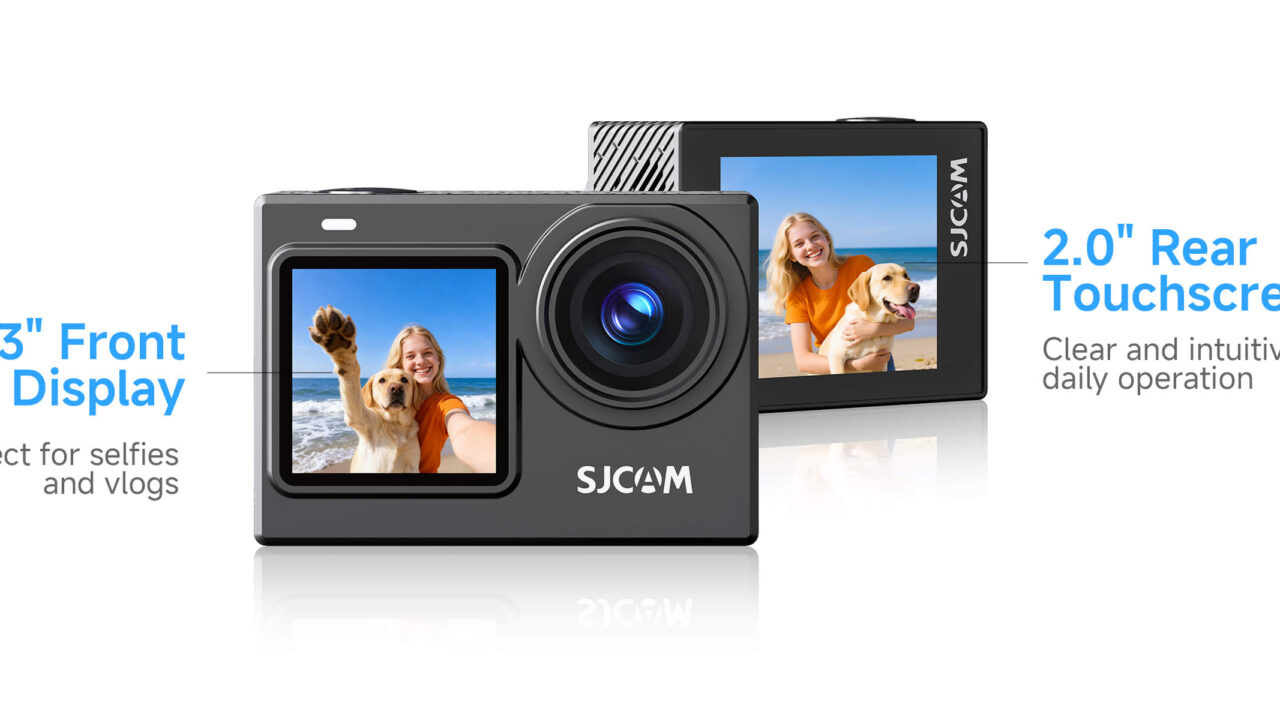
One of the more practical touches is the 2.51-inch flip touchscreen, which rotates 180 degrees. In other words, it’s built with solo creators in mind. No guesswork framing, no awkward angles.

Add in voice control, and you’ve got something that leans heavily into hands-free use. Ideal if you’re travelling, cycling, or just juggling too many things at once.

There’s also native vertical video support up to 5K, which means content can be captured as intended for social platforms, rather than cropped afterwards.

Keeping Things Steady

Stabilisation is handled by what SJCAM calls SteadyMotion 2.0, backed by a six-axis gyroscope. In simple terms, it’s there to smooth things out when life gets a bit… bumpy.

A built-in 45-degree horizon lock helps keep footage level too, even when the camera isn’t.

Built to Keep Going

Battery life is another area where the SJ30 leans into real-world use. With a 2000mAh internal battery and optional power handle, it can deliver up to seven hours of continuous recording at 4K.

That’s less “quick clips” and more “just leave it running and capture everything.”

Audio, Mounting and Practical Touches

Sound hasn’t been overlooked either. A detachable wind guard and support for a wireless microphone aim to improve audio quality in outdoor or high-motion environments.

There’s also a magnetic quick-release mounting system, which feels like one of those small but genuinely useful features. No fiddling about when you want to switch setups.

Ready for Real Conditions

Despite its everyday focus, the SJ30 hasn’t forgotten its action camera roots. It’s waterproof to 5 metres straight out of the box, or up to 30 metres with an optional case, and designed to operate in temperatures ranging from -20°C to 60°C.

So yes, it’ll still handle the more adventurous moments if they come along.

A Different Take on the Category

What stands out here isn’t just the spec sheet. It’s the intent.

The SJ30 isn’t trying to outdo every other action camera on extreme performance alone. Instead, it’s redefining what an action camera is for.

Less adrenaline. More everyday storytelling.

And perhaps that’s exactly what the category has been missing.

Price & Availability
The SJ30 is available now, priced at around £195.

SAYPH: The Smartphone That Isn’t Trying to Be Everything

There’s a quiet shift happening in the world of tech. For years, smartphones have been on a relentless march toward doing more, showing more, and demanding more of our attention. Now, a UK startup called Sayph is heading in the opposite direction… and it’s rather refreshing.

Sayph has unveiled what it describes as the UK’s first responsible smartphone for children aged 8 to 16. Not a cut-down adult device. Not a standard handset wrapped in layers of parental controls. Instead, this is something altogether different, a phone designed from the ground up with a very specific purpose in mind.

A Middle Ground That Actually Exists

For many parents, the decision is a familiar dilemma. No phone at all, or a fully fledged smartphone with all the baggage that comes with it. Social media, open internet access, endless notifications… it’s a lot.

Sayph positions itself squarely in the middle.

Out of the box, the device focuses on the essentials. Calls, one-to-one messaging, and location tracking. That’s it. No social media apps. No app store. No web browser unless a parent explicitly decides to enable it.

This isn’t about locking things down after the fact. It’s about starting from a place of simplicity and control.

Built Different, Not Bolted On

What makes this interesting is the philosophy behind it. Most devices rely on add-ons and restrictions layered over a standard smartphone experience. Sayph flips that approach completely.

Everything is intentional.

Contacts must be approved. Communication is controlled. And instead of navigating endless menus and toggles, parents use a companion web app designed to give clear oversight without turning into a full-time job.

It’s less about surveillance, more about structure.

Independence Without the Noise

Co-founder Ben Humphrey sums it up neatly, describing the challenge many families face today: giving children independence without exposing them to the pressures of always-on digital life.

Walking to school. Visiting friends. Staying in touch. These are the real-world use cases Sayph is built around.

Not scrolling. Not chasing likes. Not being pulled into the endless gravity of online platforms.

Fellow co-founder Ami Penolver frames it slightly differently, positioning the device as pro-childhood rather than anti-technology. It’s a subtle but important distinction, and one that feels increasingly relevant.

Pricing and Positioning

At £189 for the handset and £5 per month for the parental platform, Sayph is clearly aiming to sit in an accessible space. Not a premium luxury device, but not a disposable gadget either.

It’s a considered purchase. One that reflects a shift in thinking about what a child’s first phone should actually be.

Tech With a Social Angle

There’s also an interesting layer beyond the hardware itself. Sayph has built a social impact model into its rollout.

For every ten devices purchased within a school, one is donated to a pupil premium child. For every hundred devices sold overall, another is provided to a looked-after child.

It’s a small touch, but one that hints at a broader ambition. Not just selling devices, but shaping how children access technology in the first place.

There’s something quite compelling about a product that deliberately does less. In a market obsessed with features, specs and endless capability, Sayph feels like a bit of a reset button.

A phone that knows exactly what it’s for… and more importantly, what it isn’t.

And in today’s world, that might just be its biggest feature.

Available now at Sayph

Anthropic’s Project Glasswing Could Change Cybersecurity Forever

There are moments in tech when you read an announcement and immediately realise that something important has shifted.

That was very much my reaction when I came across Project Glasswing, a newly announced initiative from Anthropic that is aimed squarely at one of the biggest looming problems in modern computing: what happens when AI becomes exceptionally good at finding software vulnerabilities. Source

According to Anthropic, Project Glasswing brings together a heavyweight list of partners including Amazon Web Services, Apple, Broadcom, Cisco, CrowdStrike, Google, JPMorganChase, the Linux Foundation, Microsoft, NVIDIA and Palo Alto Networks, all with the goal of securing critical software for what Anthropic calls the AI era. It is also extending access to more than 40 additional organisations that build or maintain important software infrastructure. Source

Now, that alone would be interesting enough, but the real headline here is the model sitting behind it all.

Anthropic says its unreleased model, Claude Mythos Preview, has already demonstrated the ability to find and exploit software vulnerabilities at a level beyond all but the most skilled human experts. That is a huge claim, and if it holds up in practice, it means we may have crossed into a very different phase of cybersecurity. Source

In plain English, this is not just about a chatbot helping someone write a bit of code more quickly. This is about AI being able to inspect complex software, spot weaknesses that humans and automated tools have missed for years, and in some cases work out how those weaknesses could be exploited. Anthropic says the model has already found thousands of high-severity vulnerabilities, including flaws affecting major operating systems and web browsers. Source

Some of the examples are rather startling. Anthropic says Mythos Preview uncovered a 27-year-old vulnerability in OpenBSD, a 16-year-old flaw in FFmpeg, and even chained together several Linux kernel vulnerabilities in a way that could escalate ordinary user access into full control of a machine. The company says those issues have now been responsibly disclosed and patched. Source

That, to me, is the bit that really lands.

Because for years we have tended to think of cybersecurity in terms of patching known issues, following best practice, keeping software up to date and hoping the really serious flaws are found by the good people before the bad people. But if AI systems are now reaching the point where they can autonomously discover dangerous bugs in code that has survived decades of scrutiny, then the pace of both defence and attack could increase dramatically. Source

Anthropic is clearly trying to frame Glasswing as a defensive first move. The company says it is committing up to $100 million in usage credits for Mythos Preview and $4 million in direct donations to open-source security organisations. The idea seems to be to put these capabilities into the hands of defenders, infrastructure operators and maintainers before similar systems become more widely available. Source

And that is probably the most sensible angle here.

Because whether we like it or not, the genie is not going back in the bottle. If one frontier AI lab can build a model that is frighteningly good at vulnerability discovery, others will too. Eventually, those capabilities will spread further. The question is not really whether AI will reshape cybersecurity. It is whether defenders can get enough of a head start to stop things getting seriously messy. That is an inference from Anthropic’s announcement and the examples it gives, rather than a direct claim from the company, but it feels like the unavoidable conclusion. Source

For those of us who run websites, servers, ecommerce platforms, mail systems or anything else connected to the wider internet, this should be a bit of a wake-up call. The old approach of leaving systems half-maintained, delaying updates, or assuming that obscure software will somehow stay below the radar looks even more risky in a world where AI can inspect code at speed and scale.

Project Glasswing may turn out to be remembered as one of those early milestone moments, the point where the cybersecurity industry publicly acknowledged that AI is no longer just a helpful assistant for defenders. It is becoming a serious force multiplier, and one that could work for either side.

That makes this announcement both exciting and slightly chilling.

And, in true Gadget Man fashion, it is exactly the kind of development that reminds us technology is never just about shiny new tools. It is also about consequences, responsibility and how quickly the world has to adapt when the rules suddenly change.

Source

Anthropic, Project Glasswing: Securing critical software for the AI era

VIZO Steps Into the AR Arena with Cinema-Scale Smart Glasses

There is a quiet but unmistakable shift happening in wearable tech. What once felt like science fiction is edging closer to something you might genuinely throw in your bag alongside your phone and headphones. Enter the VIZO V1 AR Glasses, a new entrant aiming to make augmented reality feel less like a novelty and more like an everyday companion.

Backed by audio and hardware specialist TOZO, VIZO is positioning its debut product as a practical, usable piece of kit rather than a futuristic curiosity. And on paper, it makes a strong first impression.

A Pocket Cinema You Can Wear

VIZO Steps Into the AR Arena with Cinema-Scale Smart Glasses

The headline feature here is the 118 inch virtual display, effectively turning the glasses into a personal cinema screen. Pair that with Full HD resolution, a 41 degree field of view, and a claimed 100,000 to 1 contrast ratio, and you are looking at something designed squarely for media consumption.

What makes it more interesting is the 1800 nit brightness, which is unusually high for this category. That matters because one of the long standing weaknesses of wearable displays has been usability outside dimly lit rooms. VIZO is clearly pushing the idea that this is something you can use on a train, in a park, or sat by a bright window without everything washing out.

Designed for Real Life, Not Just Demos

One of the biggest hurdles for AR glasses has always been comfort. If they are awkward or fatiguing, they simply do not get used.

VIZO claims to have leaned heavily into real world testing here, producing a lightweight and balanced design intended for longer sessions. There is also built in myopia adjustment up to 500 degrees, which is a genuinely practical touch. It means a chunk of users can skip prescription inserts altogether and just dial things in.

That sort of thinking suggests this is less about impressing at a trade show and more about surviving daily use.

Plug, Play, and Get On With It

VIZO Steps Into the AR Arena with Cinema-Scale Smart Glasses

Connectivity is refreshingly straightforward. The V1 uses USB C with DisplayPort support, meaning it should work with a wide range of devices including smartphones, laptops, and even games consoles.

No convoluted pairing process. No ecosystem lock in. Just plug it in and go.

That simplicity could be one of its biggest strengths, especially for anyone who has wrestled with early VR or AR setups that felt like assembling a small satellite before you could watch a film.

More Than Just a Screen

Audio is handled via integrated stereo speakers, and there is support for switching between 2D and 3D viewing modes. That points towards a flexible use case, from streaming films to casual gaming or even just expanding your screen real estate when working on the move.

It is not trying to be a full mixed reality headset. Instead, it sits in an interesting middle ground between entertainment device and productivity tool.

VIZO Steps Into the AR Arena with Cinema-Scale Smart Glasses

A New Name to Watch?

VIZO itself is a relatively new brand, founded in 2025 and built around the idea of “Tech Around You.” That philosophy comes through quite clearly here. The V1 does not attempt to reinvent computing, but rather slips into your existing setup and enhances it.

Whether it succeeds will depend on real world adoption, but the direction is promising. AR does not need to be dramatic to be useful. Sometimes it just needs to work.

The VIZO V1 is available now via TOZO’s store and Amazon UK, signalling a fairly confident launch rather than a tentative experiment.

Final Thoughts

We have seen plenty of ambitious AR concepts over the years. Many have dazzled briefly before fading away under the weight of complexity or impracticality.

What makes the VIZO V1 interesting is that it appears to be aiming for something far simpler. A wearable screen that just works, wherever you happen to be.

And in 2026, that might be exactly what this space needs.

VIZO V1 AR Glasses Available from Amazon for around £399

Artificial Intelligence, Technology, News and Gadget Reviews on air, online, in print and in person