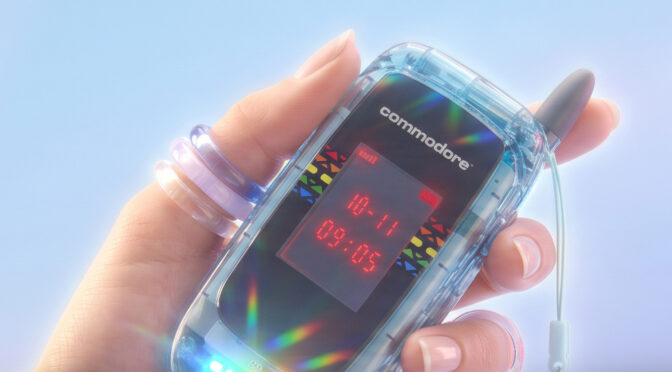
The Commodore Callback 8020 combines retro styling, modern essentials and a refreshingly firm rejection of endless scrolling. For me, the Commodore name also brings back memories of the VIC-20 that first led me into coding
There are certain technology brands that immediately transport you back to a particular moment in your life.
For me, Commodore is one of them.
As a teenager, I owned a Commodore VIC-20. By modern standards, it was extraordinarily limited, but to me it felt like a doorway into the future. It was the machine that introduced me to programming and started me on the path into coding, computers and, eventually, the career I have today.
So when Commodore announces a new piece of hardware, I cannot help but take notice.
The latest arrival is called the Commodore Callback 8020, and it is not another conventional smartphone competing to offer more apps, more notifications and more reasons to stare at a screen.
Instead, Commodore has created a flip phone designed to help us disconnect.
A Phone That Is Smart Enough
Commodore describes the Callback 8020 as the phone between a smartphone and a dumbphone.
It does not include conventional web browsing or social media. Those features are blocked at system level, rather than merely hidden behind parental controls or screen-time reminders. The idea is to remove the temptation altogether.
At the same time, the Callback is not completely cut off from the modern world. It supports messaging through services including WhatsApp, Signal and Telegram, alongside SMS and MMS. It also offers maps, podcasts, music, voice notes, QR code scanning, a calendar, a Wi-Fi hotspot and other practical tools. ls like an interesting compromise.
Many so-called minimalist phones go so far in removing functionality that users end up carrying a smartphone as well. The Callback appears intended to retain enough useful features to become an everyday phone, while removing the applications and services most likely to pull you into hours of scrolling.
Email and workplace apps are not offered through the Callback app store either, although Commodore says advanced users will be able to sideload compatible apps, apart from blocked browsers and social platforms. The message is clear: when you have finished work, you should be able to finish work. ish OS Rather Than Android
The Callback 8020 runs a customised version of Sailfish OS, developed in partnership with Finnish technology company Jolla.
Sailfish is a Linux-based mobile operating system with roots in the work carried out by former Nokia engineers. It provides an independent alternative to the familiar Android and iOS ecosystems.
Commodore says the phone can run more than 99 per cent of Android applications through a secure compatibility environment, although apps that depend heavily on Google Play Services, including some banking applications, may not work completely. There is no Google Play Store and no standard Google account requirement. e of us who remember when the computer market was filled with genuinely different platforms, operating systems and ideas, that in itself is rather appealing.
Proper Retro Details
Commodore has not simply stuck its logo on a generic flip phone.
The Callback includes several details intended to connect it with the company’s computing history. It features SID-inspired ringtones and music playback, a selection of Commodore 64 games and an external display influenced by Commodore calculators from the 1970s.
There is also a replaceable battery, interchangeable rear covers and a proper 3.5mm headphone socket. These are all things that used to be perfectly normal before smartphones became sealed glass rectangles that were almost impossible to personalise or repair.
The phone also includes five softly glowing notification LEDs. Rather than constantly lighting up the main screen with messages and alerts, the LEDs can provide simple indications that something requires your attention. A physical privacy switch can also be used to disconnect the device when you really want to go off-grid. act of closing a flip phone creates a natural endpoint. You finish the call or message, snap the handset shut and put it away. There is no glowing screen waiting to offer another video, notification or suggested post.
More Capable Than It Looks
Although the Callback is deliberately restrained, the hardware is not entirely basic.
It includes a 48-megapixel Sony rear camera, a front-facing camera for video calls, HD audio hardware, an FM radio and support for lossless music. The phone uses a MediaTek Helio G81 processor with 4GB of memory and 64GB of internal storage.
Connectivity is limited to 4G rather than 5G, but that decision fits the product’s philosophy. This is not a phone intended for streaming endless high-resolution video. It is designed for calling, messaging, navigation, music and other everyday tasks. has Snake, which feels compulsory for any flip phone with Nokia engineering heritage somewhere in its family tree.
The Commodore Connection
The Callback name is also a clever piece of Commodore history.
The model number follows the Commodore 8010 modem, while also referencing the company’s association with the 1980s and the phone’s early-2000s design influences. Commodore even sold a branded rotary telephone in Canada during the 1980s, so this is not technically the company’s first phone. however, the emotional connection remains the VIC-20.
That computer did not try to conceal how it worked. You switched it on and were presented with a BASIC prompt. It encouraged experimentation. You could type something, run it and immediately see what happened.
It invited you to participate rather than simply consume.
That experience led me into coding and helped shape a lifelong fascination with technology. It is why the Commodore name still means something to me more than four decades later.
The Callback 8020 is a very different machine, but I can see a little of that original philosophy in it. Technology should be useful, understandable and enjoyable. It should help us do something, rather than constantly demanding our attention.
Price and Availability
Pre-orders for the Commodore Callback 8020 are now open, with the latest official product listing showing prices starting at $399 before tax.
It will be available in several distinctly Commodore colour schemes, including BASIC Beige, ProtoPET White, SX Silver, a translucent Starlight Edition and a gold-accented Founders Edition. UK customers should be aware that orders are processed in US dollars and VAT is added where required. not a review, and I have not handled or tested the Callback 8020. It is still progressing through final software optimisation and regulatory compliance testing, so real-world performance and battery life remain to be seen. less, I find the idea enormously appealing.
At a time when almost every technology company is competing for more of our attention, Commodore is proposing a phone that actively encourages us to put it down.
For someone whose journey into technology began with a Commodore VIC-20, it is genuinely exciting to see the name attached to something imaginative again.
The Callback 8020 may look backwards for its styling, but its central idea could hardly be more relevant to the way we live today.