Twenty years ago, we all relied on photographic film when taking pictures of friends, family or interesting places and landmarks. We were always very careful how and when we took these photos as at the time exposures were limited to either 24 or 36, there was also the case of having the photos developed by the nearest lab. The entire process would take from days to weeks depending on whether we were to wait until our return from our holidays.
Oh, how things have changed! We can now snap away with abandon and anything and everything! There is now no limit to how many photos we take, the storage on our cameras or phones allowing for thousands. If we do begin to fill up our devices, we can push these photos to ‘the cloud’ and start again.
In this episode, I speak to BBC Radio Suffolk about how many photos we now store and how we can safely store them away for future generations. I also talk about the possibility of hardware failure which can result in the loss of our memories.
Following reports of an increase in car-related crime, I spoke to Mark Murphy on BBC Radio Suffolk about what can be done to reduce the chances of falling foul to Keyless Car Crime.
Keyless Keyfobs are devices that have come to replace the ‘traditional’ car entry methods which required us to actively press a lock/unlock button on our fobs. Instead the car constantly ‘polls’ the keyfob and when you within a short distance of the vehicle, automatically opens its to allow for entry. It also enables the driver to start and stop the car using on dash buttons.
As is usual, technology strives to make our lives easier, but also it seems gives criminals new opportunities to steal our vehicles. Readily available gadgets can be purchases specifically to scan for these ‘handshake’ signals between car and fob and upon interception, thieves can drive the cars with an instantly cloned device.
It is important to note that many cars will allow the car to be driven even if the key is no longer present. Check with your manufacturer if this is the case with your vehicle.
Rather than concentrate on the specific technology to achieving this wireless theft, drivers should concentrate in the short term on how they can ensure their cars are secure.
Leading car security organisation, Thatcham Research have published a list of steps we as drivers should follow to ensure this security. This very list has been adopted by Police forces across the UK.
Contact your dealer and talk about the digital features in your car. Have there been any software updates you can take advantage of?
Check if your keyless entry fob can be turned off. If it can, and your dealer can also confirm this, then do so overnight.
Store your keys away from household entry points. Keeping your keyless entry fob out of sight is not enough – thieves only need to gain proximity to the key before amplifying the signal.
Be vigilant. Keep an eye out for suspicious activity in your neighbourhood – and report anything unusual to the Police.
Review your car security. Check for aftermarket security devices such as Thatcham-approved mechanical locks and trackers, which are proven to deter thieves. A list can be found on the Thatcham Research website, here.
You can also download the Suffolk Constabulary ‘Tips for Drivers’ factsheet below. I have also included links to key pouches that block scanners. These can be purchased from Amazon using the links below.
Don’t forget to ‘Like’, ‘Subscribe’ and of course ‘Comment’ and stay tuned for our reviews and comment.
Security Tips for Drivers with Keyless Entry Vehicles – Suffolk Police
The Genie is now officially out of the bottle! We use our smartphones too much!
Most of us will already know this though, how could we miss it? You only have to travel on buses, trains and planes to see myriads of people sitting quietly staring at their smart phones, glued to Facebook, Snapchat or Twitter, scrolling through the latest news.
In restaurants alongside the place settin will sit a smartphone, ready at a moments notice to be snatched up and used to photograph a plate of food of a group selfie.
At rock concerts, the crowd is now lit up by mobile phone screens at they live stream or record a band whilst watching on those same screens, perhaps forgetting to watch and enjoy the band live rather than by proxy.
A designated ‘Cellphone Sidewalk’ in Chongqing, China. Photo credit: China Daily/Reuters
In homes across the world, millions of people are sitting scrolling through their devices, then standing and walking into the kitchen, the phone still in front of their faces, then to bed, when finally after another 10 minutes of messaging, the phone is plugged in to finally rest and recharge, it’s peace only broken in the middle of the night as a hand reaches out to grab it and check Facebook.
Apple iPhone 8 and 8 Plus are one of the most popular smart phones in the UK Image Credit: Apple
As morning breaks, a sleepy hand reaches out, slowly grabs the device and the day begins again.
This information overload is affecting peoples brains, our bodies are fooled by the blue light from an LCD screen and now we believe it is daylight 24 hours a day. We are conditioned to rely on our devices for everything, for affirmation from our friends, to give that affirmation back in a pre-formatted ‘Sending Hugs 🤗🤗🤗’ .
So, have we forgotten how to communicate? Are we now so reliant on our smartphones, that we no longer feel the need to use it for it’s original purpose? That of speaking to people and conveying our true feelings without relying on pre-programmed ’emotions’ invented by clever people in California.
Samsung Galaxy S9 with Infinity display providing vast displays in the palm of your hand. Image Credit: Samsung
Time will tell, but no amount of intervention by software giants will put that Genie back. We as a race have to take that step.
I spoke to Mark Murphy at BBC Radio Suffolk about the obsession with smart phones this morning. Listen to the stream above, I would love to read your comments on the subject.
The cashless society is economic model that removes physical money from our wallets and replaces it with fully digital transactions. So, we no longer carry banknotes and coins, instead we carry our traditional bank cards or mobile devices. These transactions can be made in our home currencies (in my case Pound Sterling), an international currency or even a digital currency such as Bitcoin or Ethereum. When using our traditional currency, we can completely remove a ‘standard’ bank from the equation and use alternatives from Paypal or Amazon.
Apple Pay and Google Pay give us access to our bank accounts to transact contactless payments using our mobile devices and also track our payments using linked cards, thus attempting to give us the best of both worlds. The sting in the tail is the utterly endless opportunities to spend at will which will surely lead to intervention by governments to protect individuals from spending above their means.
Consequently, cashless and contactless systems give us greater power to transact business quickly and painlessly. However, whilst online and large businesses can easily transfer to these systems, there is a great danger of smaller businesses being completely crowded out either by lack of infrastructure or lack of funds.
Yesterday, I was interviewed by Tony Gillham at BBC Guernsey about the cashless society and how businesses in remoter islands in the Bailiwick, such as Alderney, can continue to transact business in a rapidly cashless world.
Listen in by clicking the link above. If you have a comment, please feel free to add your opinions below. Don’t forget to like and subscribe and I look forward to hearing from you soon.
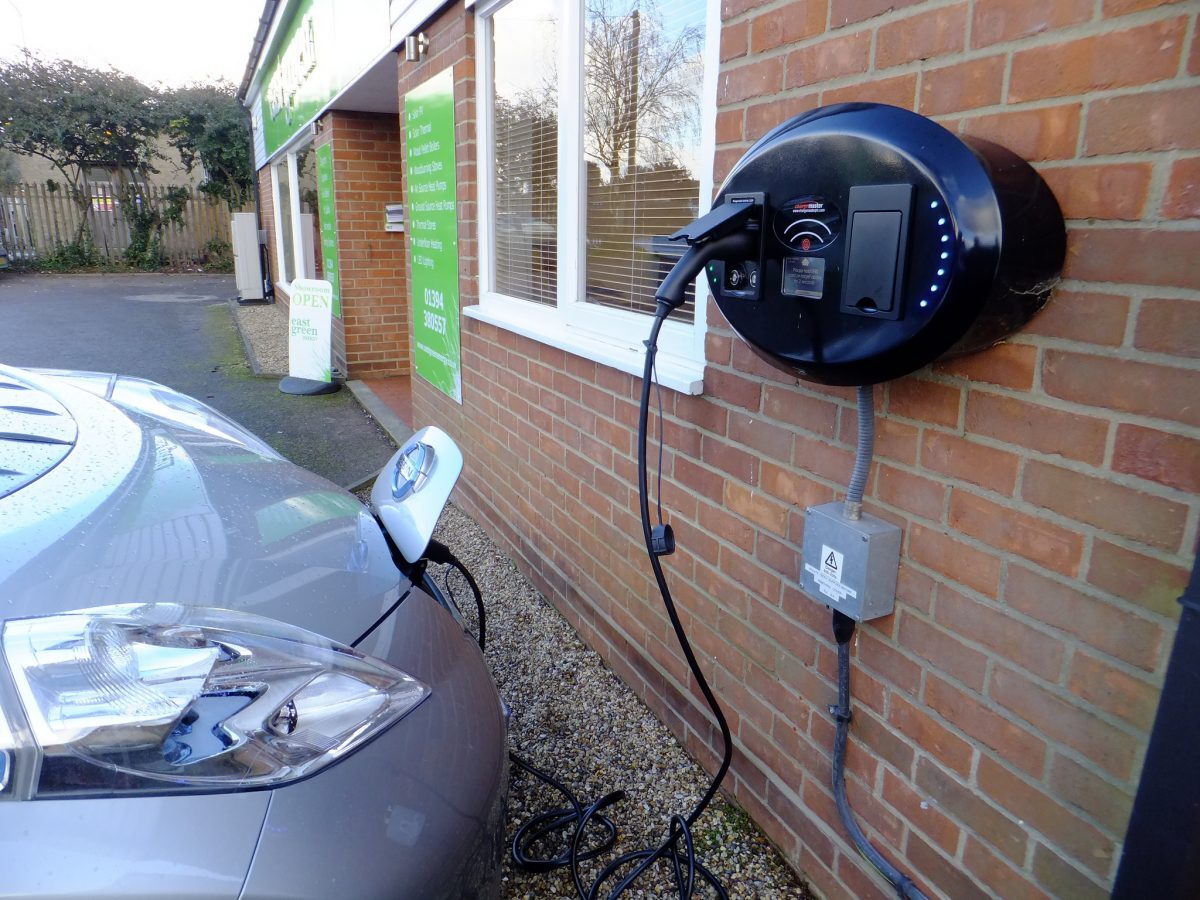
Transport Secretary Chris Grayling has announced proposals to change building regulations to encourage the mandatory installation of electric vehicle charge points in new homes and offices. New street lighting columns which service on-street parking will also have charging points in appropriate locations.
Along with these changes, the government has also promised more money to fund the charging infrastructure.
Rt Hon Chris Grayling MP as Secretary of State for Transport. Image Credit: HM Government.
Mr Grayling said the proposed measures would mean the UK having “one of the most comprehensive support packages for zero-emission vehicles in the world”.
“The prize is not just a cleaner and healthier environment but a UK economy fit for the future and the chance to win a substantial slice of a market estimated to be worth up to £7.6 trillion by 2050”.
Tesla Destination Charger, Adelphi Distillery – Image Credit: Matt Porter
I’ve tested 14 different electric and hybrid cars and I’m obviously sold on the idea of alternative fuel cars. Having travelled from Ness Point to Ardnamurchan in Scotland in a Tesla Model S 100 D and found the charge network was already in place, but improvements and investment from the Government would be very useful. With mass production of electric cars and more importantly lithium-ion batteries, the costs should come down in line with petrol and diesel powered cars. We should also look forward to electric powered lorries in the near future too. Exciting times indeed!
This morning, I spoke to Mark Murphy at BBC Radio Suffolk about the proposals. To listen to what I had to say, click on the stream above.
What do you think about electric cars, do you think they will be mainstream in your lifetime? Let me know in the comments below.
Following on from the ongoing Facebook / Cambridge Analytica scandal, I was invited to be a guest on James Hazell’s show on BBC Radio Suffolk. We talked in depth about how social networks and apps are using our data.
Please listen in by clicking the ‘play’ button above. Don’t forget to Like, Subscribe, Comment and Share.
I chatted to Mark Murphy at BBC Radio Suffolk this morning as part of a discussion about Kitchen Gadgets that have fallen out of use.
We have all bought something for the kitchen to help us cook or prepare food and consequently found that although useful, they end up sitting in a cupboard, in a draw or on top of a kitchen cabinet.
Listen into the audio stream to find out what I thought and how I placed my foot in my mouth at a well known shopping channel.
It is always particularly interesting to test technology that has been developed by leaders in their particular sector, so I was very excited about visiting Orbitsound in London to have a demonstration of their ONE P70W Speakers.
Orbitsound was founded by Ted Fletcher, the inventor of Airsound™ technology. Ted has been working for many years as a musician, audio engineer, electronics designer and studio designer, to give the listener a more realistic, more immersive sound experience. These years of experience in the industry led to the release in 2017 of the Orbitsound ONE P70, the worlds first multi-orientation speaker, meaning regardless of where you stand, it sound remains the same.
The controls for the Orbitsound ONE P70W are found at the side of the speaker
The P70W is designed in such as way that it can be shelf or wall-mounted. It has a narrow design (700mm wide x 173mm deep x 77mm high), this allows for comfortably mounting below a flat screen television or on a wall as a ‘party’ speaker. It’s built from wood and steel and can be purchased in matte black, bambo or bone white weighing in a 5.1kg.
Sound is provided by two (front and top) 2″ ‘Orbitsound MK4 drivers’, a Sub-bass low-profile 5.25″ driver and 2X2 Airsound Orbitsound MK4 drivers. By positioning the main speakers both front and top mean that sound production is maintains regardless of how the speaker mounted.
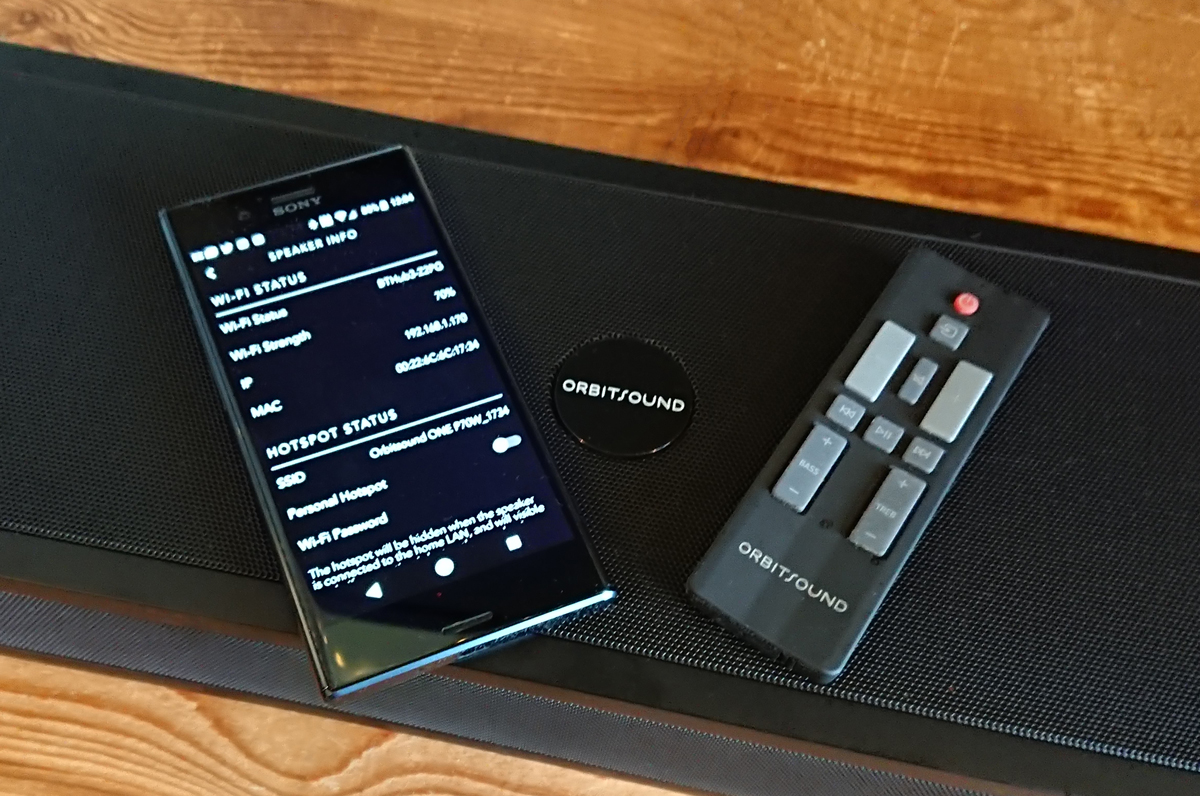
Connectivity is provided by Bluetooth, Optical cable, 3.5mm stereo jack and the Wi-Fi. The Wi-Fi feature is the most impressive as it allows streaming of audio from a variety of sources without the loss of quality associated with Bluetooth, effectively allowing for uncompressed playback of music. It also allows for multi-speaker / multi-room playback with perfectly synchronised sound and zero delay. This is achieved by using the Orbitsound Smartphone app (Android and iOS) which supports streaming providers and internet radio stations and allows you to ‘group’ sets of speakers to create one virtual speaker. When I was given a demonstration of this at the Orbitsound offices, 3 separate speakers, both wall and shelf mounted were grouped together using the app. I was then asked to close my eyes to try and decide where I thought the sound was coming from. It was unearthly as it sounded like it was coming out of thin air, very impressive!
The Orbitsound App running on Android. Streaming from Tunein
The app currently supports TuneIn, iHeartRadio, Spotify, Tidal, Napster, Apple Music (iOS only) and of course your own device stored music. If you are absolutely focused on using other services such as Google Play Music or Amazon, then you can of course stream using Bluetooth. I used the speak in conjunction with my Amazon Dot, as well as my iMac and Xperia XZ Premium, all worked flawlessly.
I was also able to connect the speaker to my Freesat HD box using the supplied optical cable. This worked great, although the Freesat box had a bug with Netflix which meant it would only broadcast Dolby sound. This was a simple configuration on the Freesat box and all was working again.
The speaker comes with very nicely designed remote control and you can also use you own remote control using the speakers ‘learning mode’. I was able to control the speaker using my TV remote within a couple of seconds of setup.
The people at Orbitsound definitely had the environment in mind when they designed the P70W as it is built to power-down components that aren’t used, but power up instantly when required.
Quite a bit of thought has gone into small details on the P70W with the inclusion of reversible LED information display and Orbitsound badge. This might seem small things but they count as you really wouldn’t want to be showing off your new speaker to friends and have the badge upside down. integrated wall mounting and 200mm VESA bosses and bolts are included to allow you to get going straightaway with unnecessary visits to AV stores to buy mounting kits. There is also a protective sleeve for the speaker, to protect it when not in use.
The speaker also comes with a standard power cord, aux cable, quick-start guide and safety and warranty information, all packaged up in a very smart box. The useful inclusion of a carry handle was helpful too, as I carried a demonstration unit to the train station.
The Orbitsound P70W feels like a speaker that can fit many needs, be that as a Sound-bar for your TV, a party speaker for gatherings of people and the facility to extend your listening experience to multiple speakers. The smart design of the speakers means that it they would sit very comfortably in a professional or public environment. The whole family has really enjoy the quality and versatility of the speaker and we’ll be sad to see it go.
At £399, the Orbitsound P70W is great value for buyers looking for a richer smoother sound regardless of their position in the room.