Category Archives: Apple

Gadget Man – Episode 130 – Why are people not upgrading their phones as often?

Many of us will remember the halcyon days when upgrading our mobile phone handsets was a six-month event.

No so now it would seem, instead, we are waiting much longer and are clearly looking for greater incentives to part with our beloved devices and even more importantly, our money.

You can listen into my interview with James Hazell on BBC Radio Suffolk where I talk about why the smartphone market is slowing down. Click on the link above to hear what I had to say. 

A Short(ish) History

My first mobile phone was bought in 1993 (some 26 years ago) from Dixons in Derby. It was an NEC P100 and I think it cost me £50 and then £7.50 per month for the contract with Vodafone, no calls were included, so I paid 50p per minute if I did need to call anyone.

The phone itself ran on the old 1G analogue network at 900MHz which was very quickly superceded by the digital 2G networks split between 900MHz for Vodafone and Cellnet and the alternative 1800Mhz for Orange and Mercury One2One.

Note: if you don’t recognise many of these names, it’s because due to buyouts, rebrands and mergers, Vodafone remained, Orange became EE, Cellnet became BT Cellnet, then O2. Mercury One2One became just One2One and then changed to T-Mobile which in turn is merged with Orange to become EE. Then of course 3 launched a 3g service later on and of course, two dozen or so ‘piggy-back’ operators such as Giffgaff, Sky Mobile, Virgin etc, who don’t, in fact, run their own networks but instead using the Big Four’s network. 

So my first phone was relatively cheap in today’s terms and in fact in ‘yesterdays’ terms too. the NEC P100 was meant to be a durable portable phone which it was and I kept it for some years until the analogue network was phased out and I had to get a more modern phone. The 2G network roll-out in the UK caused a market explosion and along with it came the Nokia 5110 and then 3310 phones which completely dominated the marketplace.

This explosion in popularity came with reasonably cheap phones with cheap and short contracts, this meant that phones could be renewed quite regularly and soon cupboards would start filling up with unwanted and out of date devices, fuelling development and in reality, a war between manufacturers and networks to provide more and more functionality. Heading this surge was Orange and O2 who had struck up a deal with little known manufacturer HTC to produce the very first Microsoft Windows CE based ‘Smartphones’, long before the birth of the iPhone.

HTC was at the time manufacturing the Compaq and HP iPaq Pocket PC and by adding cellular functionality, the Orange SPV (Sounds, Pictures and Video) and O2 XDA (extended PDA) began to be sold and the Smartphone was born.

Suddenly our dumb phones became ‘Smartphones’ and with it rapidly increasing prices. These costs had to be passed onto consumers via increased contracts with longer minimum terms (mainly to allow for the handset and network infrastructure costs to be absorbed ). Minimum six-month contracts became twelve, then eighteen, then twenty-four months. All of this was necessary to pay for the device and network overheads!

The phone networks began bundling minutes (and later, data), in part to placate phone users who were starting to become caught up in the ever increasing contract times.  Subsequently, devices became more expensive, resulting in more expensive contracts.

With the launch of Apple’s iPhone, O2 and T-Mobile began offering ‘all you can eat’ data plans in order for these data-hungry devices to take advantage of the vast amount of content appearing. Once the iPhone 3G was launched, with its ability to consume vast amounts of bandwidth and data, the all-you-can-eat model was scrapped or altered with ‘acceptable usage’ policies to limit data consumption, unless you were prepared to pay more.

Now that the smartphone had become established as a Super-Gadget, the manufacturers began an ‘Arms-Race’ to establish themselves as the Go-To brand in the multi-billion dollar marketplace, the likes of Apple, Samsung, Nokia, Motorola, LG, Sony and HTC began pumping billions into product development, patent registrations, cross-licensing and all-out war!

In turn, the Smartphone industry has driven bigger, better, faster and more costly devices into the consumers’ hands! Meanwhile, in China, Xiaomi, Huawei and Honor are producing comparable and in some cases, better products, the market is now awash with products that were once competing with each other but are now blurring their differences making it difficult to see the differences

Summing Up

We now have a smart-device marketplace with astoundingly high-quality handsets costing £1000 plus! How can we justify paying over £100 a month for a mobile phone contract, when we are struggling to differentiate between ‘last-years’ model?

What is needed now is for the manufacturers to take a breath! They need to find out what their customers really want. Maybe we are becoming tired and bewildered of being told what functions we need by these companies and it’s time for them to start listening to their consumers.

Matt Porter
The Gadget Man


Gadget Man – Episode 129 – Gadgets in the Home

It was great to be on BBC Radio Suffolk this morning, talking with Wayne Bavin about Gadgets used in the home.

Following the first episode of Hard to Please OAP’s on ITV1, I spoke to Wayne about Gadgets which are used regularly and less regularly in our homes.

It was fun to chat about Soda-Stream, Amazon Alexa, Sandwich Toasters, Waffle Irons and all the good and bad tech now found in our homes.

You can listen in to the latest podcast to hear what I had to say and also how I managed to link this to watching an old episode of Terry and June.

Enjoy listening and don’t forget to Like, Share, Subscribe and I will see you next time!

Matt

Gadgets Featured in this Podcast on Amazon


Gadget Man – Episode 114 – Too Much Smartphone Part II

You might remember a few weeks back, I talked about how smartphones have now officially taken over our lives, squeezing into every social, domestic and work situation.

Today, I spoke to James Hazell on BBC Radio Suffolk about how our very Government is considering investigating how to make the use of a smartphone safer for us all.

China continues to innovate in this area by providing ‘mobile friendly’ footpaths for phone users to protect them from walking into each other or falling into fountains!

A designated 'Cellphone Sidewalk' in Chongqing, China. Photo credit: China Daily/Reuters
A designated ‘Cellphone Sidewalk’ in Chongqing, China.
Photo credit: China Daily/Reuters

While you sit and ponder how we as an advanced civilisation found ourselves in this position? Why not listen into my interview with James.

If you like what you read or listen to, why not ‘Like’ and ‘Share’ this story.

Gadget Man – Episode 112 – Too Much Smartphone!

The Genie is now officially out of the bottle! We use our smartphones too much!

Most of us will already know this though, how could we miss it? You only have to travel on buses, trains and planes to see myriads of people sitting quietly staring at their smart phones, glued to Facebook, Snapchat or Twitter, scrolling through the latest news.

In restaurants alongside the place settin will sit a smartphone, ready at a moments notice to be snatched up and used to photograph a plate of food of a group selfie.

At rock concerts, the crowd is now lit up by mobile phone screens at they live stream or record a band whilst watching on those same screens, perhaps forgetting to watch and enjoy the band live rather than by proxy.

A designated 'Cellphone Sidewalk' in Chongqing, China. Photo credit: China Daily/Reuters
A designated ‘Cellphone Sidewalk’ in Chongqing, China.
Photo credit: China Daily/Reuters

In homes across the world, millions of people are sitting scrolling through their devices, then standing and walking into the kitchen, the phone still in front of their faces, then to bed, when finally after another 10 minutes of messaging, the phone is plugged in to finally rest and recharge, it’s peace only broken in the middle of the night as a hand reaches out to grab it and check Facebook.

Apple iPhone 8 and 8 Plus are one of the most popular smart phones in the UK
Image Credit: Apple

As morning breaks, a sleepy hand reaches out, slowly grabs the device and the day begins again.

This information overload is affecting peoples brains, our bodies are fooled by the blue light from an LCD screen and now we believe it is daylight 24 hours a day. We are conditioned to rely on our devices for everything, for affirmation from our friends, to give that affirmation back in a pre-formatted ‘Sending Hugs 🤗🤗🤗’ .

So, have we forgotten how to communicate? Are we now so reliant on our smartphones, that we no longer feel the need to use it for it’s original purpose? That of speaking to people and conveying our true feelings without relying on pre-programmed ’emotions’ invented by clever people in California.

Samsung Galaxy S9 with Infinity display
Samsung Galaxy S9 with Infinity display providing vast displays in the palm of your hand.
Image Credit: Samsung

Time will tell, but no amount of intervention by software giants will put that Genie back. We as a race have to take that step.

I spoke to Mark Murphy at BBC Radio Suffolk about the obsession with smart phones this morning. Listen to the stream above, I would love to read your comments on the subject.

Matt Porter
Gadget Man

[amazon_link asins=’B079X582LF,B075ZW3QV9,B075LYDD7Z’ template=’ProductCarousel’ store=’thgama03-21′ marketplace=’UK’ link_id=’286cb31c-965c-11e8-ac1f-23478c99e127′]

Gadget Man – Episode 109 – Mobile Devices in the Classroom

On Friday I spoke to Jenny Kendall-Tobias on BBC Radio Guernsey about children carrying mobile phones in classrooms.

This followed an interview  in the Daily Telegraph two weeks ago with Matt Hancock MP, Minister of State for Digital and Culture. He gave his views on the use of mobile phones in class by children and what he believed headteachers should be doing to tackle the issue.

Matt Hancock - All rights reserved by Department for Digital, Culture, Media and Sport
Matt Hancock MP – Credit: Department for Digital, Culture, Media and Sport

“Technology makes being a parent much harder. And schools have a big role too. I enthusiastically support using technology for teaching. But we also need to teach children how to stay safe with technology. Why do young children need phones in schools?”

“There are a number of schools across the country that simply don’t allow them. I believe that very young children don’t need to have access to social media. While it is up to individual schools to decide rather than government, I admire headteachers who do not allow mobiles to be used during the school day. I encourage more schools to follow their lead. The evidence is that banning phones in schools works.”

“Studies have shown mobile phones can have a real impact on working memory and fluid intelligence, even if the phone is on a table or in a bag.”

Following this article, I was asked to appear on Jenny’s show to discuss my thoughts on children carrying mobile phones in classrooms.

Mobile phone use in school - Credit: IntelFreePress / Flickr
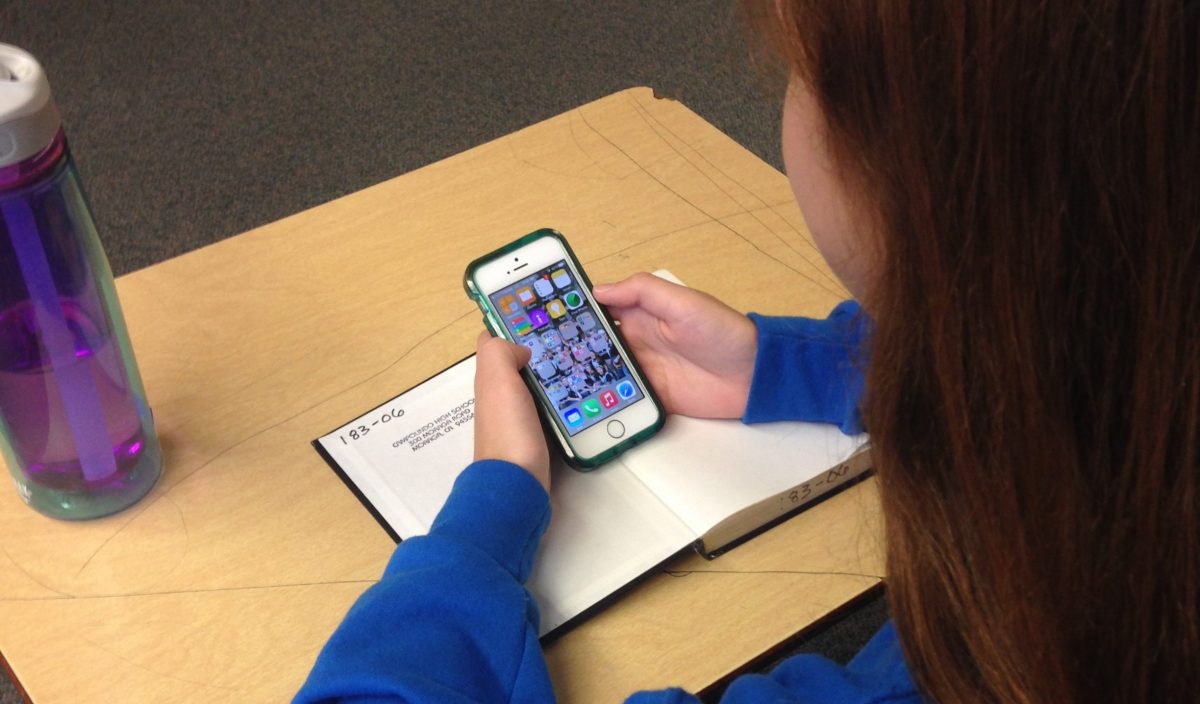
Mobile phone use in school – Credit: IntelFreePress / Flickr

You might be surprised to hear that I don’t think mobile devices have a place on the classroom. They are an enormous distraction and I think they pose a very real safeguarding issue within the school where they could be used inappropriately and there is also a very clear issue of peer pressure, with device cost stretching to £1000. There is also a problem with children carrying extremely valuable devices to and from school, which again exhibits a danger of theft.

If you feel differently, please let me know if the comments and of course you can listen in to the interview by click on the link above.

[amazon_link asins=’B076GV8DCL,B076H1YM9T’ template=’ProductCarousel’ store=’uk=1′ marketplace=’UK’ link_id=’5b8d618a-81c6-11e8-930f-e51c9f8d8d3b’]


First Products of the Tech Giants – Play our Quiz!

We all have to start somewhere and so did some of the biggest tech companies. Play our quiz and see if you can guess what their first products were? You might be surprised at some of the answers!

Don’t forget to comment with your score and don’t forget to like and share!!

The Cosmic Watch – A Mesmerising & Beautiful App for Viewing the Cosmos

The human race has always been fascinated by the stars in the sky. From guiding themselves across the seas, planning the harvests or daydreaming about visiting far away planets, we spend a great deal of our time thinking about the stars and planets.

It is fascinating to  think that we have only really begun to understand the Universe in the last 50 years and continue to be humbled by our place its vastness and the influence it still continues to holds on us.

So, when I was contacted by the makers of Cosmic Watch, I was intrigued on how an app was going to give me a much deeper understanding of our solar system and the movement of the planets and celestial bodies.

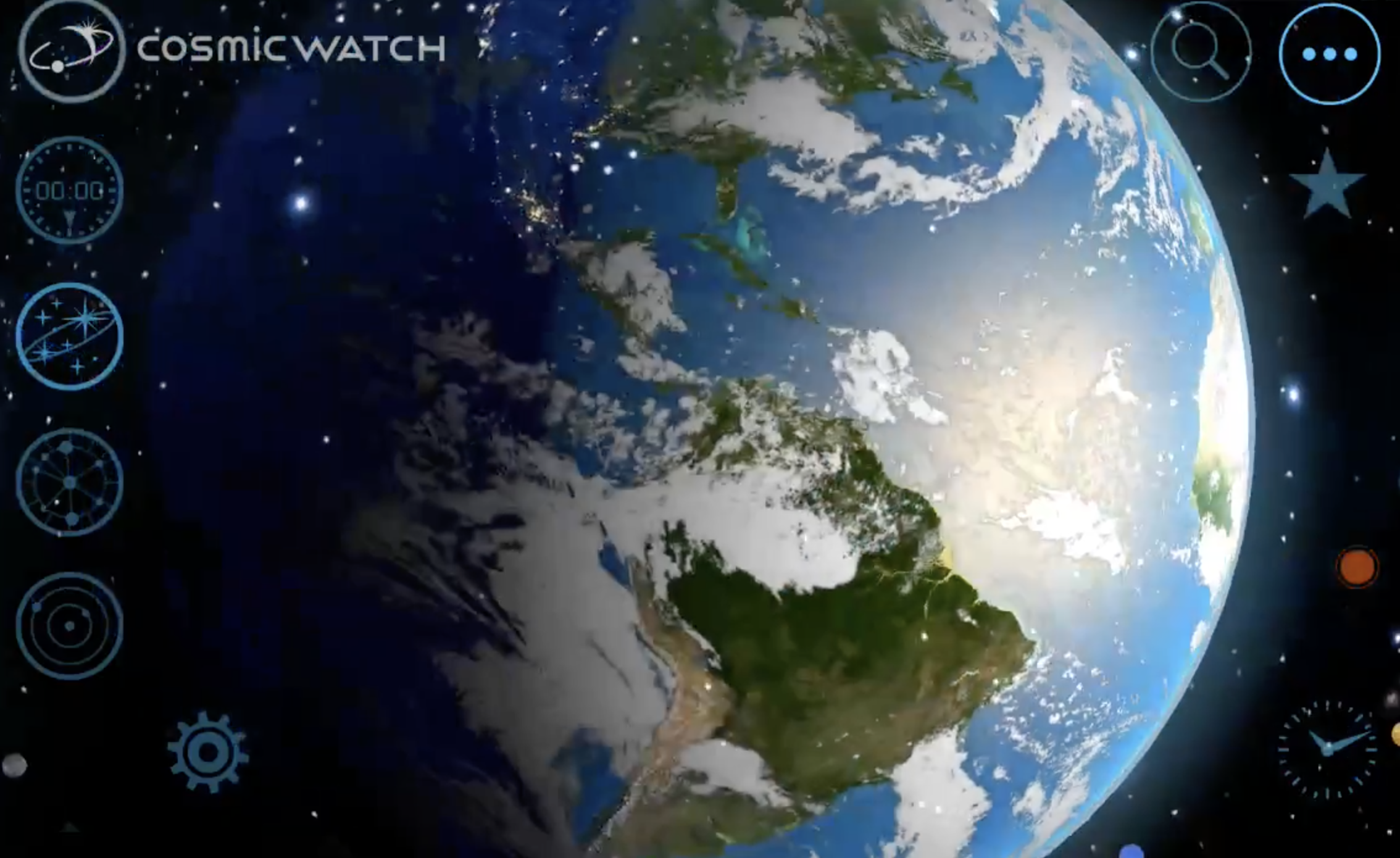
A screenshot The Cosmic Watch of one of the many different modes available.

To start with, Cosmic Watch is a really good looking mobile application, with an incredibly slick, but simple to operate user experience. This is an app that can be any one of many things, from world clock, searching for planetary positions to finding Astrology Star Sign and it’s relation to those constellations at your time of birth.

Any astrophysicist worth his salt will tell you that the study of our Universe is not simply the study of ‘space’, it is also the study of ‘time’, this is conveniently called ‘Space-Time’. It’s called this because everything in our Universe is moving and thus “In physics, spacetime is any mathematical model that combines space and time into a single interwoven continuum.”.

In order to understand and track the stars and planets we need to understand Space-Time in order to be able to find the positions of the planets and stars at any given point in the past and the future.

A screenshot The Cosmic Watch of one of the many different modes available.

Cosmic Clock can provide this information using a 3d user experience which places our planet Earth in the centre of everything, not as a step backwards in our understand, but in fact to help us understand our place in the Universe. It does this both effortlessly and beautifully.

Cosmic Clock has three main modes:

  1. World Clock – For time keeping around the globe
  2. Astronomy – For viewing the constellations and planets
  3. Astrology – The study of the position of the stars and their perceived influence on us and our daily lives.


To navigate any of these modes you use buttons on the left hand side of the screen, with additional buttons placed at the base of the screen to control how the information is displayed.

Swiping the screen causes everything to rotate in 3d around the Earth, you can also pinch to zoom in order to see a particular place in detail.

In clock mode, you can actually use your phone or tablet as a desktop clock, just make sure you connect it to a charger first. You also need to switch off ‘sleep’ mode to keep the screen on. This is a fascinating view as it shows the Earth in real time including the approaching sunrise or sunset.

Astronomy mode display the stars and planets with added labels. You can speed up, freeze or reverse time to find out the exact position of celestial bodies as specific times.

Astrology mode shows the plants and stars using their traditional symbols and signs of the zodiac. It’s very detailed if this kind of thing interests you.

Throughout all of these modes, there are a myriad of different settings available to allow you to display the cosmos in pretty much any conceivable fashion and it’s certainly extremely interesting to use.

The app makes use of the internal sensors or your phone and tablet including the compass. This helps you align the display of the app with the actual night sky and makes the experience fascinating as rather than guessing the position of a planet, you can accurately predict when it will be in the sky.

If the stars and planets interest you, Cosmic Watch will provide you with a fascinating insight into the Solar System and wider Universe and it an absolute MUST PURCHASE and at £4.99 it is worth every penny.

You can purchase Cosmic Watch for iOS here or Android here

Or visit them directly here at http://cosmic-watch.com/


Gadget Man – Episode 91 – ASUS ZenPad 3S 10 – A Great Alternative To The Obvious (with Podcast)

ASUS Zenpad 3s 10
Aluminium construction with etched logo make the device appear luxurious and high end.

I’m a real fan of tablet computers. I love being able to comfortably read eBooks, magazines and news websites. I love watching streaming movies and catching up on TV either on the move on in the comfort of my home.

https://audioboom.com/posts/5966596-asus-zenpad-3s-10-a-great-alternative-to-the-obvious

Make no mistake, modern smartphones are great for most of these things too, but the tablet gives you the extra space to comfortably read digital versions of magazine in (almost) their intended footprint. This is possibly what has driven the gradual increase in screen sizes on both phones and tablets, becoming a replacement for our televisions and with it changing the way we watch video.

Having dominated the tablet market for so long, the iPad in all it’s various sizes is a hard act to match let alone beat! I’ve tried contenders in the past from Nokia and Samsung, both promised great things, but stumbled where it mattered most, performance.

ASUS Zenpad 3s 10
The ASUS Zenpad 3s 10 has a great screen, it’s 4/3 ratio is great for surfing the net.

The Asus ZenPad 3s 10 definitely ticks every box with it’s performance packing a Hexa-core CPU (basically 6 CPUS packed on one chip), 4Gb of RAM, 32 or 64Gb of data storage, SUPER bright 9.7 inch IPS LCD Screen with a resolution of 1536 x 2048 pixels. Around the screen is in incredibly thin bezel, so although it shares the same size screen with the iPad, it is in fact slightly smaller to hold. Inbuilt stereos speakers with DTS Surround Sound gives a really nice (and loud) audio experience too. The case is made from aluminum with front (5 MP) and rear cameras (8 MP), the rear camera features Geo-tagging, touch focus, face detection, HDR, and panorama with both cameras able to record 1080p video. Charging the ZenPad is possible with the supplied USB-C Cable and Fast Charger, able to restore the battery from zero to 83% in 30 minutes. Security is provided by the integrated fingerprint reader which is seamlessly embedded in the front central button.

Also supplied is a small stand which allows you to prop the tablet whilst watching it, I tried this twice and felt the cardboard material used to make it wasn’t really strong enough for extended us.
Asus have bundled masses of software along with the Google suite of apps such as GMail, Google Documents, Maps etc. They have modified the stock Android experience and allowed lots of customisation to suite everyone’s taste.

ASUS Zenpad 3s 10
The Zenpad has an 8MP rear camera capable of capturing 1080p

Using the Zenpad was really impressive, they have gone with a 4×3 screen ratio which has been popular with the iPad since launch. In my experience 16×9 is better for viewing movies in widescreen, so you do get the extra bars at the top and bottom of the screen which watching video, but it’s when you use the tablet for surfing, Facebook, Twitter and especially reading that you see the benefit of the extra screen width.

ASUS have gone to a lot of trouble to make a luxury product that weighs 430g and is 5.8mm thick with diamond cut bevels and nicely etched logo on the back. It really feels and looks expensive, colours are really bright, but not over saturated and the hexacore processor makes just about any task completed in a instant. It’s a great device, possibly one of the best I’ve used so far across the board.

ASUS Zenpad 3s 10
The UHD screen is perfect for reproducing sharp bright images.

At roughly £299, the Zenpad comes in at roughly £100 cheaper that the iPad Air and in fairness to both it performs admirably and in some cases improves on the Apple device. It is a fabulous device at a great price.


It really is a great alternative to the obvious and I would encourage people to check out these devices if they are looking for iPad alternative at a slightly more affordable price.