There are car launches that make you stop scrolling, and then there are car launches that make you check whether you have accidentally opened a science fiction trailer.
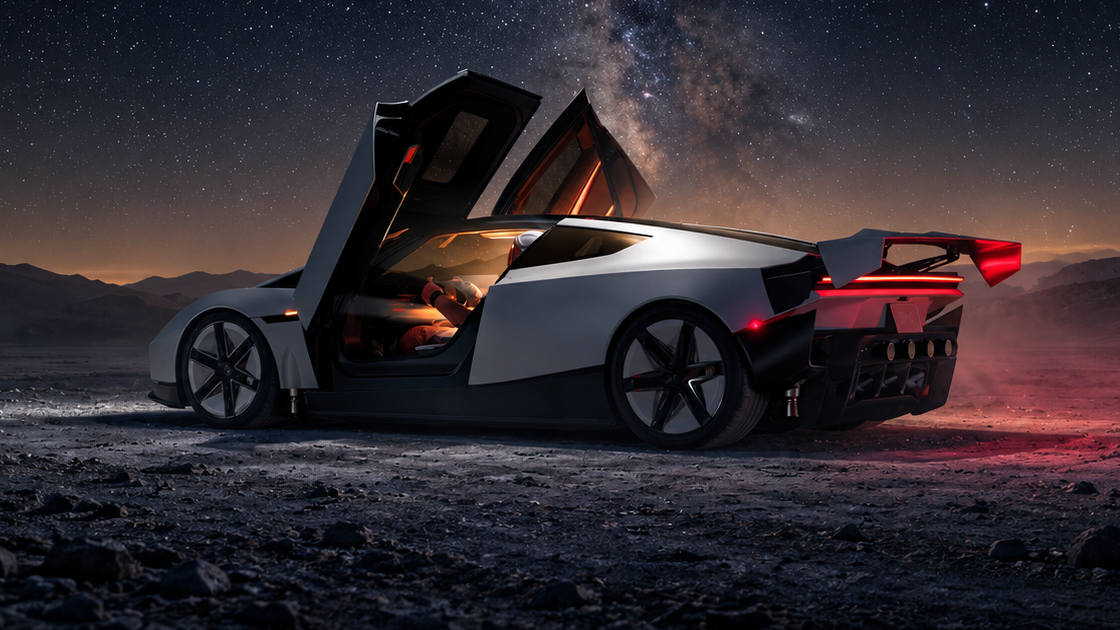
Tesla’s latest Roadster reveal falls firmly into the second category.
Electric performance, rocket-style thrusters and a demonstration involving a car leaving the ground. Somewhere along the way, the conversation appears to have moved from “How quickly does it accelerate?” to “Does it need a departure lounge?”
My interest in Tesla comes with some personal experience behind the wheel. Over the years, I have driven the Model S P85+, Model S P85D and Model S 100D. Nine years ago, I drove the 100D on the East-West road trip, travelling from Lowestoft to Kilchoan and back again.
That was an opportunity to experience a Tesla over a substantial journey, getting to know the car beyond the initial excitement of its acceleration. It is the sort of experience that shapes the questions you ask when the next ambitious announcement arrives.
So, as The Gadget Man, I am fascinated by this new Roadster. Having experienced what Tesla’s electric cars can do on the road, I am particularly interested in how much of this latest spectacle will translate into a car customers can actually own and drive.
A Roadster With a Rather Unusual Party Trick
At its latest unveiling, Tesla demonstrated a redesigned Roadster developed with SpaceX, using thrusters to perform aerial manoeuvres and a suction system to drive upside down on a ramp. Tesla says production will begin in 2028, and quoted acceleration to 60mph in under a second, alongside a top speed exceeding 230mph. Those remain manufacturer claims, rather than independently verified production-car results.
Just pause on that for a moment.
We have reached a point where an electric sports car being extraordinarily fast is apparently insufficient. It now needs a few tricks that would make a Bond villain ask for the options brochure.
For someone who loves technology, that is difficult to ignore.
Read the Small Print Before Preparing for Take-Off
Visit Tesla’s UK Roadster page and there are some significant qualifications beneath the excitement.
Tesla states that the features and specifications shown reflect its optional Thrust upgrade. It also says that a marked feature is exclusive to the Rocket trim, which will not be available in every region. Availability depends on local legal requirements, and the vehicle is listed as left-hand drive only.
That matters, particularly if you are viewing the page from Britain and imagining one on your driveway.
A spectacular demonstration does not establish which capabilities customers will receive, where they can use them, or what will be permitted on a public road.
I would certainly want those questions answered before working out where to put the charging cable.
The Engineering Interests Me More Than the Stunt
The prospect of combining electric propulsion with additional systems for grip and acceleration is fascinating.
Tyres have a finite ability to transmit force to the road. Engineers chasing ever more extreme performance eventually have to think beyond simply adding more motor power.
That is what makes this Roadster interesting to me. It invites questions about how different technologies can work together, how repeatable the performance might be, and what compromises come with it.
How much preparation does a maximum-performance run require? What happens after several attempts? What maintenance will these additional systems need?
Those are the details I would enjoy exploring in a proper technical demonstration.
The launch video gets your attention. The answers would tell us much more about the car.
Excitement Still Needs a Delivery Date
There is also the question that follows every ambitious vehicle announcement: when will customers actually receive it?
The second-generation Roadster was first announced in 2017, with an original production promise of 2020. Tesla’s latest production target is now 2028.
That history makes a little patience with the promises entirely reasonable.
I can admire an engineering project while still wanting to see finished vehicles, independently measured performance and a clear ownership proposition.
For a UK buyer, I would add charging, servicing, insurance and everyday usability to that list. Even the most extraordinary car will eventually encounter a wet Tuesday.
The Gadget Man’s Take
I love technology that makes me curious, and this Roadster certainly does that.
There is room in the automotive world for ambitious, slightly outrageous projects. They give engineers difficult problems to solve and give the rest of us something entertaining to argue about.
But my enthusiasm comes with questions. I want to see how much of this spectacle becomes a dependable product, and which capabilities reach customers in a form they can actually use.
For now, Tesla has certainly produced a conversation starter.
Although I suspect “Does it come with floor mats?” may no longer be the most interesting question in the showroom.
Explore the Tesla Roadster on Tesla’s UK website.
Discover more from The Gadget Man | AI & Tech News and Reviews | Matt Porter
Subscribe to get the latest posts sent to your email.