Something rather important happened in the world of 3D printing this week, and I don’t think the interesting part is the $27.6 million.
A federal jury in Texas has found that Bambu Lab infringed four Stratasys patents covering technologies including purge towers, extrusion toolpaths and force detection in 3D printers. The jury also found the infringement was willful and rejected Bambu’s attempts to prove the asserted patent claims invalid. Stratasys was awarded $27.6 million in past damages.
That’s a sizeable amount of money.
But there is currently no order banning Bambu printers from sale, and the judge declined to increase the damages despite the finding of willfulness. The judgment is about money for past infringement, not Bambu printers suddenly disappearing from shops.
Bambu is also expected to continue challenging the result.
So this isn’t really a story about Bambu being finished.
I think it might be the opening chapter of something much bigger.
Haven’t we seen this before?
Anyone who followed smartphones during the early 2010s might be experiencing a little déjà vu.
Apple sued Samsung.
Apple sued HTC.
Motorola sued Apple.
Microsoft sued Motorola.
Samsung sued Apple.
Google bought Motorola, along with an enormous patent portfolio.
Companies obtained injunctions, appealed them, redesigned software, negotiated licences and accumulated patents partly so they had something to fire back with when another manufacturer came knocking.
Eventually the smartphone became surrounded by what lawyers call a patent thicket.
There were patents covering radios, touch interfaces, gestures, graphical interfaces, antennas, codecs, power management and countless other technologies.
A manufacturer couldn’t simply build “a smartphone”.
It was building a machine containing thousands of individual technologies, many of which somebody somewhere had patented.
I wonder if consumer 3D printing has just reached the same point.
The modern 3D printer has become remarkably standardised
Think about what we now expect from a decent consumer 3D printer.
An enclosed CoreXY mechanism.
Automatic bed levelling.
Automatic Z offset.
High-speed printing.
A camera.
Wi-Fi.
Remote monitoring.
Automatic calibration.
Multiple filaments.
Automatic filament changing.
A purge or wipe tower.
Sophisticated slicing.
Flow compensation.
Nozzle sensing.
A few years ago, many of those would have been individual selling points.
Today we’re rapidly reaching the stage where they’re simply expected.
Bambu Lab arguably accelerated that process more than anyone else.
The X1 and P1 series didn’t necessarily invent all their constituent technologies. What Bambu did exceptionally well was integrate everything into something approaching an appliance.
Load a model, select a filament and press print.
The printer sorts most of the rest out.
Competitors noticed.
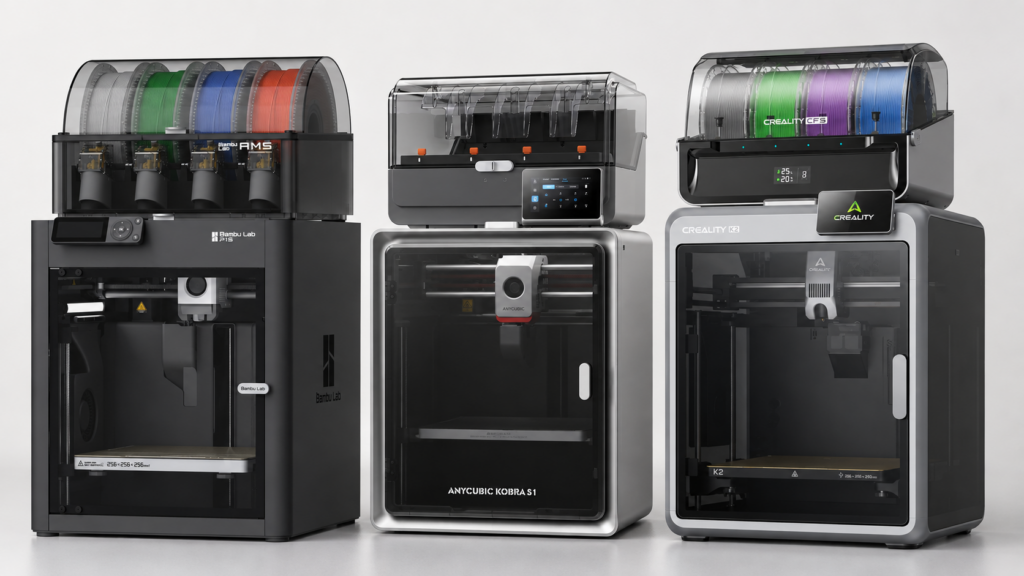
The Anycubic Kobra S1, for example, is an enclosed CoreXY machine with a 250 x 250 x 250mm build volume, automatic levelling, flow calibration, camera support and claimed speeds up to 600mm/s. Pair it with Anycubic’s ACE system and you have automated multicolour printing too.
I’m not suggesting Anycubic infringes anybody’s patents. There is absolutely no basis for making that claim merely because two products have similar features.
The point is that manufacturers are converging on the same idea of what a modern 3D printer should be.
And technological convergence is exactly when patent disputes become interesting.
Stratasys has been here since the beginning
Stratasys isn’t a patent troll in the conventional sense.
It actually develops and manufactures 3D printers and has been involved in fused-deposition technology for decades.
It also has a substantial patent portfolio.
Then there is MakerBot.
For anyone who watched the excellent documentary Print the Legend, this part of the story might seem strangely familiar.
MakerBot began life in 2009 as part of the exciting desktop 3D-printing and maker movement. It grew incredibly quickly and became one of the best-known names in consumer 3D printing.
In June 2013 Stratasys announced that it was buying MakerBot in a deal initially valued at around $403 million. The acquisition completed that August, with Stratasys later recording the purchase price at approximately $493.7 million.
Stratasys didn’t sue MakerBot into submission, despite an understandable fuzzy recollection some of us might have after watching Print the Legend.
The major patent lawsuit depicted alongside MakerBot’s story in that documentary was actually 3D Systems versus Formlabs.
But Stratasys acquired MakerBot’s technology and intellectual property along with the company.
Fast-forward thirteen years and Stratasys now finds itself enforcing a substantial patent portfolio against the company that has arguably done more than anyone recently to shake up desktop FDM printing.
History has a sense of humour.
What did Bambu actually infringe?
The four patents in this particular case concern technologies including:
- force detection within a 3D printer
- purge towers used during material changes
- extrusion-based toolpath generation
The purge tower one is especially interesting.
Anybody who has performed multicolour printing will understand the principle.
Change filament, purge the old material and put the unwanted extrusion somewhere that isn’t your model.
Today that feels almost obvious.
But “obvious to us now” and “legally obvious at the time the patent was filed” are very different things.
Bambu challenged the patents.
A Texas jury has now nevertheless concluded that the products before it infringed the four asserted patents and that Bambu had not proved those claims invalid.
That doesn’t mean Stratasys owns the concept of multicolour printing.
It doesn’t mean every purge tower infringes a Stratasys patent.
It doesn’t mean Prusa, Anycubic, Creality or QIDI are infringing anything.
Patent infringement comes down to the precise wording of patent claims and whether a particular implementation contains all the necessary elements.
But other manufacturers will surely be reading this judgment very carefully.
The HTC warning
There is another lesson from the smartphone wars.
HTC.
At one point HTC was one of the most important smartphone companies on the planet.
It made some superb hardware.
Apple sued HTC in 2010 over smartphone patents, resulting in years of litigation before the companies settled in 2012 with a ten-year patent licensing agreement covering current and future patents.
The patent battle didn’t kill HTC.
Competition did.
Samsung achieved enormous scale.
Apple built an incredibly powerful ecosystem.
HTC increasingly found itself squeezed between them.
That’s the lesson I think matters for Bambu.
A $27.6 million judgment probably isn’t the interesting danger.
The danger would be years of cumulative friction.
Patent litigation.
Licence fees.
Engineering redesigns.
Appeals.
More patents.
More lawyers.
While simultaneously Anycubic, Creality, QIDI and others continue producing printers that offer more and more of the experience that originally made Bambu distinctive.
One lawsuit rarely destroys a successful technology company.
But litigation combined with rapidly commoditising hardware can change the economics of a market surprisingly quickly.
And Bambu could eventually become the other side
Here’s where things get really interesting.
Bambu has patents too.
Imagine five years from now that Bambu owns hundreds of patents covering genuinely useful improvements it has developed.
Then another manufacturer releases something suspiciously close to a Bambu mechanism.
Bambu might sue.
Suddenly the disruptor has become an incumbent defending its intellectual property against the next disruptor.
That is almost precisely how technology industries evolve.
Eventually you reach the position we saw in mobile phones where enormous companies effectively point patent portfolios at each other.
“You infringe six of ours.”
“Yes, but you infringe five of ours.”
Rather than everyone spending the next decade in court, they negotiate.
Patent portfolios become bargaining chips.
Is this the beginning of the 3D printer patent wars?
I’m not quite ready to declare that yet.
At the moment we principally have Stratasys versus Bambu.
The first of Stratasys’s two patent cases has produced a $27.6 million award, while another case remains to be dealt with.
But imagine we start seeing:
Stratasys versus another consumer printer manufacturer.
Bambu versus Anycubic.
Bambu versus Creality.
Prusa versus Bambu.
Manufacturers acquiring companies primarily because they want their patent portfolios.
Cross-licensing agreements.
Design-arounds appearing in firmware updates.
Features mysteriously disappearing from particular markets.
Then we’ll know.
The smartphone patent wars will have arrived in 3D printing.
And perhaps the most fascinating part is that this is happening in an industry with unusually deep open-source roots.
RepRap, Marlin, Klipper, Slic3r, Cura, PrusaSlicer, Voron and countless other projects have left years of code, documentation, forum discussions and development history scattered across the Internet.
Every time somebody asserts a broad patent, lawyers on the other side can start digging through twenty years of maker history looking for evidence that somebody had already done it.
That could make the coming battles very interesting indeed.
For now Bambu printers remain on sale, nobody is coming to confiscate your P1S, and this week’s decision can still be challenged.
But I suspect the $27.6 million will ultimately be remembered as something rather more important than a damages figure.
It may turn out to have been one of the opening shots in the 3D printer patent wars.
Discover more from The Gadget Man | AI & Tech News and Reviews | Matt Porter
Subscribe to get the latest posts sent to your email.