Yesterday myself and industry expert, Dario Talmesio, Principal Analyst & Practice Leader at Omdia spoke to James Hazell on BBC Radio Suffolk about the COVID-19 / 5G Conspiracy Theory.
You can listen to the stream above or read on to find out more.
5G has been under attack by conspiracy theorists for as long as it has existed. Every conceivable disease, illness or cancer has been blamed on the technology. It has been open-season for several years.
During this time, every single theory has been repeatedly debunked by teams of scientists and experts throughout the world, but still, it prevails.
Enter Coronavirus Disease 2019 (COVID-19), the highly infectious disease caused by Severe Acute Respiratory Syndrome Coronavirus 2 (SARS-CoV-2) first discovered in December 2019 Wuhan, China.
At the time of publication, COVID-19 has infected more than 1.36 million people in 184 countries. Sadly, resulting in the death of an excess of 76000 people. This virus has become a global killer on a scale not seen since the Spanish Flu Epidemic of 1918.
Dario Talmesio Principal Analyst & Practice Leader Country UK – Image Credit OMDIA
At a time when our highly advanced telecommunications networks are one of the saving graces of the crisis, the last thing we need to hear is that people are beginning to try and link COVID-19 to the building of the 5G network. Worse, there are now acts of vandalism being enacted upon the newly installed equipment, damaging expensive equipment and putting peoples lives at risk.
This damage and continued encouragement from high profile celebrities have resulted in the UK providers issuing a joint letter to customers asking for the damage to stop.
Frankly, I continue to be exasperated by the need for every single thing that happens on our planet to be blamed on technology, government or secret societies! The sooner we knuckle down and work together to defeat this appalling virus in every way we can, the better!
Stay at Home, Protect the NHS and Save Lives
Open Letter to Customers from EE, O2, 3 and Vodafone
Don’t forget to LIKE, SUBSCRIBE, SHARE and COMMENT.
Such are the strange times we live in, many of us now face working from home for the first time along with caring for our children.
I have worked from home extensively over the past 20 years and I thought I would try and share some tips on how I have been able to work effectively in a home environment.
This morning I spoke to James Hazell at BBC Radio Suffolk about the trials and tribulations about working from home. Listen in to the stream to hear what I had to say and especially the advice at the end.
Stay Safe and Healthy
If you have been given a laptop to use at home, then there is a danger that you may find yourself sitting in an armchair trying to work and you will soon find this isn’t going to work well.
Set up a work environment in a spare room or even your bedroom where you can away from disturbances and distractions as best as possible.
Find a comfortable chair and if possible sit near a window so you can get fresh air while you are working.
Set up your computer, so that is a semi-permanent environment and will allow you to separate work from home and give you a place to ‘go to work’
Get dressed, you don’t go to your place of work in your pyjamas, so again, getting dressed gets your prepared for work.
Take plenty of breaks. If you have children at home, you will need to be able to give them attention. If you can set specific times during the day to stop work, get up and walk around and make yourself a drink.
Try to begin and end your work-day as you would if you were going to your place of work. Let your employer know that these are your work times. Setting these boundaries will mean that you aren’t on-call 24/7.
Most home-working requires an internet connection. Over the coming months, our communications links are going to be under a great deal of strain. The video streaming services are going to be used extensively and this will put a great deal of pressure on internet connection speeds. Home internet is very different to work internet due to what’s called ‘contention ratios’, so you should be prepared for slower than normal connection speeds.
Ask your employer to provide you with a mobile device that can be used as a ‘tether’. This means that should traditional broadband experience issues, you can fall back onto connecting to the internet by connecting via a ‘personal mobile hotspot’.
Make sure all of your internet-connected devices are up to date. This means ensuring anti-virus is updated where applicable and any operating systems updates on your computers, set-top boxes, TV’s, IpCams etc are updated
Keep all of your battery-powered devices charged up, but don’t leave mobile phones plugged in all of the time as the batteries don’t work as effectively if they all continuously charged.
Use a trusted VPN connection to secure your broadband connection further. I recommend Ivacy VPN. Using a VPN or Virtual Private Network secures your connection.
Finally, regardless of whether you are working at home or not, you WILL find the number of scam calls you receive will increase, mainly because you will find yourself at home so much more. NEVER give out any personal bank details over the phone including PIN numbers or passwords. Ignore all automated calls and just hang up. These people care little for the health or financial wellbeing of their victims. If in doubt, speak to a trusted friend or member of your family before taking any action that will cost you money.
Keeping backup copies of your data has never been so important and only this week it has been revealed that a fire at Universal Music has resulted in the loss of the original master tapes of some of the worlds most famous artists.
To compound the issue, the backups were kept in the same vaults and seemingly perished resulting in the total loss of the original recordings of the likes of Buddy Holly, Eminem, Sheryl Crow, Tupac and Tom Petty (to same but a few!).
With digital photography now the primary method of capturing images, it is now more important than ever that these sometimes precious images are also kept safe. Hardware failure or loss of devices is more common than ever before, so multiple backups are extremely important!
Hardware failure is a real and present issue
Today I spoke to James Hazell on BBC Radio Suffolk about backups and my experience of how to keep your data safe.
To find out more, listen into the stream above. Don’t forget to Like, Subscribe and Comment with your experiences of backup successes and failures.
You’ve got a business, and you’ve got plenty of customers milling in and out of it every day you’re open and operating. Even when you’re closed, you’ve got an ecommerce website that allows people to order what they want from you whenever they want, allowing you to ship out products or services as soon as you’re next able to. It’s a great element to have to your business, and increases your exposure, outreach, and potential sales from these by tenfold.
But that means you’ve got a lot of data to keep track of at the same time. And this data is very important, so you need to keep it safe. So here’s just a couple of details to remember about storing customer data, in the safe and right ways.
Always Give Customers an Option
Whenever a customer comes through your ecommerce site, give them plenty of choice over how their details are used. Let them know how their information will be used whilst they’re on the site. Let your customers know they have the option to store their credit or debit details when they use your site, and that they also have the option for the system to forget all about their card. After all, it’s completely up to the person shopping with you whether or not you have their details on file, and you shouldn’t want it any other way.
Move On From Physical Storage
If you’re using physical storage to keep a track of your customer details, you might be missing a trick here. Not only do things like hard drives, USB sticks, and filing cabinets all have a maximum capacity to them, but they’re also quite hard to sort through. Flash drives alone have a huge risk to them, in that the data stored on them can be lost at any moment, and pieces are chipped away every time you log one in and out of your computer. And then you’ll have to look up a guide like https://setapp.com/how-to/usb-data-recovery.
So use cloud storage, or server based storage, instead. There’s a lot more room for expansion, and you can invest in private storage that only you have access to. End to end encryption, as well as the ability to search for the right files in seconds – it’s a real upgrade to have a look into at least.
Keep Outside Connections to a Minimum
If you’re looking to stay safe and secure in the modern day and age, you need to be sure as few people as possible have access to your company files. Especially the customer details you have stored for ease of access on both sides of the screen. So make sure only a select few people have the passwords or keys to the storage, and make sure only secured WIFIs have access.
Customer data is a priority. Security is a big part of maintaining business longevity, so it needs to be something you prioritise in your quest to take your company higher.
How many of us own and drive a vehicle with a keyless entry system? Well, it appears that many thousands of us that do have woken up this morning to a very worrying report from the General German Automobile Club (ADAC),
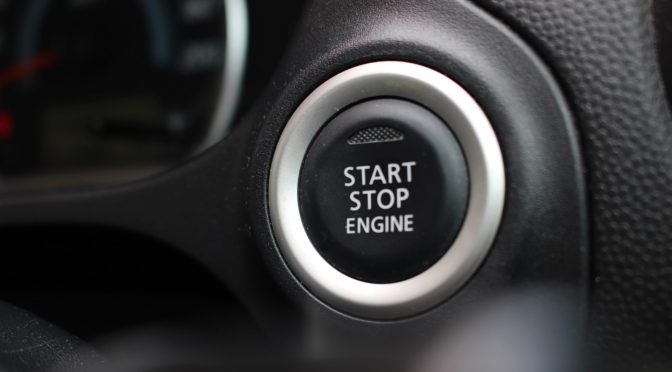
In order to unlock your keyless entry vehicle, you simply need to carry your key-fob. As you approach the vehicle, it recognises the encrypted signal transmitted from the fob. This, in turn, instructs the vehicles central-locking system to unlock the doors when you either touch the door handle or press the button on the door-handle. There is no requirement to insert the key into the ignition as the car is fitted with a start/stop button. If you own a car with both keyless entry and start/stop system, you aren’t alone, they are now widely used in hundreds of models or cars and in some cases motorbikes.
Now for the bad news. A recent study by the General German Automobile Club (ADAC) has discovered that the technology is far from secure in all but THREE cases and in fact the method of stealing a keyless vehicle is extremely simple.
In order to steal a keyless vehicle, a thief simply employs a rudimentary transceiver which takes the relatively weak signal transmitted and received from the fob to the car and amplifies it, it is then possible for the signal to reach from the fob to the car and hey presto, the car is unlocked and can (in most cases) be started.
[videopress VxMJuooi]
Once the car is running, the need for a key is obsoleted and the car can now be driven until it is depleted of fuel. In most cases, the cars are taken abroad and the retrofitted with standard locking and start systems. As long as the car does not stall, it will run for as long as the fuel tank will take it.
NO AMOUNT of hacking or decryption is needed, it is reliant solely on the amplification of the already transmitted signal!
Arnulf Thiemel, car-technician at the ADAC. Image Credit: ADAC
Arnulf Thiemel, car-technician at the ADAC, said “The ADAC demands that vehicles be protected against any kind of manipulation and illegal access. For the affected vehicles, there must be solutions put in place to improve the security. All new vehicles should also be equipped with a methodologically that ensures secure safety solutions which also withstands neutral side checks”
Which cars and manufacturers were affected?
Unfortunately, it would appear that EVERY manufacturer tested has at least one model which could be stolen using the method above.
The following vehicles could NOT be opened or started using this method.
Jaguar i-Pace (2018) Land Rover Discovery (2018) Land Rover Range Rover (2018)
The vehicles above are currently immune from this method of attack. This is because they employ a variation of the keyless system by broadcasting using ultra-wideband frequencies. Basically, the equipment used to amplify the signal is ‘currently’ unable transmit or receive at the radio frequencies used in these models of cars.
Jaguar-Land Rover filed the patent for this method of keyless access in 2017. We can now only hope that they freely license these patents to other car makers or a comparable technology can be developed.
What Now?
All too often our deep-rooted human needs to be ‘waited upon’ result in solutions which in the first instance appear to solve a problem that really didn’t exist, but in real-world use turn out to have a sting in the tail. In the case of the study by ADAC, it would appear that there are very urgent questions to answer and drivers should be aware of the security issues surrounding their vehicles.
Faraday Cases?
Prior to speaking to BBC Radio Suffolk, many listeners talked about using Faraday Cases or Bags to house their keys. The theory behind this was to block the signal completely whilst the car isn’t in use (ie. whilst the keys were stored in the home or place of work).
Faraday Bag for Keyless Fobs from Amazon
I personally believe that keeping the keys away from the car or placing them in a container which COMPLETELY blocks radio signals is the only way to avoid the potential theft of vehicles using this method. However, radio signals can travel through types of metal, so be ABSOLUTELY confident that anything you purchase to secure your fobs, does indeed work as described.
Immediate Steps to Take
If you are concerned about the security of your keyless car fob, contact your car’s manufacturer as soon as possible and ask them what steps they have taken to secure your car? Ask them if there are software updates to improve security? Ask them if these systems can be deactivated until such time as they can be completely secure?
Listen in!
This morning I spoke to Mark Murphy on BBC Radio Suffolk about the use of Faraday Cage technology to try and reduce the chances of Keyless entry cars being stolen. Listen in to the stream above. If you like what you hear or read, don’t forget to LIKE, SHARE and SUBSCRIBE. See you next time!
Matt
The Gadget Man
I previously spoke about this topic a while back, you can read and listen at this link Gadget Man – Episode 113
Following reports of an increase in car-related crime, I spoke to Mark Murphy on BBC Radio Suffolk about what can be done to reduce the chances of falling foul to Keyless Car Crime.
Keyless Keyfobs are devices that have come to replace the ‘traditional’ car entry methods which required us to actively press a lock/unlock button on our fobs. Instead the car constantly ‘polls’ the keyfob and when you within a short distance of the vehicle, automatically opens its to allow for entry. It also enables the driver to start and stop the car using on dash buttons.
As is usual, technology strives to make our lives easier, but also it seems gives criminals new opportunities to steal our vehicles. Readily available gadgets can be purchases specifically to scan for these ‘handshake’ signals between car and fob and upon interception, thieves can drive the cars with an instantly cloned device.
It is important to note that many cars will allow the car to be driven even if the key is no longer present. Check with your manufacturer if this is the case with your vehicle.
Rather than concentrate on the specific technology to achieving this wireless theft, drivers should concentrate in the short term on how they can ensure their cars are secure.
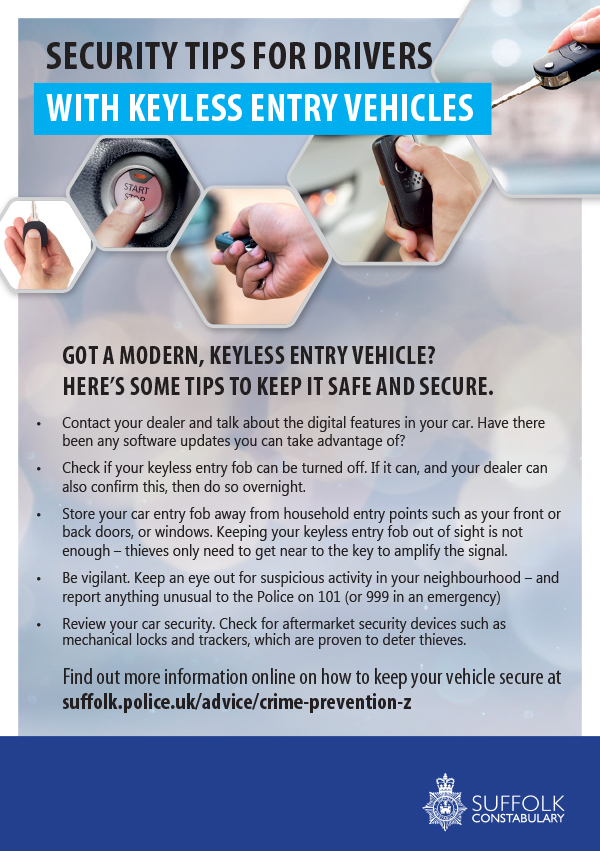
Leading car security organisation, Thatcham Research have published a list of steps we as drivers should follow to ensure this security. This very list has been adopted by Police forces across the UK.
Contact your dealer and talk about the digital features in your car. Have there been any software updates you can take advantage of?
Check if your keyless entry fob can be turned off. If it can, and your dealer can also confirm this, then do so overnight.
Store your keys away from household entry points. Keeping your keyless entry fob out of sight is not enough – thieves only need to gain proximity to the key before amplifying the signal.
Be vigilant. Keep an eye out for suspicious activity in your neighbourhood – and report anything unusual to the Police.
Review your car security. Check for aftermarket security devices such as Thatcham-approved mechanical locks and trackers, which are proven to deter thieves. A list can be found on the Thatcham Research website, here.
You can also download the Suffolk Constabulary ‘Tips for Drivers’ factsheet below. I have also included links to key pouches that block scanners. These can be purchased from Amazon using the links below.
Don’t forget to ‘Like’, ‘Subscribe’ and of course ‘Comment’ and stay tuned for our reviews and comment.
Security Tips for Drivers with Keyless Entry Vehicles – Suffolk Police
Following on from the ongoing Facebook / Cambridge Analytica scandal, I was invited to be a guest on James Hazell’s show on BBC Radio Suffolk. We talked in depth about how social networks and apps are using our data.
Please listen in by clicking the ‘play’ button above. Don’t forget to Like, Subscribe, Comment and Share.












 I personally believe that keeping the keys away from the car or placing them in a container which COMPLETELY blocks radio signals is the only way to avoid the potential theft of vehicles using this method. However, radio signals can travel through types of metal, so be ABSOLUTELY confident that anything you purchase to secure your fobs, does indeed work as described.
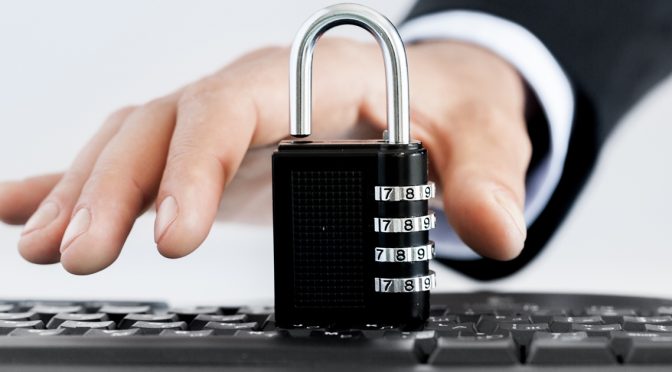
 Following on from the ongoing Facebook / Cambridge Analytica scandal, I was invited to be a guest on James Hazell’s show on BBC Radio Suffolk. We talked in depth about how social networks and apps are using our data.